
news
Forged Steel Ball Supplier
Forged Steel Ball Supplier: What Mining Operations Should Look for Beyond Price
Choosing a reliable forged steel ball supplier is essential for improving grinding efficiency, reducing media consumption, and maintaining stable performance in mining operations. Shandong Jinchi New Material Technology Co., Ltd. develops and manufactures grinding media including forged steel balls, steel rods, and cylpebs, supported by material research, controlled production, and technical service for mineral processing plants. For purchasing teams and concentrator managers, the real question is not simply where to buy grinding media—it is how to select a supply partner whose products perform consistently in the mill.
Grinding media sits at the center of comminution. A ball that chips too early, loses hardness too quickly, or varies widely from one shipment to another can affect far more than media consumption. It may alter mill throughput, increase unplanned replenishment, create excess fines, and make plant operating costs harder to predict. In a process where every tonne of ore passes through demanding grinding conditions, consistency matters.
A dependable forged steel ball supplier should therefore be evaluated as part of a broader grinding solution: raw material selection, chemical composition, forging control, heat treatment, inspection, packing, logistics, and the willingness to understand the customer’s ore and mill conditions.
The Supplier Decision Starts with the Mill, Not the Catalogue
It is tempting to begin with diameter, hardness, and quotation price. Those details are important, but they do not tell the entire story. The correct grinding media selection depends on the ore’s abrasiveness, feed size, mill type, slurry chemistry, target grind, ball charge strategy, and operating intensity. A media specification that works well in one copper, gold, iron ore, or polymetallic circuit may not provide the same result in another.
For example, larger forged balls are generally selected where coarse feed requires stronger impact energy, while smaller sizes can support finer grinding stages. Yet size alone does not determine value. The ball must maintain a practical balance between hardness and toughness. Excessive brittleness can lead to breakage risk; insufficient hardness can accelerate wear and increase consumption. A capable supplier helps customers look at this balance in relation to real operating conditions rather than making a selection based on a single number.
Before requesting an offer, procurement and plant teams should prepare a concise operating profile:
- Mill type, dimensions, and typical operating speed;
- Ore type, mineral composition, and expected abrasiveness;
- Feed size and required product fineness;
- Current media size distribution and top-up practice;
- Known concerns, such as high wear, broken media, inconsistent grinding, or delivery instability;
- Annual or monthly consumption estimates and delivery destination.
Providing this context makes supplier recommendations more useful. It also helps avoid a common purchasing mistake: comparing products that look similar on paper but were made from different steel sources, processed under different heat-treatment conditions, or subjected to different inspection standards.
Why Forging and Heat Treatment Influence Grinding Performance
Forged grinding balls are valued in many mineral processing applications because the forging process can help create a dense internal structure. However, the word “forged” should not be treated as an automatic guarantee of quality. The reliability of a forged ball depends on how the steel is selected, heated, formed, quenched, tempered, and inspected.
Raw material chemistry is the starting point. Carbon, chromium, manganese, silicon, and other alloying elements each contribute to hardenability, wear behavior, and toughness. The suitable combination varies by ball diameter and intended operating environment. Larger diameters, for instance, require careful heat-treatment control to achieve an appropriate hardness profile without sacrificing resistance to impact.
At Shandong Jinchi New Material Technology Co., Ltd., grinding media production is supported by selected raw materials from established domestic steel mills, automated manufacturing equipment, and a quality-control process designed to trace material and production records from incoming steel through finished goods. This approach is especially meaningful to mines that need repeatable supply over long operating cycles rather than a one-time purchase.
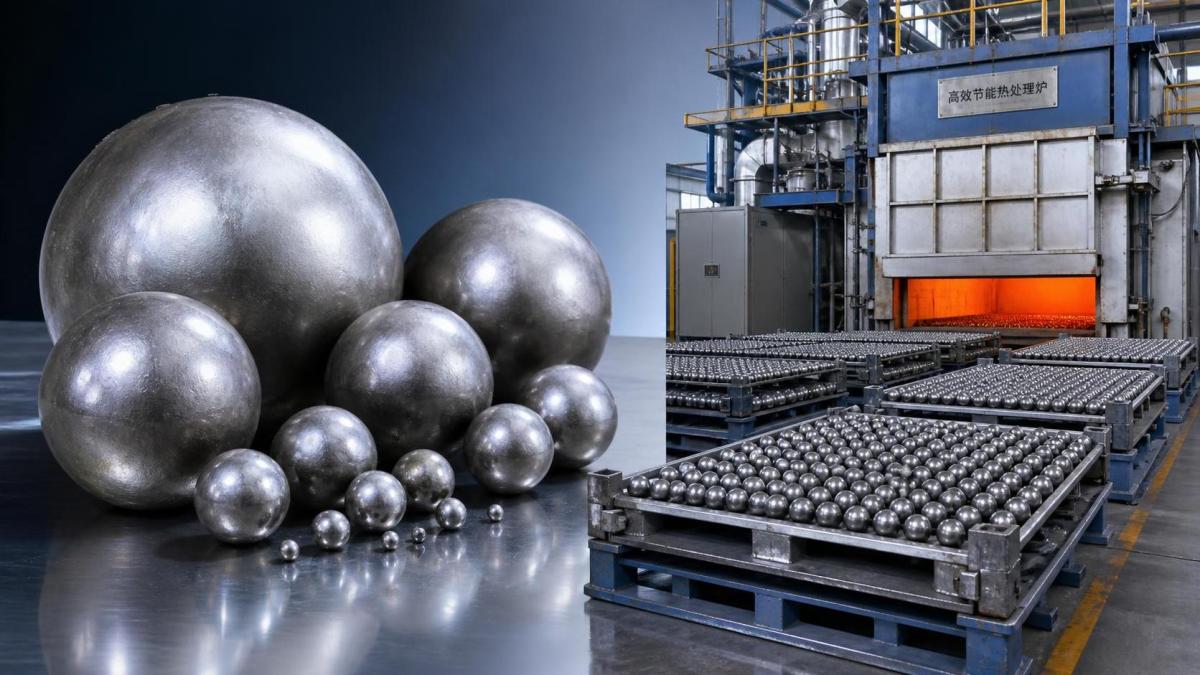
Heat treatment is where much of the product’s practical value is established. Properly controlled heating, quenching, and tempering improve wear resistance while preserving the toughness needed to withstand repeated impacts inside the mill. The objective is not merely to achieve a high surface hardness reading. A good grinding ball should retain dependable performance as it wears down, resisting premature cracking and abnormal deformation under service conditions.
Reading Technical Data Without Losing Sight of the Application
Technical data sheets are useful, but they should be read in context. Buyers often focus on HRC values because hardness is easy to compare. In reality, hardness should be considered alongside impact toughness, chemical composition, diameter, and production consistency.
For selected grinding media grades, surface hardness can exceed 60 HRC in smaller and medium diameters, while larger sizes are specified with hardness levels suited to their heat-treatment characteristics and impact demands. Impact toughness of at least 12 J/cm² is also an important reference point for resisting operational shocks. These figures help establish a quality baseline, but a supplier should be able to explain how they relate to the customer’s mill environment.
Material options may include B2, B2-1, high-carbon B2, B3, B4, B6, B6-1, 45#, 40Cr, 42CrMo, 65Mn, 60Mn, and 50Mn grades. Each option has different composition ranges and mechanical characteristics. B2- and chromium-containing grades are frequently considered where wear resistance and hardenability are priorities, while manganese and carbon steel grades may be selected for specific applications, budgets, or operating profiles. The best choice should be based on a reasoned evaluation—not on the assumption that the highest alloy content is always the best answer.
Diameter availability also affects media management. Sizes from 20 mm to 150 mm allow operations to build a ball charge appropriate to their grinding stage, whether the priority is crushing coarse particles, maintaining impact energy, or supporting finer size reduction. A supplier with a broad size range can help reduce unnecessary compromises when a plant adjusts its media makeup.
Quality Control Should Be Visible, Not Just Claimed
Mining companies have learned to be cautious about broad statements such as “high quality” or “long service life.” A stronger indicator is whether the supplier can describe its inspection process clearly and provide relevant documentation when required.
Effective quality management begins with incoming material checks. Chemical composition needs to align with the intended grade, because variation at this stage can affect every later process. During manufacturing, process parameters should be controlled rather than left to operator judgment alone. Finished products should be inspected for dimensions, surface condition, hardness, and other relevant mechanical properties.
For buyers evaluating a forged steel ball supplier, useful questions include:
- How are raw materials identified and traced through production?
- What tests are performed before shipment?
- How is hardness checked across different ball sizes?
- What controls are used to reduce cracking, out-of-round conditions, or surface defects?
- Can the supplier provide batch-level inspection records when the project requires them?
- Which management systems and independent testing practices support quality assurance?
Shandong Jinchi operates under ISO 9001 quality management, ISO 14001 environmental management, and ISO 45001 occupational health and safety management systems. SGS authoritative testing can also support product verification requirements. These systems do not replace practical mill evaluation, but they provide a structured foundation for production control, documentation, and responsible manufacturing.
More Than Balls: Matching Media to Different Grinding Duties
Grinding circuits do not all use the same media form. Forged steel balls are widely used in ball mills and related mineral processing systems, while rods and cylpebs may be better suited to particular equipment configurations or grinding objectives. Cement and building-material processing, coal grinding in power plants, chemical engineering, machinery applications, and gold mining operations can each present different wear and impact conditions.
In rod-mill applications, straightness, surface quality, alloy selection, and resistance to tangling or uneven wear deserve close attention. For operations seeking complementary media for coarse or controlled grinding duties, Grinding steel rod options are available in diameters from 20 mm to 150 mm, with material grades selected according to operating requirements. Considering balls, rods, and cylpebs together can be helpful when a plant uses multiple stages or is reviewing its overall comminution strategy.
The key is to avoid treating every media product as interchangeable. A ball mill, rod mill, and fine-grinding circuit place different demands on media geometry and material performance. The most useful supplier relationship begins with that distinction.
How to Compare Quotations Fairly
A lower unit price can appear attractive until consumption, breakage, freight, and production interruptions are included. The more meaningful comparison is total grinding-media cost per tonne of ore processed or per tonne of finished product, measured over a sufficient operating period.
When reviewing quotations, compare the exact grade, diameter range, hardness requirement, test method, packaging, shipment terms, lead time, and documentation scope. Ask whether prices refer to net weight and whether the supplier can maintain the same specification in future orders. If one quotation is much lower than the others, it is worth understanding whether the difference comes from material chemistry, manufacturing route, inspection level, or logistics assumptions.
For international customers, delivery planning has practical importance. Shandong Jinchi is located near Qingdao Port, with access to a major logistics hub in approximately four hours. This location can support efficient export coordination for customers who need reliable container scheduling and clear shipment communication. Still, lead times should be confirmed for each order because quantity, grade, packaging, and destination all influence the final plan.
A Practical Evaluation Process for New Suppliers
For a mine changing suppliers or testing a new grade, a staged approach is usually safer than making an immediate large-volume switch. Begin by confirming the technical specification and intended trial conditions. Keep records of media additions, mill throughput, product size, liner condition, and observed breakage. Compare results with historical performance under similar ore and operating conditions.
Trial outcomes should be judged carefully. Ore characteristics can change from week to week, and plant variables may distort a short test. Rather than drawing conclusions from a few shifts, establish a monitoring window that reflects normal production variability. A responsible supplier can assist with interpreting the results and adjusting the selection if the data indicates a better fit is possible.
This is also where technical service becomes valuable. A supplier with mining-industry experience can help translate plant feedback into practical decisions about diameter mix, material grade, replenishment timing, and product selection. The purpose is not to make complicated promises; it is to make grinding media management more predictable.
Building a Supply Relationship That Supports the Plant
The best forged steel ball supplier is not necessarily the one with the loudest claims. It is the one that understands the cost of instability in a grinding circuit and responds with disciplined manufacturing, transparent quality information, and practical communication.
Shandong Jinchi New Material Technology Co., Ltd. combines grinding media research and development with production, sales, and supporting technical services for mining customers. Its portfolio of grinding steel balls, rods, and cylpebs is designed to support customers looking for dependable media selection, controlled product quality, and convenient global delivery.
When grinding performance affects recovery, throughput, and operating cost, the purchasing decision deserves more than a price comparison. Review the supplier’s materials, processing discipline, test capability, service response, and ability to match media to the realities of your mill. That is how a grinding-media order becomes a more reliable part of the entire mineral processing operation.
Get real-time quotes
Interested? Leave your contact details.