
Forged Steel Balls for Ball Mills: Size Selection for Efficient Coarse Grinding
For coarse grinding, the largest ball is not automatically the best choice. Forged steel balls for ball mills need enough mass to fracture the largest competent particles entering the mill, but an oversized charge can reduce the number of impact points, waste energy on already-fine material, and leave too little effective surface area for the next stage of size reduction.
A workable starting point is to select the top ball size from the mill feed’s upper size limit and ore competence, then build a graded charge beneath it. Operators should treat ball size as a mill-circuit setting, not as a fixed purchasing specification. A change in crusher product, ore blend, mill speed, liner profile, or target grind can make a previously acceptable media charge inefficient.
Start with the particles the mill must break
Coarse grinding depends on impact. Large balls carry more kinetic energy and are more capable of breaking hard, coarse particles. That is why a primary ball mill receiving a coarse crusher product usually requires a meaningful proportion of larger media. If the largest feed particles remain in the mill too long, recirculating load can rise, throughput can become unstable, and downstream separation may receive a wider-than-intended particle-size distribution.
However, feed size alone is not enough. Two ores with the same top size may need different media charges if one fractures readily along mineral boundaries while the other is dense, abrasive, or mechanically competent. In practical terms, operators should look at the material that survives grinding rather than only the nominal feed specification. Persistent coarse fragments, scats, or a growing coarse fraction in cyclone overflow can indicate that the top ball size, large-ball proportion, or mill operating condition is insufficient.
The reverse problem is also common. When the crusher product becomes consistently finer but the mill retains a charge dominated by very large balls, the mill may continue to consume power without producing the required fine material efficiently. The impact energy is present, but much of it is poorly matched to the particles available for breakage.
Use a ball-size mix rather than a single diameter
A mixed charge is normally more useful than a mill filled with one nominal ball diameter. Large balls address coarse-particle breakage; intermediate balls continue the reduction after the first impacts; smaller balls provide more contact points for the finer fraction. The right distribution is therefore tied to the full feed-size range and the desired product, not just the largest particle entering the mill.
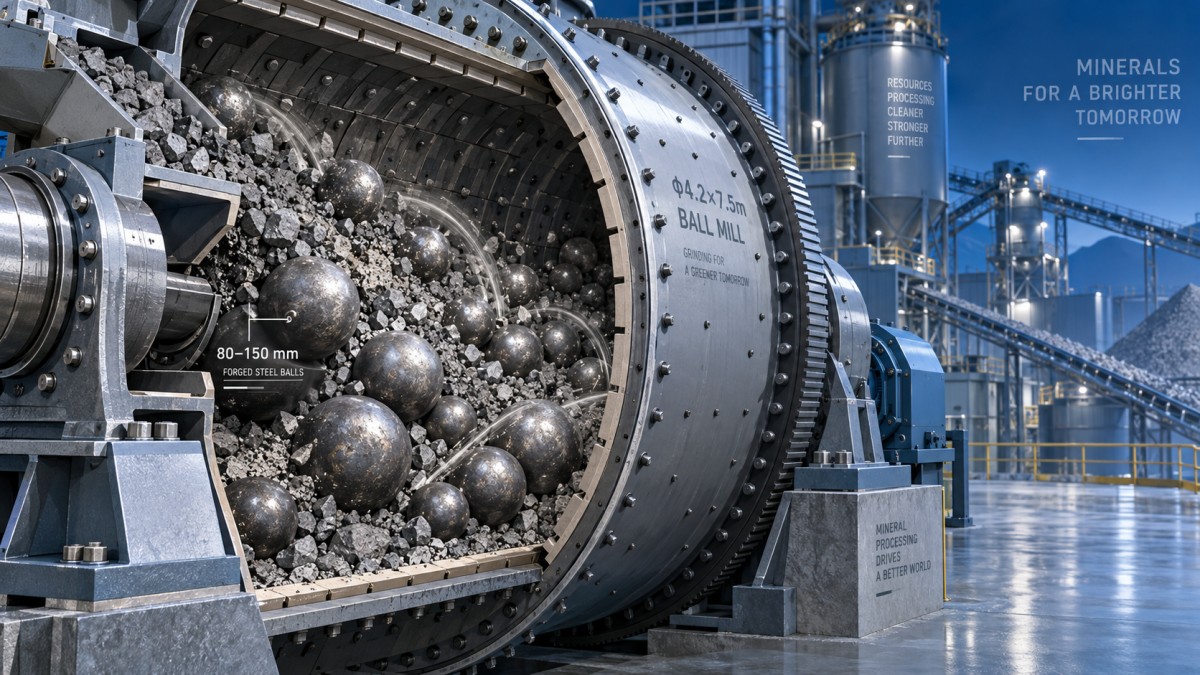
For coarse duty, the upper end of the charge often deserves the closest attention. A mill handling a broad and variable feed may need large balls in the 80 mm to 150 mm range, while a finer feed or secondary grinding duty may perform better with a lower top size and a greater share of intermediate media. Available forged-ball sizes commonly extend from 20 mm through 150 mm, allowing the charge to be adjusted in steps rather than forcing the mill into a one-size selection.
Operators should also account for media wear. A fresh charge gradually shifts downward in diameter, so the operating charge may look very different from the delivery size. Adding only one replacement size can create gaps in the distribution or allow the top-size fraction to disappear. A planned make-up schedule, based on mill behavior and actual media consumption, is more reliable than replacing media only after grinding performance has visibly deteriorated.
Mill diameter and lift determine whether large balls can do useful work
Ball size cannot be selected independently of mill geometry. Larger-diameter mills can lift larger media to a greater height and generally make better use of the impact energy carried by large balls. A small-diameter mill charged aggressively with very large media may have limited active contacts and poor grinding efficiency, even if the feed contains occasional coarse particles.
Liner design matters for the same reason. The lifter profile controls how the charge is raised and released. If liners are worn, the charge may cascade earlier than intended, reducing impact intensity. In that condition, increasing ball diameter alone may not solve a coarse-grinding problem. The operator should first distinguish between insufficient impact energy caused by media selection and insufficient impact generation caused by charge motion.
Mill speed, filling level, and slurry conditions also change the outcome. At an unsuitable speed, media may not reach the trajectory needed for effective impact. Excessive slurry density can cushion impacts; too little slurry can reduce transport and increase unnecessary steel-on-steel wear. A ball-size adjustment should therefore be checked alongside power draw, mill sound, density control, feed rate, and product size rather than judged from one variable alone.
Hardness is useful only when toughness supports it
For forged grinding media, high surface hardness helps resist abrasion, but coarse grinding places repeated impact loads on the balls. A ball that is hard but insufficiently tough can crack, spall, or break under severe impact. Those failures reduce usable media life and can introduce irregular fragments into the charge, changing grinding behavior and complicating mill inspections.
The material grade should match the ore and duty. Carbon and alloy steel options such as B2, B3, 60Mn, 65Mn, 40Cr, and 42CrMo offer different balances of hardness, wear resistance, and impact resistance. There is no universally best grade: a highly abrasive but moderately impact-intensive circuit may favor a different balance than a coarse, hard-rock application with strong repeated impacts.
When comparing forged balls, the useful questions are practical ones:
- Does the ball retain sufficient hardness after heat treatment and through its working section?
- Is impact toughness appropriate for the mill’s feed size and charge dynamics?
- Are diameter tolerances controlled well enough to maintain the intended charge distribution?
- Can the supplier provide traceable quality checks for chemical composition, hardness, and physical condition?
For example, media specified with surface hardness above 55 HRC, 58 HRC, or 60 HRC should still be assessed in relation to toughness and operating duty. A stated hardness value alone does not predict consumption rate or breakage resistance in a specific mill.
How to recognize that the charge needs adjustment
Media selection should be reviewed when the circuit changes, but there are also operating signals that justify a closer look. A coarser mill product at steady feed rate may indicate that the upper-size media fraction has worn down or that feed competency has changed. Rising power draw without a corresponding throughput gain can point to an inefficient charge mix, poor slurry transport, or a filling level that no longer matches the mill’s duty.
Other warning signs include frequent large fragments in discharge, unusual ball breakage, excessive liner wear near the feed end, and unstable downstream classification. None of these observations proves that ball diameter is the sole cause. They do provide a reason to inspect the charge, sieve or measure representative retained media where practical, and compare current conditions with the operating period that produced acceptable results.
A trial should be controlled. Change the top size or make-up distribution in a defined way, maintain comparable operating conditions where possible, and watch product size, throughput, energy use, and media consumption together. Replacing the entire charge on the basis of a single shift’s result can obscure the actual cause of improvement or decline.
A practical purchasing specification for coarse grinding
For operators buying forged steel balls for ball mills, the purchase order should describe the intended duty rather than listing only a diameter and hardness target. Include the ball-size range and planned proportions, acceptable dimensional tolerances, required material grade or approved alternatives, hardness requirement, impact-performance requirement where relevant, inspection documentation, and packaging or delivery conditions that fit site handling.
In coarse and variable ore service, it is often useful to secure more than one size band so the make-up charge can be tuned without waiting for a new procurement cycle. Products such as Grinding steel forging can be considered across the 20 mm to 150 mm range, but selection should begin with the mill’s feed, geometry, and operating data rather than the widest available size range.
The best coarse-grinding charge is the one that breaks the difficult particles consistently while preserving enough smaller media to finish the reduction efficiently. Reviewing the top feed size, ore competence, retained ball-size distribution, liner condition, and product-size trend together gives operators a sound basis for making that decision.
Get real-time quotes
Interested? Leave your contact details.