
Forged Hot Rolled Steel Balls: Process Differences That Affect Service Life
Forged hot rolled steel balls are widely evaluated for grinding efficiency, impact resistance, and total service life in demanding mining operations.
For technical evaluators, the key difference is not simply the product label, but how forging, rolling, heating, quenching, and tempering parameters shape internal structure and surface hardness.
A ball may meet a nominal hardness specification yet still fail prematurely through spalling, deformation, cracking, or uneven wear.
The most reliable evaluation therefore connects manufacturing evidence with the ore characteristics, mill conditions, ball diameter, and expected wear mechanism.
When comparing forged hot rolled steel balls, service life should be treated as a system outcome rather than a single laboratory value.
Why Process Control Matters More Than the Product Name
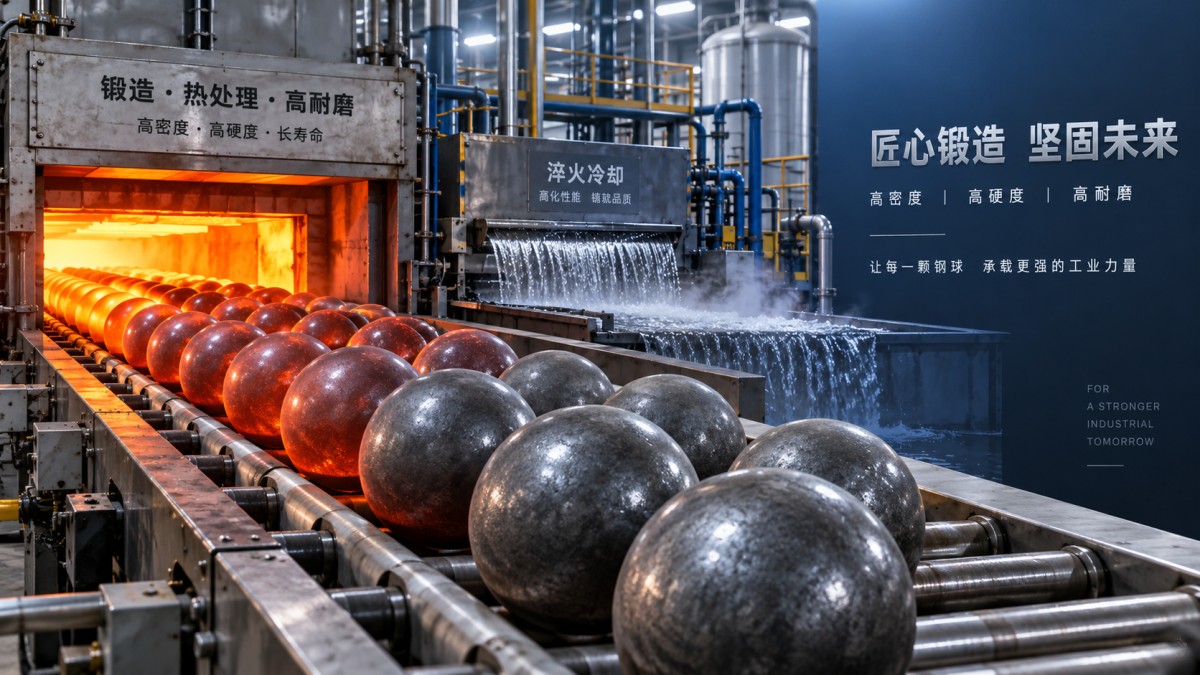
Forged hot rolled steel balls are produced by heating steel billets, shaping them under pressure, rolling them into spheres, and applying controlled heat treatment.
Each stage affects grain flow, carbide distribution, residual stress, hardness depth, impact toughness, and the ball's ability to resist repeated mill impacts.
Technical evaluators should avoid assuming that all forged products provide identical performance simply because they use similar steel grades or diameters.
Different suppliers may use different billet quality, heating temperatures, rolling speed, quenching media, tempering cycles, and inspection criteria.
Those differences can be especially important in SAG mills, ball mills, and primary grinding circuits handling abrasive or high-impact ore.
A well-controlled process creates a hard, wear-resistant surface while retaining sufficient core toughness to reduce breakage under cyclic loading.
An unstable process can create excessive surface hardness, shallow hardening depth, internal stress, decarburization, or localized microstructural inconsistency.
These defects may not be visible during routine receiving inspection, but they can emerge after weeks of operation as unexpected consumption or ball fragments.
Forging and Rolling Determine Internal Density and Grain Flow
The forging stage applies compressive force that closes internal voids and improves material density before the ball enters downstream rolling and heat treatment.
Proper deformation refines the steel's grain structure and helps create a more continuous grain flow around the spherical form.
This structure is valuable because grinding media experiences repeated impact from ore, liners, other balls, and mill rotation during operation.
Dense material with refined grains generally resists crack initiation more effectively than material containing pores, segregation bands, or nonmetallic inclusions.
Hot rolling shapes the heated billet into a precise sphere and influences surface quality, dimensional consistency, and the uniformity of deformation.
Insufficient rolling pressure may leave uneven density, while excessive or poorly controlled deformation can introduce residual stresses before quenching.
Technical teams should ask whether the manufacturer controls billet temperature consistently from furnace discharge through the rolling process.
If the billet cools unevenly before forming, hardness response and microstructure can vary across the ball, increasing wear variability between batches.
Dimensional tolerance also matters because oversized or undersized media changes charge behavior, grinding kinetics, and the ball size distribution inside the mill.
Heat Treatment Has the Largest Influence on Wear and Breakage
Heat treatment is often the most decisive factor in the service life of forged hot rolled steel balls.
After rolling, the balls are heated to an austenitizing range that prepares the steel for transformation during quenching.
The correct temperature and holding time depend on chemistry, ball diameter, alloy content, furnace loading, and the intended hardness profile.
Underheating can produce incomplete transformation and lower wear resistance, while overheating may cause coarse grains and reduced impact toughness.
Quenching must cool the ball rapidly enough to develop a hard martensitic structure without creating destructive thermal gradients.
Large-diameter balls are particularly demanding because their centers cool more slowly than their surfaces during the quenching process.
A supplier should demonstrate control over quench water temperature, flow rate, circulation, loading arrangement, and transfer time from furnace to quench.
Inconsistent quenching can produce a very hard shell around a softer core, increasing the risk of flattening, core collapse, or abnormal wear.
Tempering follows quenching to relieve residual stress and balance hardness with toughness, reducing the likelihood of brittle fracture.
For evaluators, surface hardness alone is insufficient; the hardness gradient from surface to core provides a better indication of usable wear life.
How to Interpret Hardness, Toughness, and Metallographic Results
A high surface hardness can improve abrasion resistance, but it is not automatically the best outcome for every grinding circuit.
Very hard media with inadequate toughness may chip or fracture in high-impact applications, especially where large feed particles enter the mill.
Conversely, media with excellent toughness but insufficient hardness can wear rapidly, raise consumption rates, and alter the working ball charge.
Technical evaluation should consider surface hardness, core hardness, impact toughness, microstructure, and retained austenite as connected performance indicators.
For many mining applications, hardness values above 55 HRC, 58 HRC, or 60 HRC may be specified according to ball size and duty.
However, the required value must be confirmed against ore abrasiveness, slurry chemistry, mill type, and the dominant failure mode.
Metallographic examination can reveal whether martensite is distributed uniformly and whether undesirable structures, cracks, or decarburized layers are present.
Cross-sectional testing is more meaningful than a single surface reading because it shows whether heat treatment penetrated adequately into the ball.
Impact toughness testing, such as values at or above 12 J/cm2 where applicable, helps assess resistance to sudden loading and crack propagation.
Matching Ball Chemistry and Diameter to the Grinding Duty
Steel chemistry must be selected for the operating environment rather than chosen solely for nominal hardness or purchase cost.
Common grinding media materials include B2, B3, B4, B6, 60Mn, 65Mn, 40Cr, 42CrMo, and high-carbon alloy steel variants.
Carbon provides hardenability and wear resistance, while manganese, chromium, boron, and other alloying elements influence transformation behavior and toughness.
Larger balls require stronger hardenability because their cores are more difficult to cool rapidly enough during quenching.
Diameter selection also affects grinding performance because larger media supplies more impact energy, while smaller media provides more contact points for fine grinding.
Forged hot rolled steel balls are commonly supplied from 20 mm to 150 mm, allowing mills to build a charge suited to feed size.
For coarse crushing products and high-impact duties, larger diameters may be appropriate, provided the heat-treatment profile remains consistent through the core.
For fine grinding, smaller diameters may provide improved grinding contact, but operators must monitor consumption and classification efficiency carefully.
What Technical Evaluators Should Request Before Approval
A credible supplier evaluation should begin with traceable chemical certificates for each raw-material heat used in production.
Raw material quality affects inclusion content, segregation, hardenability, and the repeatability of every subsequent manufacturing stage.
Evaluators should request process descriptions covering billet heating, forging or rolling equipment, quenching conditions, tempering parameters, and batch identification.
Batch-level test reports should include diameter measurement, surface hardness, core hardness where relevant, impact toughness, and visual defect inspection.
Independent verification may include destructive cross-section testing, metallographic analysis, ultrasonic inspection, or trial use under documented mill conditions.
It is also useful to compare wear data in kilograms of media consumed per tonne of ore processed, not only the purchase price per tonne.
A lower-priced product may create higher operating cost when it causes frequent additions, changing charge composition, mill downtime, or reduced throughput.
For applications requiring an alternative media configuration, Casting balls may also be assessed against the same operational and metallurgical criteria.
Building a Practical Service-Life Comparison
The most defensible comparison uses an on-site trial with similar ore, mill loading, liner condition, operating hours, and ball size distribution.
Trials should measure wear rate, breakage frequency, size retention, throughput, energy consumption, product size, and operator observations.
Do not rely solely on short trial periods because some heat-treatment defects become visible only after the initial surface layer has worn away.
Tracking ball fragments and removing failed media for examination can identify whether failure occurred through spalling, cracking, deformation, or normal abrasion.
A supplier with automated production, controlled heat treatment, and documented quality checks can offer more consistent batch-to-batch performance.
Equally important, the supplier should provide technical support to interpret results and recommend chemistry, diameter, and hardness for changing ore conditions.
For mining operations, the right forged hot rolled steel balls are those that maintain predictable wear behavior while preserving mill availability and grinding efficiency.
Conclusion
Service life is determined by the combined effect of steel chemistry, forging density, rolling consistency, quenching penetration, tempering balance, and quality control.
Technical evaluators should prioritize verified process capability and cross-sectional performance evidence instead of comparing only nominal hardness or quoted price.
When manufacturing controls match the actual grinding duty, forged hot rolled steel balls can reduce breakage risk, stabilize media consumption, and improve lifecycle value.
Get real-time quotes
Interested? Leave your contact details.