
Forged Steel Balls vs Cast Balls: Which Performs Better in High-Impact Mills?
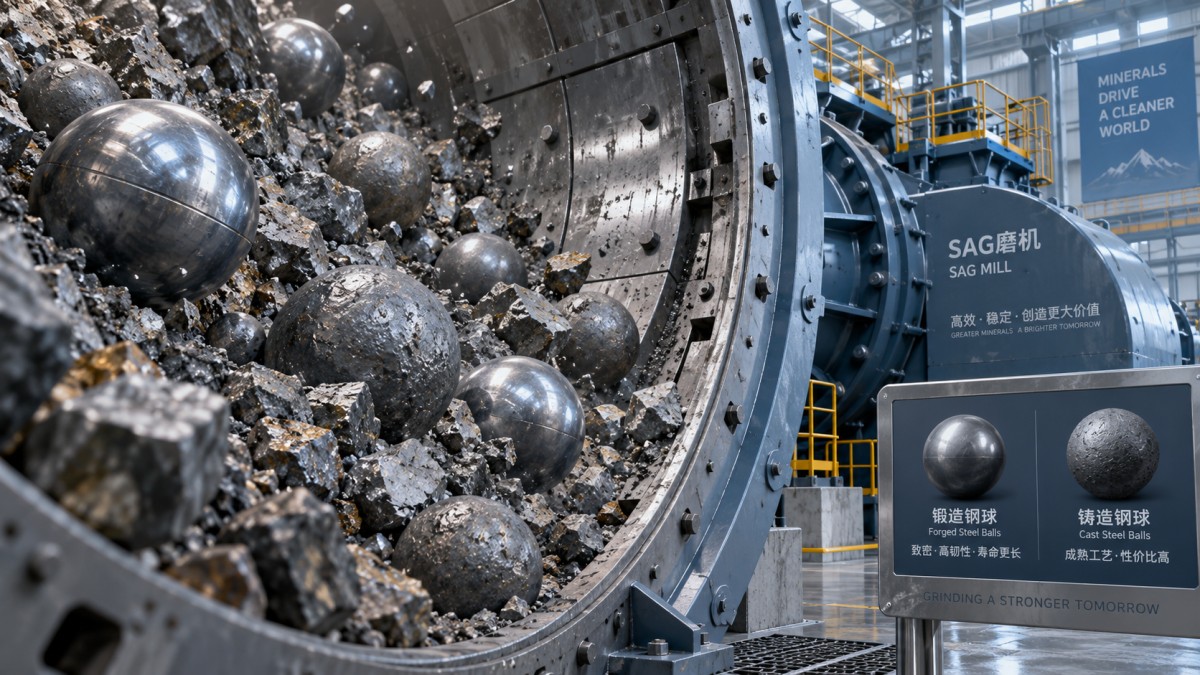
For high-impact mills, forged steel balls usually offer the lower-risk performance choice when breakage, unstable media size, and unplanned mill interruptions are costly. Their advantage comes from a worked and dense internal structure that is generally better able to absorb repeated impact. Cast balls can still be a valid option, particularly where abrasive wear is more important than severe impact and the operating duty is well controlled. The correct choice depends less on the label “forged” or “cast” than on the mill’s impact environment, ball size, ore characteristics, and the supplier’s process consistency.
Technical evaluators should therefore start with the duty cycle. A large-diameter ball falling repeatedly in a SAG mill, a coarse grinding mill, or a circuit handling hard competent ore faces a different failure mechanism from media used mainly for fine grinding. A lower purchase price can disappear quickly if balls crack, spall, or lose their intended size distribution before delivering useful grinding work.
Why high-impact duty favors forged media
Forging plastically deforms the steel billet, helping consolidate the material and refine its internal structure. When the subsequent heat treatment is properly controlled, the result is typically a ball with a tough core and a hard, wear-resistant surface. That combination matters in high-impact service: the surface needs enough hardness to resist wear, while the interior needs sufficient toughness to withstand repeated impact without catastrophic fracture.
Cast balls are made by filling a mold with molten metal. A well-engineered casting process can produce effective grinding media, but it must manage risks associated with shrinkage cavities, segregation, porosity, inclusions, and uneven cooling. These risks do not mean every cast ball will fail. They do mean that internal quality control has greater importance when the balls will experience high drop heights, large feed particles, intermittent overloads, or frequent mill starts and stops.
In a mill where impact dominates, a fractured ball creates more than a media-consumption issue. Broken pieces can disrupt the charge, create irregular wear behavior, and complicate interpretation of grinding performance. If fragments are discharged early, the operation may consume metal without obtaining the expected breakage energy. For this reason, forged steel balls are often preferred for primary grinding duties and other circuits where impact resistance is a first-order requirement.
Wear resistance alone is an incomplete comparison
It is common to compare balls through nominal hardness or an advertised wear rate. Those figures are useful screening inputs, but they do not settle the selection. A very hard surface may resist abrasion well while also becoming more vulnerable to cracking if core toughness, heat-treatment depth, or microstructural uniformity is inadequate. Conversely, a tougher ball that wears too quickly may require excessive top-up rates and alter the media charge faster than the circuit can tolerate.
Wear behavior should be assessed together with shape retention and size progression. A ball that wears down in a predictable, largely spherical manner continues to contribute energy in a more consistent way. A ball that chips, spalls, or fractures can change the effective media size distribution abruptly. In coarse grinding, that loss of larger media may reduce impact breakage capacity. In downstream stages, excessive oversize media can also be inefficient, so the target is a controlled wear profile rather than simply the hardest available product.
Where cast balls may still make commercial sense
Cast media should not be rejected automatically. In applications with moderate impact and substantial abrasive wear, a suitable cast alloy may provide acceptable service at an advantageous acquisition cost. Fine grinding, certain cement applications, coal grinding, and less aggressive sections of a mineral-processing circuit can present a different balance of requirements than a primary or high-impact grinding stage.
Diameter is also relevant. As ball diameter increases, impact energy rises and any internal discontinuity becomes more consequential. A 20 mm ball used in a lower-impact environment should not be assessed by the same logic as a 100 mm or 150 mm ball working in a coarse grinding charge. Available cast-media ranges commonly extend across diameters from 20 mm to 150 mm, so a technical review should align the selected diameter, alloy family, and mill duty rather than treating the product category as uniform.
When reviewing Casting balls, evaluators should ask for evidence tied to the proposed grade and diameter, not generic statements about hardness. Grades such as B2, B3, 40Cr, 42CrMo, and manganese-steel variants have different composition and heat-treatment potential. Their suitability depends on the required balance between surface wear resistance and resistance to impact-induced cracking.
Tests and documentation that support a defensible decision
A meaningful comparison starts with representative samples from the actual proposed production route. One polished sample, or a general material certificate detached from the supplied lot, says little about batch-to-batch consistency. Review chemical composition, ball diameter and mass tolerance, surface condition, hardness profile, and traceability by heat or production batch.
For high-impact mills, the hardness profile deserves particular attention. Surface hardness alone does not reveal whether the ball has adequate hardness depth or whether the core is too brittle or too soft. Sectioned-ball examination, microstructure review, and impact or drop testing can provide a more useful view of how the media is likely to behave under load. The appropriate acceptance method should reflect the mill’s failure concern: abrasive loss, impact breakage, spalling, or a combination of these.
- Define the mill type, ball diameter range, feed size, ore competence, and operating conditions before comparing quotes.
- Request lot-level quality records rather than relying on a single nominal specification.
- Evaluate breakage rate and wear pattern separately; low mass loss does not compensate for premature fracture.
- Use a controlled trial with a measurable baseline where media failure has a material effect on throughput or downtime.
- Track media consumption by tonnes processed and observe the retained charge size distribution, not only purchase cost per tonne of balls.
Compare cost per tonne processed, not cost per tonne delivered
The economic case is often decided by total media cost per tonne of ore processed, together with the operational consequences of media failure. This includes purchase price, consumption rate, disposal or recovery implications, downtime exposure, and any effect on grind size or mill stability. Forged steel balls can justify a higher delivered price when their service life and lower breakage risk maintain a more stable charge in severe-duty milling.
That conclusion should not be treated as universal. If the circuit is abrasion-led rather than impact-led, or if trial results show a cast grade maintains its size and integrity at lower total cost, cast media may be the rational selection. The technical decision should follow the dominant failure mechanism in the mill, not a blanket preference for one manufacturing route.
For the most demanding high-impact applications, specify forged media first and require proof that its hardness, toughness, and dimensional consistency suit the actual operating window. For cast media, apply a higher level of scrutiny to internal integrity and breakage behavior before approving it for critical duty. That discipline turns a product comparison into a decision based on mill performance rather than on nominal material descriptions.
Get real-time quotes
Interested? Leave your contact details.