
What Is Grinding Media and How Does It Affect Mineral Processing Efficiency?
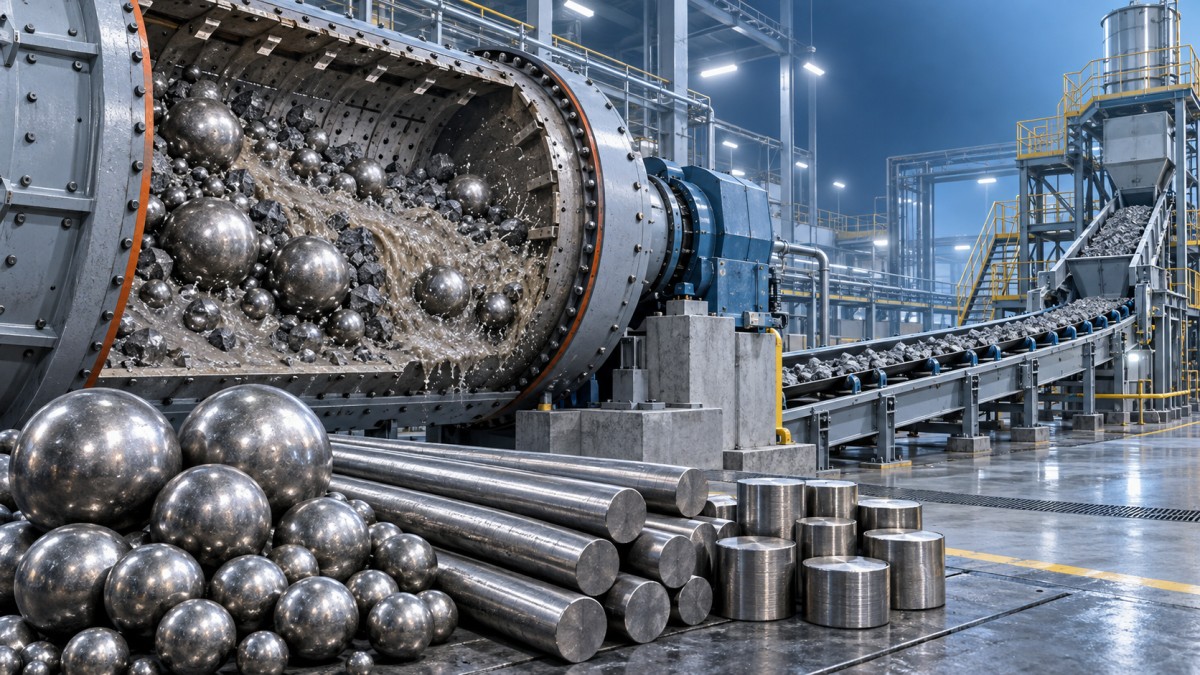
Grinding Media is the working material inside a grinding mill. It transfers the mill's energy to ore particles through impact, abrasion, and compression, reducing rock from a coarse feed to a controlled particle size for flotation, leaching, magnetic separation, or other downstream processes.
That definition is simple, but the operating effect is not. The wrong media can leave valuable minerals too coarse for liberation, consume excessive steel, create unstable mill performance, or generate unwanted fines. The right media does not merely last longer; it helps the mill deliver the required particle-size distribution at an acceptable total operating cost.
How Grinding Media Breaks Ore
In a rotating ball mill, SAG mill, or rod mill, the grinding charge is lifted by liners and then falls or rolls through the ore slurry. Large particles are mainly broken by high-energy impacts. As the material becomes smaller, abrasion and repeated compressive contacts become more important.
This is why grinding media must be matched to both the ore and the mill. A hard, competent feed needs sufficient impact energy to initiate breakage. A finer grinding duty needs enough contact points and surface area to keep reducing smaller particles. Media that is too large may consume energy without efficiently grinding fines; media that is too small may lack the force needed to break coarse ore.
Efficiency, therefore, is not simply “more hardness” or “larger balls.” It is the relationship between media size, charge mix, material properties, mill speed, slurry conditions, feed size, and the target grind.
Why It Has Such a Strong Effect on Mineral Processing
Grinding is usually one of the most energy-intensive stages in a mineral processing plant. Its output determines what happens next. If particles are not sufficiently liberated from the surrounding gangue, downstream separation may recover less of the target mineral. If material is ground much finer than necessary, the mill uses extra energy and may create slimes that complicate separation.
Grinding media affects this balance in several practical ways:
- Throughput: A stable, correctly sized charge promotes consistent breakage. Excessive breakage of the media itself, poor size distribution, or irregular media make-up can reduce effective grinding action.
- Product size: Media size and shape influence the balance between impact breakage and fine grinding. This affects whether the circuit can meet its target grind.
- Wear cost: Every kilogram of worn media must be replaced. Faster wear increases purchasing, handling, and mill make-up requirements.
- Contamination: Steel wear contributes iron to the pulp. In some processes this is acceptable; in others, especially where chemistry is sensitive, it must be considered during media selection.
- Mill availability: Media that fractures, spalls heavily, or varies widely in size can create operational instability and make charge management harder.
A useful distinction is between media consumption and grinding efficiency. Low wear is valuable, but it is not the only objective. A very wear-resistant ball that does not provide suitable breakage behavior for a specific ore may not reduce the overall cost per tonne processed.
Steel Balls, Rods, and Cylpebs Serve Different Duties
Grinding media comes in several forms because not all mills perform the same task. Steel balls are widely used in ball mills and many mineral grinding circuits because they provide a broad mix of impact and abrasive action. Their size can be selected and blended to suit feed characteristics and the required final grind.
Grinding rods are used primarily in rod mills. They create more line-contact grinding action and are often chosen where controlling excessive fines is important. Rod quality and straightness matter because bent or broken rods can interfere with the charge and reduce mill performance.
Cylpebs are short cylindrical media commonly used in finer grinding applications. Compared with balls of similar nominal size, they can provide more contact points and surface area. That may be useful for fine material, but the result still depends on mill design and operating conditions.
What Makes One Steel Ball Perform Differently From Another?
For forged or hot-rolled steel balls, performance is shaped by steel chemistry, heat treatment, internal structure, size consistency, and the balance between hardness and toughness. Surface hardness helps resist abrasive wear, but the ball also needs a sufficiently tough core to withstand repeated impact without cracking or breaking.
This balance matters most in aggressive conditions, such as coarse feed, high-impact milling, or hard abrasive ore. A brittle ball may initially appear hard but lose value if it fractures in service. Conversely, a ball that is very tough but wears rapidly can raise media consumption. The intended mill duty should guide the specification, rather than a single hardness figure viewed in isolation.
Diameter tolerance also has an operational role. A controlled size helps maintain a predictable charge and supports planned media addition. In practical selection, buyers should examine the complete specification: diameter range, hardness profile, impact resistance, wear behavior, and quality consistency between production batches.
Choosing Media Starts With the Grinding Duty
Before comparing grades or quotations, establish the conditions the media will face. The most useful starting questions are:
- What are the feed size, ore hardness, abrasiveness, and mineral composition?
- Is the mill performing coarse grinding, primary ball milling, regrinding, or fine grinding?
- What particle size is required for the next processing stage?
- What is the existing media charge, including its size distribution and make-up practice?
- Are broken balls, rapid wear, low throughput, or poor downstream recovery the actual problem?
This order matters. It prevents a common purchasing mistake: choosing media based only on unit price or advertised hardness. The appropriate solution may be a different ball diameter mix, a more suitable alloy grade, an adjustment to make-up frequency, or a review of mill operating conditions. Changing media alone cannot correct every grinding problem.
For mineral extraction, cement and building-material grinding, coal grinding, and related industrial duties, Hot-rolled steel balls are one option to assess where a ball mill requires durable steel media across a broad diameter range. The relevant grade should be selected against the actual impact and wear duty, not simply selected because it is a familiar material name.
Do Not Judge Media by Purchase Price Alone
The lowest-priced media can become the more expensive choice when it wears quickly, breaks prematurely, or produces an inconsistent grind. At the same time, the most alloyed or hardest option is not automatically justified for every circuit. The practical comparison is the cost of achieving the required mill output and product size, including media consumption, energy use, downtime, handling, and downstream consequences.
A sound evaluation usually tracks media addition, mill throughput, particle-size results, and any changes in separation performance over a representative operating period. Testing one variable at a time is more informative than changing media, mill speed, water addition, and feed conditions together.
Shandong Jinchi New Material Technology Co., Ltd. develops grinding steel balls, steel rods, cylpebs, and related technical support for mining applications. For operators moving from basic research to procurement, the most productive discussion begins with mill type, ore characteristics, feed and target sizes, and the problem the circuit needs to solve. Those details make it possible to select a grinding media specification for the process rather than purchasing a generic steel product.
Get real-time quotes
Interested? Leave your contact details.