
Grinding Cylpebs for Fine Grinding: When Are They Better Than Spherical Media?
Grinding cylpebs are not a universal substitute for spherical grinding media. Their strongest case is in fine-grinding duty where the feed is already relatively small, breakage is driven more by abrasion and frequent media-particle contacts than by high-impact events, and the circuit needs tighter control of the fine end of the product size distribution. In these conditions, the geometry of cylpebs can create more contact opportunities per unit charge volume than balls of comparable nominal size.
That advantage disappears when the mill still requires substantial impact energy to break coarse, competent particles. A media change should therefore begin with the breakage duty, not with the assumption that a larger surface area automatically produces higher throughput or lower energy use.
Why shape changes grinding behavior
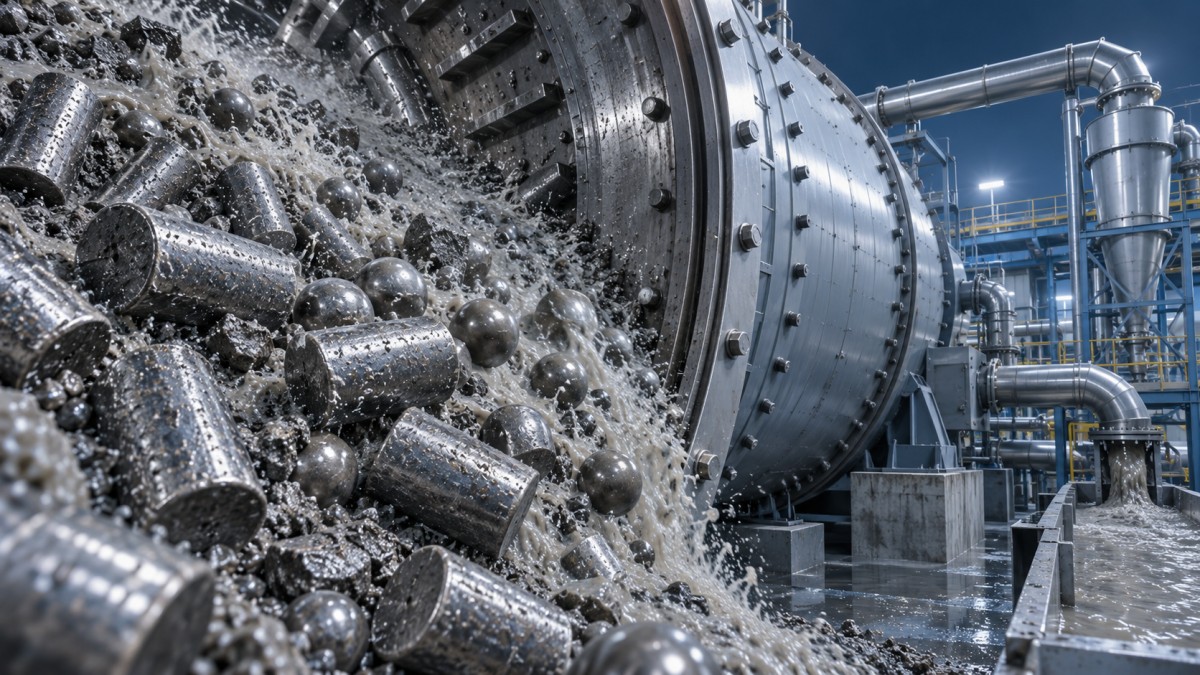
A spherical ball has a point-like contact relationship with adjacent media and tends to roll and cascade in a relatively predictable manner. A cylpeb has a short cylindrical form, creating line and edge contacts in addition to broader face interactions. At a similar nominal dimension, cylpebs generally provide a higher number of pieces and a greater exposed surface area per tonne of media than larger spherical balls. This can increase the frequency of low-energy contacts within the pulp.
For fine particles, frequent abrasion, attrition, and confined-particle breakage can be more useful than isolated high-energy impacts. That is the technical basis for considering grinding cylpebs in regrind mills, secondary fine-grinding stages, and some cement or industrial-mineral applications where the target product is already well below the coarse grinding range.
However, nominal diameter is an incomplete comparison. A 25 mm cylpeb and a 25 mm ball do not have the same mass, impact energy, number of media pieces per tonne, or motion within the charge. Comparing them solely by diameter can lead to an incorrect conclusion about both grinding performance and wear. The meaningful comparison is between media charges designed to produce the required breakage environment.
Conditions that favor cylpebs
Cylpebs deserve serious evaluation when the mill feed has a low top size and the circuit objective is to reduce already-liberated or partially liberated mineral particles to a fine target. A relatively narrow feed distribution is especially favorable because it reduces the risk that oversized particles will consume grinding energy without being adequately fractured.
They can also be useful where the operating objective is not merely a lower P80, but a product distribution with more controlled fines generation. In a properly classified circuit, the additional contact density of cylpebs may improve the reduction of the intermediate-size fraction that repeatedly returns through the mill. Whether this produces a net circuit benefit depends on classifier efficiency. If classification is poor, a higher-contact media environment can simply overgrind fines while coarse particles continue to recirculate.
Mill operating mode matters as much as ore size. Cylpebs are commonly considered where the charge is operating in a cascading or attrition-dominant regime. In such a regime, the media bed and slurry environment support many small breakage events. They are less compelling where the mill is intentionally operated to generate strong cataracting impacts for coarse-particle fracture.
Ore response is equally important. Softer, friable, or already pre-crushed material may respond well to a finer and more numerous media population. Hard, highly competent ores with persistent coarse fractions normally require sufficient large-media mass to deliver impact energy. Introducing cylpebs too early in such a circuit can reduce coarse breakage capacity, increase circulating load, and complicate control of mill power draw.
When spherical media remain the better engineering choice
Spherical media remain the reference option for primary grinding and for any stage with significant coarse feed. Their mass distribution and contact mechanics are better suited to impact breakage. Balls also retain a more stable geometry as they wear, while cylpebs may experience dimensional changes that alter their aspect ratio and motion before they are fully consumed.
This does not mean that balls are only for coarse grinding. Small forged balls can be appropriate in fine-grinding circuits where impact remains necessary or where the process requires a broader media-size distribution. A graded charge can preserve the larger media needed for occasional coarse particles while supplying smaller balls for finer breakage.
For example, Forged steel balls in sizes from 20 mm upward may provide a practical benchmark when evaluating whether a cylpeb charge is genuinely improving the circuit rather than simply changing the media-size distribution. For fine-duty comparisons, media chemistry, hardness profile, size, and charge volume should be controlled as closely as possible. Replacing large balls with small cylpebs tests two variables at once and provides little useful evidence about shape alone.
Wear is not a secondary consideration
A cylpeb trial should not be judged by initial grind alone. The decision must account for the wear pattern, the amount of usable grinding life, and the composition of the worn media inventory. Cylpebs may offer high initial contact efficiency, but their non-spherical geometry can make their wear behavior more sensitive to abrasive ore characteristics, corrosive slurry conditions, and mill liner design.
Media consumption should be measured as mass lost per tonne of ore processed, then interpreted alongside product-size performance and energy demand. A lower mill product P80 is not automatically an improvement if it comes from excessive fines production, higher media consumption, or reduced downstream recovery. In flotation circuits, for instance, a change in particle size distribution can affect liberation and surface chemistry exposure; the mill result must therefore be assessed against the downstream metallurgical requirement rather than a single size metric.
Material selection remains important regardless of shape. Carbon and alloy content, heat-treatment consistency, surface hardness, core toughness, and dimensional control influence breakage resistance and wear rate. A very hard medium with inadequate toughness may spall or fracture under impact. Conversely, a tough but insufficiently hard medium can wear too rapidly in abrasive service. The preferred balance depends on ore abrasiveness, mill speed, media size, and the proportion of impact versus abrasion in the duty.
Charge behavior and mill compatibility
Before changing media shape, the existing mill should be examined as a system. Cylpebs alter packing behavior and void volume within the charge. Their orientation changes during operation, and their movement can differ from that of balls under the same speed and filling conditions. These changes may affect slurry transport, pulp viscosity tolerance, power draw, and the risk of local media packing.
In a wet mill, slurry density deserves close attention. The potentially denser contact network produced by cylpebs can be beneficial only if the pulp remains fluid enough to transport fines out of the active grinding zone. If slurry becomes too viscous, fine particles may cushion media contacts, lower effective breakage, and increase overgrinding through extended residence time. In dry grinding, powder flow, ventilation, and separator performance become similarly important.
Liner configuration also matters. Lifter geometry governs how the charge is carried and released. A liner designed around a ball charge may not produce the same trajectory with cylpebs, especially when the media size is small. A disappointing cylpeb result can therefore reflect an unsuitable lift-and-drop environment rather than an inherent limitation of the media shape.
A disciplined way to evaluate the change
The most reliable approach is a controlled plant trial or a representative pilot evaluation with a defined baseline. The baseline should document feed size distribution, ore type, mill throughput, specific energy where available, mill discharge size distribution, classification conditions, media addition rate, and downstream performance indicators that matter to the process.
During the trial, avoid changing operating variables without recording them. Feed hardness variation, cyclone pressure, water addition, mill speed, and ball filling can each distort the result. The aim is not to prove that cylpebs are better under any condition; it is to determine whether their contact mechanics improve the specific duty while maintaining acceptable media wear and circuit stability.
The most informative assessment compares:
- reduction of the critical intermediate particle fraction, not only the final P80;
- coarse-particle breakthrough and circulating load;
- specific media consumption and the size distribution of worn media;
- mill power behavior, throughput, and slurry transport conditions;
- downstream recovery, filtration, leaching, or product-quality response where relevant.
Grinding cylpebs are generally the better choice when fine-particle attrition is the limiting mechanism, feed top size is controlled, classification can remove fines efficiently, and the circuit benefits from a larger population of smaller media contacts. Spherical media remain preferable where coarse fracture, robust charge motion, and high-impact breakage dominate. The decision is ultimately a circuit-specific engineering question: match media shape and size distribution to the breakage mechanism that is actually limiting performance, then verify the result across the full process rather than at the mill discharge alone.
Get real-time quotes
Interested? Leave your contact details.