
Hot-Rolled Steel Balls: Understanding the Process Behind Their Impact Resistance
Impact resistance in hot-rolled steel balls comes from a controlled balance of deformation, chemistry, and heat treatment. A grinding ball must resist repeated blows against ore, liners, and other balls without cracking, while retaining a hard working surface that does not wear away too quickly. High hardness alone is not enough: an overly brittle ball can break or spall under impact, and a very tough but soft ball can lose diameter rapidly and reduce grinding efficiency.
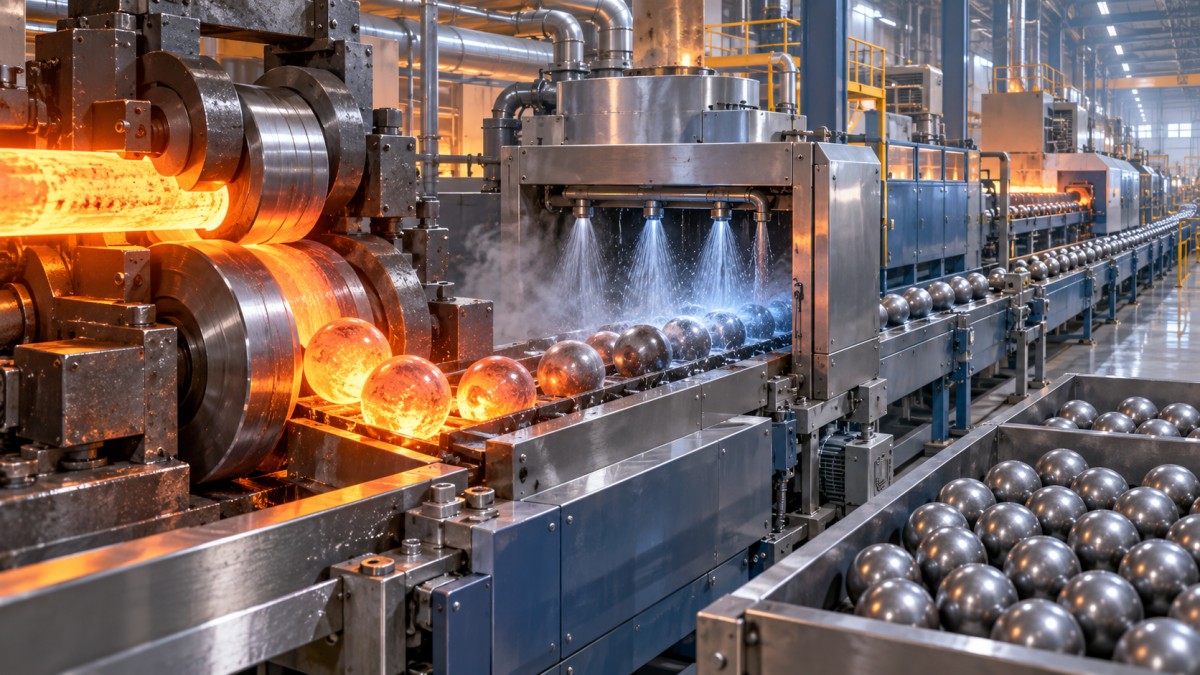
Hot rolling contributes to this balance before the final heat-treatment stage begins. Steel bar stock is heated into a plastic temperature range and passed through specially shaped rolling grooves. As the billet advances, the grooves progressively form the round profile, separate the ball from the bar, and refine its surface. The deformation is rapid and continuous, which distinguishes hot-rolled balls from balls shaped through slower forging operations or cast directly into molds.
Why rolling affects resistance to repeated impact
When steel is hot-worked, the original cast structure is changed. Rolling breaks down parts of the coarse as-cast grain pattern and elongates or redistributes inclusions along the direction of deformation. With appropriate temperature control and reduction, recrystallization produces a finer, more uniform grain structure. Fine grains generally improve the steel's ability to absorb impact energy because crack initiation and crack growth encounter more grain boundaries.
This does not mean that every rolled ball will automatically have superior toughness. The result depends on whether deformation occurs within a suitable temperature window. If the steel is rolled too cold, excessive rolling force, surface tearing, or internal stress can develop. If it remains too hot for too long, grain growth can reduce the benefits of deformation. The temperature at the ball core also matters, particularly for larger diameters, because the surface cools much faster than the center.
Hot-rolled steel balls also benefit from a dense shape produced under compressive force. Internal voids, shrinkage-related discontinuities, and weak regions are more concerning in high-impact grinding than a small cosmetic surface mark. Compression during forming can close some discontinuities in the feedstock, but it cannot reliably correct severe raw-material defects. Steel cleanliness, segregation control, and sound bar stock remain part of the performance foundation.
The sequence from bar to grinding ball
The usual process begins with alloy-steel bar selection and cutting or feeding preparation. Carbon and alloy content are selected to support the required hardenability, wear resistance, and core toughness. Carbon-rich grades can develop a hard martensitic surface after quenching, while manganese, chromium, and other alloying elements influence hardenability and transformation behavior. Phosphorus and sulfur need close control because excessive levels can reduce toughness or create weak paths for cracking.
The bar is reheated evenly before entering the rolling mill. Uneven heating is a hidden source of variation: a colder section resists deformation while an overheated section may develop excessive scale or coarse grains. Rolling grooves then shape the heated bar through successive passes. Proper alignment is important because an off-center ball can show an irregular parting line, uneven diameter, or local distortion that changes how it contacts the mill charge.
After rolling and separation, the ball passes through controlled cooling or directly into a heat-treatment route. The transformation during cooling determines the final relationship between the hard outer zone and the tougher interior. For high-impact work, the desired result is commonly a hard, wear-resistant surface supported by a core that can absorb shock rather than fracture abruptly.
Heat treatment completes the mechanical balance
Rolling creates the shape and improves structural uniformity, but heat treatment establishes much of the final hardness and impact behavior. In a typical route, balls are austenitized, quenched, and tempered. Austenitizing dissolves enough carbon and alloying elements into the steel matrix to enable hardening. Quenching then forms a hard transformed structure near the surface, provided cooling is sufficiently rapid for the selected steel grade and ball size.
Quenching must be matched to diameter. A 20 mm ball can cool through its section much more quickly than a 120 mm or 150 mm ball. Using the same cooling practice without adjustment can produce different core structures. The smaller ball may harden deeply, while the larger ball may retain a softer center. A softer core is not automatically a defect; it can support impact toughness. Problems arise when the hardness gradient is uncontrolled, when the surface is brittle, or when the core lacks enough strength to support the hardened shell.
Tempering relieves quenching stress and adjusts the final microstructure. Skipping or under-controlling this stage can leave a ball with high surface hardness but poor resistance to repeated impact. Over-tempering, on the other hand, can reduce wear resistance. The required balance changes with mill conditions: coarse feed, high drop height, hard ore, and low slurry cushioning impose a more severe impact demand than fine regrinding in a densely charged mill.
Hardness values need context
A surface hardness result is useful, but it is only one part of the assessment. A reading above 60 HRC may indicate a strong wear-resistant surface for an appropriate grade and treatment route, yet it does not show whether the ball has a brittle heat-affected layer, a sound core, or excessive decarburization. A decarburized surface can appear different from the intended hardened condition and may wear faster even when a single test point seems acceptable.
Impact toughness results must also be interpreted with the test location, specimen orientation, and heat-treatment condition in mind. A reported impact value cannot be treated as a universal prediction of mill life. Grinding media experience cyclic, multi-directional contact rather than one laboratory blow. Still, hardness and impact testing together are far more informative than either value alone, especially when supported by metallographic examination and section hardness measurements.
Surface appearance can be misleading
A smooth spherical surface is desirable, but visual inspection alone does not establish impact resistance. Rolling scale, minor color variation, and a visible parting line can occur without indicating a serious structural problem. In contrast, fine radial cracks around the equator, deep seams, or repeated localized pits deserve closer investigation because they may act as stress concentrators during mill operation.
Diameter and roundness also affect performance in less obvious ways. A ball that is significantly out of round does not distribute contact load evenly. Localized contacts raise stress at particular points and can encourage surface damage. Size selection matters as well: larger balls deliver more impact energy and suit coarser feed, while smaller balls provide more contact points for fine grinding. Choosing a large diameter merely for apparent durability can increase liner impact and reduce the efficiency of fine-particle breakage.
Comparing hot-rolled and forged media
Hot rolling and forging can both produce durable grinding media when the steel grade, deformation control, and heat treatment are suited to the service environment. The manufacturing label should therefore not replace process evidence. A comparison should focus on dimensional range, hardness profile, impact performance, internal soundness, and the expected ore and mill conditions.
For example, a Forged steel ball made from carbon and alloy steel grades such as B2, B3, 60Mn, 65Mn, or 40Cr may be evaluated using the same fundamental questions: whether the material is clean and consistent, whether the core supports the hardened surface, and whether the selected diameter matches the duty. The forming method changes the deformation path, but it does not remove the need to verify heat-treatment consistency across the ball section.
The most useful technical records connect material chemistry, ball diameter, heat-treatment route, surface hardness, and impact test data from the same production batch. When those elements are reviewed together, the resistance of hot-rolled steel balls becomes easier to interpret as an engineered outcome rather than a single hardness number.
Get real-time quotes
Interested? Leave your contact details.