
news
How to Choose Forged Steel Balls
When a grinding circuit begins consuming more media than expected, producing an unstable particle size, or showing frequent ball breakage, the cause is not always the mill itself. The forged steel balls may be poorly matched to the ore, mill diameter, operating speed, slurry conditions, or target grind. Choosing by price per tonne alone can create a higher cost per tonne of ore processed.
The practical selection rule is simple: choose forged steel balls by matching ball diameter, alloy grade, hardness profile, impact toughness, and quality consistency to the actual grinding duty. Large, hard ore needs a different media balance from fine regrinding, cement milling, or coal grinding. A suitable ball should retain hardness during wear while resisting cracking under repeated impact.
Start with the grinding stage, not the ball quotation
The first question is where the media will operate. A primary ball mill receives coarser feed and experiences stronger impacts. Its grinding media usually needs larger diameters and high resistance to breakage. A secondary mill often handles material that has already been reduced, so the objective shifts toward generating more contact points and maintaining an efficient grinding surface. Regrind duties may require smaller balls to improve fine-particle breakage rather than simply increasing impact energy.
Problems often arise when one standard ball size is supplied to every mill in a plant. In a coarse grinding circuit, balls that are too small may be unable to break competent ore particles efficiently. The mill may continue running, but throughput can fall and circulating load may rise. Conversely, oversized balls in a fine grinding duty can reduce the number of grinding contacts and leave too many coarse particles in the product.
Before requesting forged steel ball specifications, collect the operating information that directly affects media selection:
- Mill type, diameter, length, and effective grinding volume
- Feed size distribution and maximum feed particle size
- Ore hardness, abrasiveness, and fracture behavior
- Target product size and classification performance
- Mill speed, media filling rate, and slurry density
- Whether the dominant issue is low throughput, high wear, ball breakage, or poor fineness
These details are more useful than a general request for “high-hardness balls.” High hardness matters, but it does not solve every grinding problem. A ball that is extremely hard yet lacks sufficient toughness can crack or spall in a high-impact environment. A tougher, lower-alloy ball may survive impacts but wear too quickly in abrasive ore. Selection is a balance between these failure modes.
Choose the diameter range based on breakage energy
Ball diameter has a direct influence on impact force and the number of contacts inside the charge. Larger balls carry more kinetic energy and are generally suited to coarse feed, hard mineral particles, and the early stages of grinding. Smaller balls provide more individual grinding points and are commonly used when material has already been reduced and a finer product is required.
A practical approach is to avoid assuming that a single diameter is ideal throughout the mill. A controlled size distribution can help maintain grinding behavior as the charge wears. Fresh larger balls can provide impact energy, while intermediate and smaller sizes fill the spaces between them and improve abrasion and attrition action. The proper distribution depends on the mill’s feed and discharge conditions, not merely on the nominal mill capacity.
Diameter tolerances also deserve attention. Wide size variation changes the intended ball charge distribution and can make media addition less predictable. For standard hot-rolled ball sizes, tolerances generally increase as diameter increases. This is normal, but the supplied range should be clear before purchase, especially when the mill uses a tightly controlled top-size media program.
Look beyond surface hardness
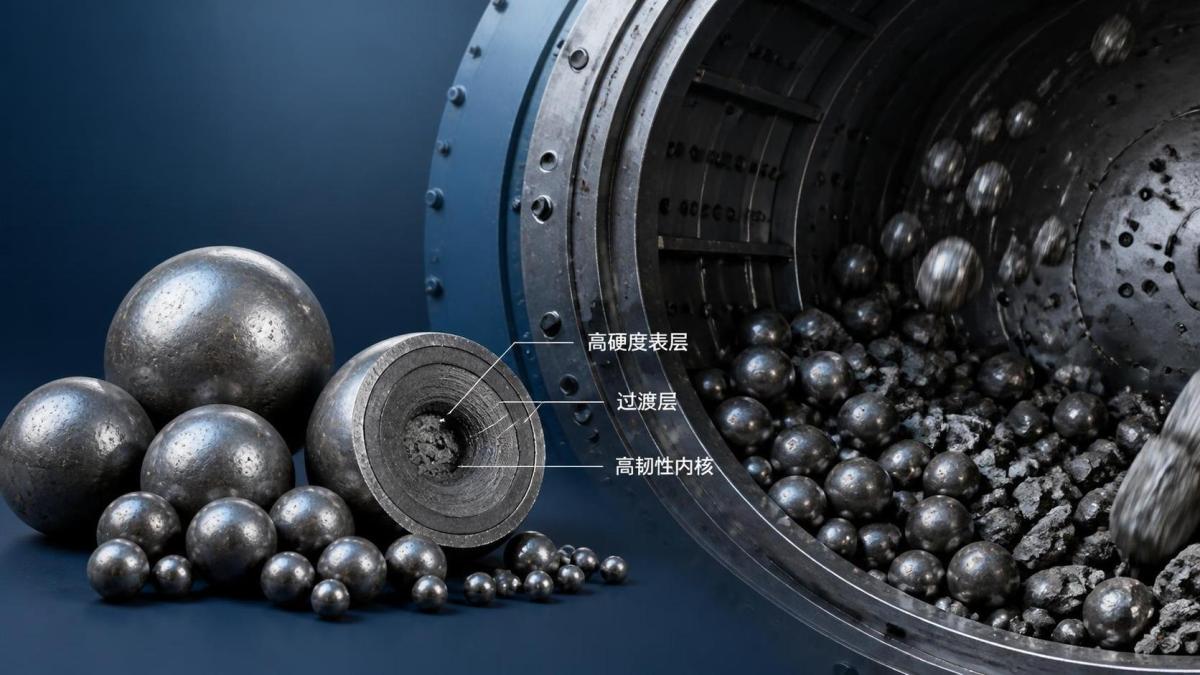
Surface hardness is one of the first figures buyers compare because it relates to wear resistance. However, a hardness number by itself does not show whether the ball has a stable structure through its working section. Grinding balls are subjected to repeated impacts, compression, sliding abrasion, and corrosive slurry exposure. The useful question is not only “How hard is the surface?” but also “Will the ball keep a suitable hardness profile as it wears?”
For common hot-rolled steel ball sizes from 20 mm to 100 mm, a surface hardness above 60 HRC can be specified. Larger sizes may have lower stated minimum surface hardness, such as above 58 HRC for 110 mm and 120 mm balls, and above 55 HRC for 130 mm to 150 mm balls. This difference reflects the challenge of achieving uniform hardening through larger sections. It should not automatically be treated as inferior performance; it needs to be evaluated against the actual impact duty and expected wear pattern.
A ball that becomes unusually soft beneath a hard outer layer may wear rapidly after the initial surface is removed. On the other hand, a ball with a very hard but brittle structure can produce broken fragments. Fragmented media reduces effective grinding action, complicates charge control, and may create screening or downstream separation issues.
What toughness tells you
Impact toughness indicates how well a ball can absorb repeated loading without sudden fracture. In a mill handling large, hard feed, this property is especially important. A stated impact toughness of at least 12 J/cm² is one useful baseline indicator, but buyers should also ask how the manufacturer controls raw material selection, rolling conditions, quenching, tempering, and final inspection.
Breakage should be investigated rather than accepted as routine media loss. When balls crack, split, or exhibit abnormal spalling, review several possible causes at once: unsuitable alloy grade, inadequate heat treatment, excessive ball size, oversized feed, changes in mill operating conditions, or foreign metallic material entering the mill. Replacing broken balls with a harder grade without identifying the failure mechanism can repeat the same problem.
Match alloy composition to the operating environment
Forged and hot-rolled grinding balls are produced from carbon steel and alloy steel grades with different carbon, chromium, manganese, silicon, and other element ranges. These elements influence hardenability, wear resistance, toughness, and heat-treatment response. They should not be compared as isolated numbers; the final performance depends on the whole steel grade and the manufacturing process.
Carbon supports hardness after heat treatment, while chromium generally improves hardenability and wear resistance. Manganese can contribute to strength and hardenability, and silicon is used within defined ranges depending on the grade. Grades such as B2, B2-1, High Carbon B2, B3, B4, B6, B6-1, 40Cr, 42CrMo, 65Mn, 60Mn, and 50Mn are not interchangeable labels. Their suitability changes with ball diameter, ore characteristics, and mill conditions.
For example, chromium-bearing grades may be considered where stronger wear resistance and hardenability are required. Manganese steel grades may be evaluated where toughness and economy are important under appropriate conditions. Higher-carbon grades can provide strong hardness potential, but their treatment must be controlled so that the ball does not become excessively brittle. Procurement specifications should therefore define the grade or acceptable grade range, required hardness, toughness expectation, diameter tolerance, and inspection requirements rather than only stating “forged steel balls.”
Check the production route and inspection evidence
A reliable ball begins with suitable steel, but raw material quality alone does not guarantee reliable grinding media. During hot rolling or forging, the ball must be formed consistently, then heat treated in a way that develops the intended mechanical properties. Poor control can lead to uneven hardness, internal defects, surface cracks, or excessive variation between batches.
Ask suppliers how they control the process from incoming steel through finished-product release. Useful topics include raw material traceability, chemical composition verification, dimensional inspection, hardness testing, impact testing, and visual checks for surface defects. For larger balls, it is also reasonable to ask how the supplier verifies the hardness profile and controls quenching conditions.
Quality documents should support the delivery, but they should be read in context. A material composition record confirms the steel chemistry; it does not independently prove that every ball has performed correctly in a mill. A hardness report is valuable, but it does not replace dimensional checks or breakage monitoring. The best purchasing practice is to link incoming inspection with operating feedback from the grinding circuit.
When evaluating available options, Hot-rolled steel balls can be specified in diameters from Φ20 mm to Φ150 mm and in grades including B2, B3, 40Cr, 42CrMo, 65Mn, 60Mn, and related compositions. The relevant choice should still be based on the mill duty rather than selecting a grade solely because it is commonly used in another operation.
Compare cost by useful grinding work, not delivered price
A lower purchase price can appear attractive until media consumption, unplanned additions, or reduced milling performance are included. The more relevant comparison is the combined operating effect of wear rate, breakage rate, grinding efficiency, and the labor needed to manage the charge. Even without calculating a full cost model, buyers can make better decisions by tracking media addition by mill and linking it to ore type, throughput, power draw, and product size.
Do not compare two suppliers using only a short delivery period when ore conditions are changing. A fair evaluation needs comparable operating conditions. Record the ball size mix added, the tonnage processed, the feed characteristics, and the reason for any major process adjustment. If one batch is used during softer ore and another during harder ore, the consumption figures alone may give a misleading conclusion.
It is also important to separate normal wear from abnormal loss. Uniform reduction in ball diameter is generally expected. Large chips, cracked halves, unusually rapid disappearance of certain sizes, or excessive fines from ball fragmentation point to a problem that should be investigated. A lower wear rate is valuable only when the balls also maintain the grinding action needed to meet the target product size.
Use a controlled trial when the duty is uncertain
Some applications can be matched confidently from existing mill information, while others need a staged trial. This is particularly useful when a plant changes ore sources, increases feed size, modifies the circuit, or experiences unexplained media breakage. The trial should have a clear purpose: compare alloy grades, adjust the top ball size, alter the size distribution, or test whether a tougher media is needed.
Keep the trial narrow enough to interpret. Changing ball grade, ball size, mill speed, classification settings, and slurry density at the same time makes the outcome difficult to understand. Start with the condition most closely connected to the observed issue, then observe the media condition and grinding performance over a representative operating period.
After the trial, inspect recovered balls where practical. Look for roundness retention, surface cracking, peeling, deformation, and the proportion of broken pieces. Compare these observations with mill output and media addition records. This approach turns forged steel ball selection from a catalogue decision into a controlled operating decision.
Questions that often affect the final choice
Should the hardest ball always be selected?
No. Higher hardness can improve wear resistance, but a ball also needs adequate toughness for its impact environment. The hardest option may be unsuitable where coarse feed or high-impact conditions increase the risk of cracking.
Can one ball diameter be used for every grinding stage?
It can be used operationally, but it is rarely the most efficient approach. Coarse grinding and fine grinding create different breakage demands. A managed size distribution often provides better control of both impact energy and contact area.
What should be checked when balls are breaking?
Check ball grade and heat-treatment consistency, then review feed size, mill operating conditions, ball charge level, and possible tramp metal. Fracture patterns can help distinguish brittle media from an operating condition that is applying abnormal impact.
Is chemical composition enough to approve a supplier?
No. Chemistry is important, but it should be considered alongside hardness, toughness, diameter tolerance, surface condition, batch traceability, and process control. The final selection should also be verified against the actual grinding duty.
Get real-time quotes
Interested? Leave your contact details.