
news
Forged Steel Ball Price
Forged Steel Ball Price Is Not a Single Number
A forged steel ball price is meaningful only when it is tied to a defined grinding duty. A quotation expressed simply as a price per metric ton can conceal major differences in ball diameter, steel grade, hardness profile, heat-treatment consistency, breakage resistance, inspection scope, packing, freight terms, and expected consumption in the mill. Two offers with a modest gap in purchase price can produce very different grinding-media costs once wear, ball breakage, throughput stability, and liner interaction are considered.
For mineral processing operations, the relevant question is not “Which forged steel ball is cheapest?” but “Which ball delivers the lowest cost per tonne of ore processed under this mill’s operating conditions?” That distinction matters especially in primary grinding, where balls must tolerate repeated high-energy impacts, and in gold, copper, iron ore, and other abrasive ores where uneven hardness or poor toughness can quickly turn an initially low quotation into a higher operating cost.
What a Forged Steel Ball Quotation Usually Includes
Most forged or hot-rolled grinding ball quotations are based on weight, commonly quoted on an FOB, CFR, CIF, or delivered basis. Before comparing figures, the buyer needs to establish whether the quoted price includes the same commercial and technical scope. A lower FOB factory price cannot be compared directly with a delivered price that includes export packing, inland haulage, port charges, ocean freight, marine insurance, and destination-side costs.
The product definition must be equally specific. “Forged steel balls” may refer to balls made from different bar grades, with different heating and forming practices, and with different quenching and tempering controls. Some suppliers use “forged,” “hot-rolled,” and “rolled forged” broadly in commercial communication, while the production route can differ. What matters operationally is not the label alone but the resulting microstructure, surface condition, hardness distribution, dimensional consistency, and impact performance.
A usable request for quotation normally identifies:
- ball diameter or a full size mix;
- ore type and whether grinding is wet or dry;
- mill type, including SAG, ball mill, rod mill, or regrind circuit;
- target hardness and any impact-toughness requirement;
- required quantity, shipment rhythm, and destination port or inland delivery point;
- applicable inspection, documentation, and third-party verification requirements;
- the requested trade term and currency basis.
Without this information, suppliers may quote different quality levels under the same product name. The result is not a competitive comparison; it is a comparison of incomplete assumptions.
Steel Input Cost Sets the Floor, but Not the Final Price
The steel bar is the principal material input in forged grinding balls, so changes in alloy-bar availability and mill pricing have a direct effect on supplier cost. Yet raw material is only one component. The relevant input is not generic carbon steel; it is steel that meets the chemical composition and cleanliness required for a grinding-media grade. Carbon, manganese, chromium, sulfur, phosphorus, and residual elements all affect hardenability, wear behavior, and crack sensitivity.
For example, a buyer evaluating high-carbon chromium-bearing balls should not assume that balls with a similar surface hardness have the same steel quality. A ball may achieve a high initial surface reading while having an inadequate hardness profile beneath the surface, excessive decarburization, or an unfavorable combination of hardness and toughness. These deficiencies may not be visible in a standard commercial quotation, but they influence ball consumption and fracture risk.
Material procurement policy also affects price stability. A producer using traceable bar from established steel mills and verifying incoming chemistry may carry a different cost structure from one purchasing opportunistically. This does not automatically make one offer superior, but it explains why a technically controlled quote may not track the lowest available steel price.
Diameter Changes More Than the Weight per Ball
Ball size is one of the most visible drivers of forged steel ball price. Larger diameters contain more steel per piece, but the commercial effect goes beyond simple weight. Heating time, deformation force, quenching behavior, handling, sorting, and inspection requirements vary with diameter. Larger balls also need sufficient through-hardening and resistance to impact cracking, particularly where they are used in coarse grinding or SAG-related duties.
Smaller balls can create their own manufacturing and quality-control challenges. They have a greater surface-area-to-mass relationship, and their performance may be more sensitive to surface defects, dimensional variation, or over-hardening. A size range from 20 mm to 150 mm therefore should not be treated as one uniform item with one interchangeable performance expectation.
The size mix in the mill is just as important as the nominal diameter ordered. Replacing a well-designed charging mix with a single low-priced size can alter impact energy, void filling, classification behavior, and grinding efficiency. The immediate purchase saving may then be offset by poorer size reduction or a change in media consumption. Price evaluation should start with the existing media charge, top-up practice, product size target, and mill operating data—not with a catalogue size alone.
Hardness Must Be Read as a Profile, Not a Sales Claim
Hardness is often used as a shorthand indicator of quality, but it is not enough to ask for a minimum HRC number. Grinding balls are repeatedly exposed to abrasion, impact, corrosion in some wet circuits, and contact stresses. A useful ball needs an appropriate relationship between surface hardness, core hardness, and impact toughness.
Very high surface hardness can improve resistance to abrasive wear, yet an excessively brittle structure raises the possibility of spalling or breakage under severe impact. Conversely, a ball with insufficient hardness may remain intact but wear too rapidly, increasing the media addition rate. The appropriate balance depends on ore competency, feed size, mill diameter, rotational conditions, pulp chemistry, and the position of the mill in the comminution circuit.
Technical comparison should therefore request more than a statement such as “60 HRC.” Buyers should ask how hardness is measured, at what locations it is tested, whether the core is examined, and whether each heat-treatment batch is traceable. A report with a surface-hardness range, sectional hardness information, impact-test method where relevant, chemical analysis, and lot identification provides a much stronger basis for comparison than a single certificate value.
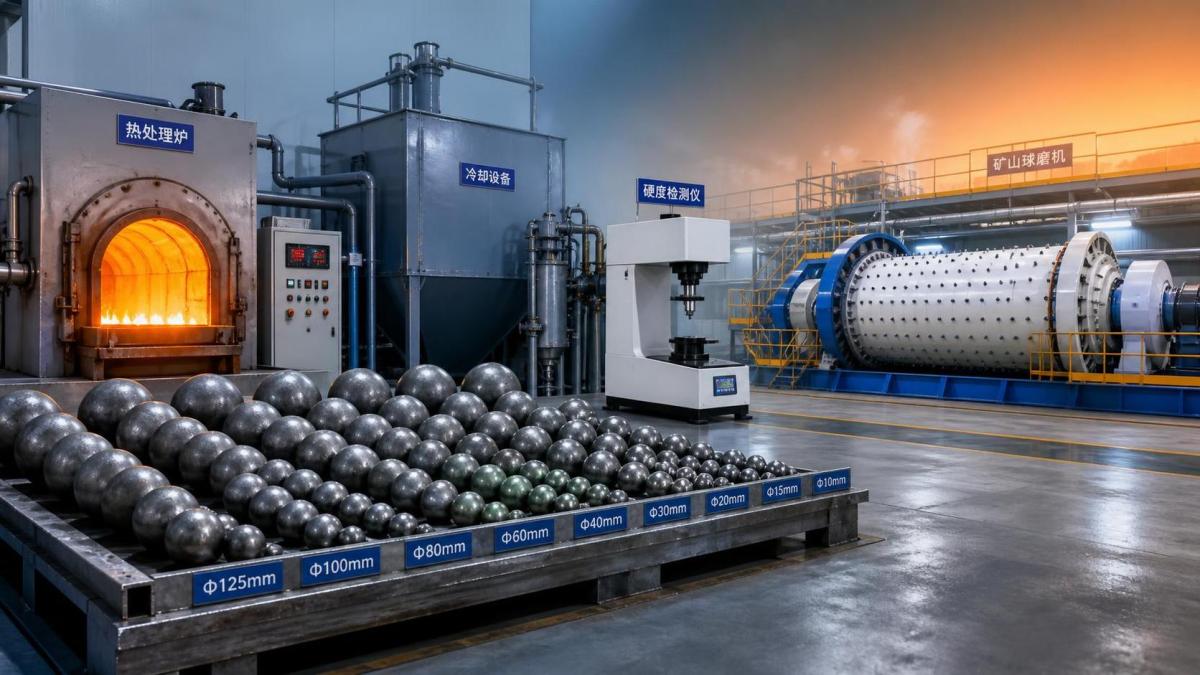
Heat treatment is a major source of price variation because it consumes energy and requires controlled equipment, process discipline, and testing. Inadequate heating uniformity, quench control, or tempering can cause residual stress, uneven properties, and cracking. These failures may emerge only after the balls enter the mill. The purchase order should define the acceptance criteria before production, rather than leaving “high hardness” or “high wear resistance” open to interpretation.
Production Route and Quality Control Affect the Real Cost
Forged and hot-rolled balls are generally selected where impact resistance and structural integrity are important. Their production economics depend on automated line capacity, yield loss, die and roll maintenance, energy use, quenching media, labor, and rejection rates. A supplier’s annual capacity alone is not proof of quality, but a stable standardized process can reduce lot-to-lot variation that is costly for end users to diagnose after delivery.
Quality assurance should cover the full chain: incoming bar inspection, heating control, forming, heat treatment, dimensional checks, surface inspection, hardness testing, and final lot traceability. The cost of such controls is often invisible in a unit quotation, although it helps limit the risk of mixed grades, under-treated balls, or inconsistent batches.
For applications requiring a broad diameter range, products such as Hot-rolled steel balls may be evaluated against the specific duty rather than solely against a nominal material grade. A stated range of 20 mm to 150 mm, for instance, is useful only if the supplier can show that the requested diameter has a verified hardness and toughness profile. The relevant question is whether the offered ball is controlled for the selected size and application, not whether the factory lists that size in principle.
Freight Can Reverse the Apparent Price Advantage
Grinding media is dense, heavy cargo. Logistics is consequently a central part of forged steel ball pricing, particularly for export orders. Sea freight is normally calculated by container and route conditions, while inland delivery may involve port handling, trucking, rail, border procedures, and local unloading limitations. A quote that appears attractive at origin can lose its advantage if the supplier is distant from export infrastructure or if packing creates avoidable weight, handling, or container-utilization inefficiencies.
Trade terms need careful reading. Under FOB, the buyer controls main carriage after loading. Under CFR or CIF, the supplier arranges ocean transport, but the buyer still needs clarity on destination charges, customs clearance, insurance scope, demurrage exposure, and inland movement. Delivered-duty-paid terms can simplify administration in some situations, but they also reduce direct visibility into underlying logistics costs.
Packaging is not a minor line item. Steel balls may be supplied in bulk, steel drums, bags, or other formats depending on size, port practice, customer handling systems, and safety requirements. The least expensive packaging is not always the least expensive delivered option if it leads to difficult unloading, damaged containers, product loss, or slow receiving operations.
How to Compare Offers on a Lifecycle Basis
The practical comparison unit is often media cost per tonne of ore ground, not media price per tonne purchased. This requires site-specific operating data, but the logic is straightforward:
Grinding media cost per tonne of ore = delivered media cost × media consumption rate ÷ tonnes of ore processed.
The consumption rate should include normal wear and any abnormal losses caused by breakage, spalling, or premature removal. If a higher-priced ball has a demonstrably lower consumption rate without harming throughput or product-size control, its operating cost can be lower. The reverse can also occur: a premium grade is not automatically economical when the grinding duty is mild and a less expensive specification performs adequately.
Trials are valuable, but only when they are designed to avoid misleading conclusions. Comparing different ball sizes, different addition patterns, different ore blends, or different mill operating conditions does not isolate ball performance. A controlled assessment should record ball additions by lot, operating hours, feed characteristics, mill throughput, grind size, liner condition, and any observed broken media. The trial duration must be long enough to capture a representative wear cycle.
Common Pricing Errors That Create Procurement Risk
One frequent error is treating a laboratory hardness result as a complete performance guarantee. It is not. Hardness is one variable within a broader metallurgical and operating system.
Another is accepting an unspecified “B2,” “B3,” “65Mn,” or similar grade designation as if it were a universal standard. Such labels are widely used commercially, but chemical ranges, processing methods, and guaranteed properties should be stated in the contract or technical annex. Grade names alone do not eliminate ambiguity.
A third error is comparing samples with production shipments without defining sampling rules. A favorable sample can demonstrate a potential capability; it does not confirm the consistency of every production batch. Purchase terms should address lot identification, inspection rights, certificate requirements, non-conformance handling, and the basis for any third-party testing.
Certification should also be interpreted correctly. ISO 9001, ISO 14001, ISO 45001, and SGS-related inspection documents can support confidence in management systems or verification activity, but they do not replace product-specific acceptance criteria. A quality management certificate does not by itself establish the hardness gradient, impact resistance, or wear rate of a particular order.
A Better Basis for Price Negotiation
The strongest negotiation is built on a technically complete specification and a transparent delivered-cost model. It gives suppliers a fair basis to quote the required quality, while giving the buyer a way to identify whether a lower price reflects logistics efficiency, material sourcing, production scale, reduced testing, a different specification, or an omitted cost.
Price should be negotiated against clearly defined variables: grade chemistry, diameter tolerance, hardness requirement and test method, impact criteria where needed, inspection level, quantity per shipment, packaging, Incoterm, destination, payment terms, and delivery window. Changes in any of these variables can legitimately change the quotation.
A forged steel ball price becomes commercially useful when it is linked to the mill’s actual consumption and performance requirements. The lowest invoice value may be the right choice only when it meets those requirements consistently. Where grinding conditions are demanding, traceable metallurgy, controlled heat treatment, reliable logistics, and verifiable lot quality are not premium extras; they are the elements that determine whether the quoted price remains economical after the balls enter the mill.
Get real-time quotes
Interested? Leave your contact details.