
Mining Grinding Media Selection by Ore Type, Mill Diameter, and Target Throughput
Selecting Mining Grinding Media should begin with the ore and the mill duty, not with the lowest purchase price or a familiar ball grade. A media charge that is too small, too soft, or poorly matched to the feed can restrict throughput, increase recirculating load, and consume more energy without delivering the required grind. An oversized or excessively hard charge can create a different problem: unnecessary liner impact, poor fine-grinding efficiency, and higher replacement cost.
The practical objective is to maintain enough impact energy to break the coarsest competent particles while preserving sufficient surface area to complete the required final grind. Ore type, mill diameter, feed size, and target throughput all change that balance.
Start with the ore, not the media catalogue
Ore hardness alone does not determine the correct grinding media. Two ores with a similar crushing work index may behave very differently in a mill. One may break along mineral boundaries and respond well to moderate impact; another may contain hard, competent fragments that survive until they receive a much higher-impact collision. Abrasive minerals also change the decision because they wear both media and liners more aggressively.
Abrasiveness deserves special attention. It is tempting to specify the hardest available ball, but surface hardness is not the whole answer. A ball must also withstand repeated impact without cracking or spalling. In a coarse primary grind, impact toughness can be as important as wear resistance. In a fine-grinding duty with less severe impact, a media option with stronger resistance to abrasion may be more relevant.
The feed-size distribution matters as much as the average feed size. A circuit receiving occasional large, hard fragments needs enough large media to control those particles. Designing only around average feed can leave the mill with a persistent coarse tail, even when total power draw appears normal.
Mill diameter changes the meaning of ball size
Mill diameter affects the trajectory and impact environment of the charge. In a larger-diameter mill, grinding media can be lifted higher before cascading or cataracting, producing more energetic impacts. That is why a ball size that performs acceptably in a smaller mill is not automatically the right top size in a larger unit.
However, increasing ball diameter is not a universal route to higher capacity. Large balls deliver stronger impacts but provide less total grinding surface per tonne of charge. If the circuit is already producing mostly small particles, an over-large charge may leave too little contact area for efficient finishing. The result can be acceptable coarse breakage but poor product-size control.
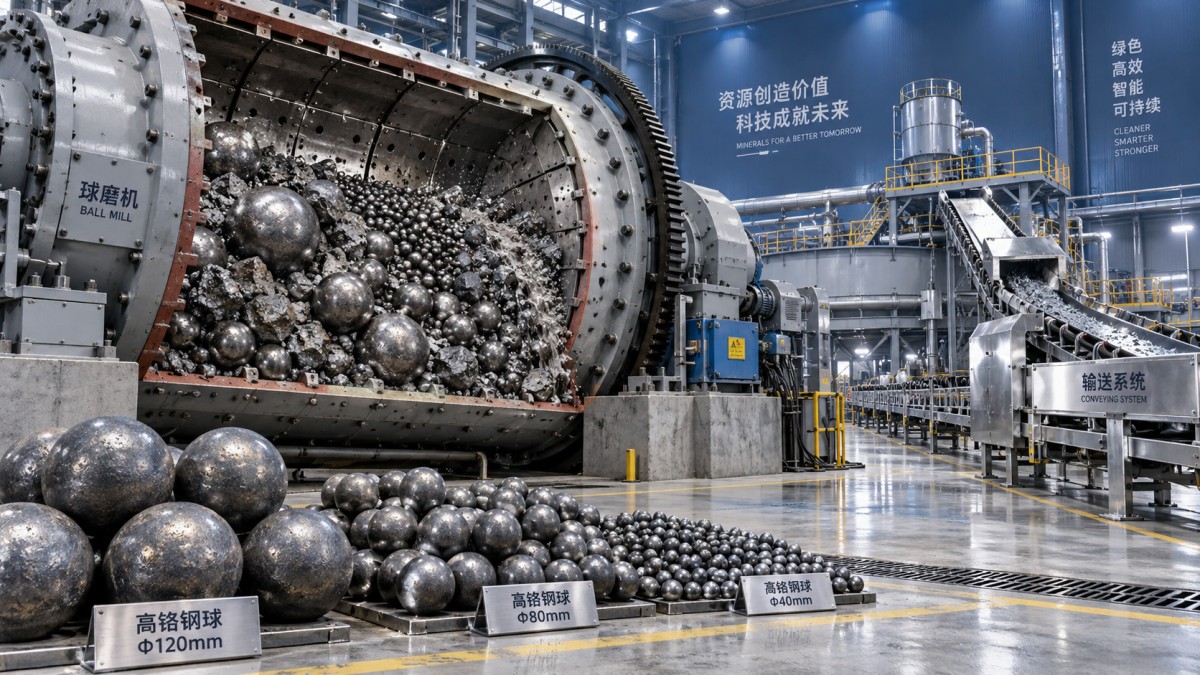
For ball mills, a mixed charge is often more effective than a single-size charge. The largest balls address fresh-feed breakage; intermediate sizes continue size reduction; smaller balls contribute surface area for the fine fraction. The correct distribution should reflect the mill’s position in the circuit. A primary mill treating coarse feed will generally need a different top-size and make-up pattern than a regrind mill treating classifier overflow.
Rod mills require a separate decision path. Steel rods are often selected where line contact and controlled coarse-particle breakage are useful, particularly when limiting excessive fines matters. They require proper rod length, straightness, and operating practice; using rods merely as a substitute for balls can lead to tangling, uneven wear, and unstable mill operation. Cylpebs can be useful in selected fine-grinding duties, but their suitability depends on the mill design and the required product size rather than on a simple assumption that more surface area is always better.
Set the charge around throughput and product size together
Target throughput is not simply a tonnage target for the mill. It must be considered with the desired product size, circulating load, classification efficiency, slurry density, and available power. A mill can process more material while producing a coarser product; that is not a successful outcome when downstream recovery depends on liberation.
Before finalizing media selection, define three operating conditions:
- The expected feed-size range, including the largest recurring competent particles rather than only the nominal crusher setting.
- The required transfer size or final grind target, stated in the same terms used by the process design.
- The planned steady-state throughput and the more demanding operating periods, such as harder ore zones or reduced crushing performance.
Then assess whether the proposed media charge can deliver both breakage stages: high-energy impacts for the coarse fraction and enough contact points for the fine fraction. This prevents a common commissioning error: choosing a large media top size to protect throughput, then discovering that the downstream circuit cannot consistently meet its grind target.
Media consumption also needs to be evaluated as an operating pattern, not just as a theoretical wear rate. The make-up schedule should preserve the intended size distribution. Adding only large balls because they are easier to stock will gradually shift the charge toward impact and away from fine-grinding surface area. Adding only small balls has the opposite risk: the mill loses the ability to break new coarse feed efficiently.
Specify material quality in terms of the duty
When comparing forged or hot-rolled balls, request the information that affects performance in the actual mill: nominal size range, chemical composition range, hardness profile, impact resistance, dimensional tolerance, heat-treatment control, and traceability. A single surface-hardness figure does not show whether hardness is retained below the surface or whether the ball will perform consistently through its wear life.
For mineral extraction and gold grinding circuits, Hot-rolled steel balls can be considered where the required diameter range, alloy grade, hardness profile, and toughness suit the mill’s impact and abrasion conditions. Available sizes from 20 mm to 150 mm make it possible to develop a charge distribution rather than force the circuit into a limited size range. Grades such as B2, B3, B6, 40Cr, and 42CrMo should be compared against the duty requirements, not treated as interchangeable labels.
Shandong Jinchi New Material Technology Co., Ltd. supplies grinding steel balls, rods, and cylpebs along with selection and technical support for mining applications. In a project evaluation, the useful supplier contribution is not a generic grade recommendation. It is the ability to align material options, size distribution, inspection documentation, and replenishment planning with the circuit’s operating conditions.
Do not confuse media problems with circuit problems
Grinding media is frequently blamed when throughput drops or the product becomes coarser, but several upstream and downstream conditions can produce the same symptoms. Worn liners alter lifting and trajectory. A changing ore blend can raise competency or abrasiveness. Poor cyclone performance can return excess fines to the mill, reducing effective grinding volume. Incorrect slurry density may suppress impact and transport. Replacing the media without checking these conditions can obscure the real cause and make performance less predictable.
A disciplined evaluation uses a baseline period. Record feed size, ore blend, mill power, charge additions, liner condition, cyclone behavior, throughput, and product size before changing media. Introduce one controlled change where possible, then compare the operating response over enough time to account for normal ore variability. This produces a decision based on the whole circuit rather than a short-term observation after a fresh charge addition.
A practical selection sequence
- Classify the ore by competency, abrasiveness, feed-size variability, and slurry behavior.
- Confirm the mill type, diameter, effective grinding length, liner profile, and whether the duty is primary, secondary, or regrind.
- Set the throughput and product-size requirement together, including expected operating extremes.
- Choose the media form first: balls, rods, or cylpebs, based on the breakage duty and mill design.
- Define a top-size and size distribution, then establish a make-up plan that maintains it.
- Compare candidate materials for hardness consistency, toughness, wear behavior, and quality control rather than relying on nominal grade alone.
- Monitor the full circuit after commissioning and adjust based on measured throughput, product size, media consumption, and liner wear.
The strongest selection is rarely the most expensive media or the largest ball available. It is the combination that keeps the mill breaking the feed it actually receives, produces the size the next process needs, and maintains a stable charge as operating conditions change.
Get real-time quotes
Interested? Leave your contact details.