
Wear Resistant Materials Market: What Mining Buyers Should Watch in 2026
Wear Resistant Materials Market: What Mining Buyers Should Watch in 2026
As mining companies set operating plans for 2026, the discussion around Wear Resistant Materials is becoming less about finding the lowest quoted unit price and more about controlling the cost of every tonne processed. That shift is especially visible in grinding circuits, where media wear, ball breakage, mill throughput, liner interaction, and delivery reliability can all influence the final economics of a concentrator.
For business evaluators, the difficult part is that two offers may look comparable on paper while performing very differently in service. A grinding ball with a similar nominal diameter and hardness may not have the same hardness profile, impact resistance, dimensional consistency, or resistance to spalling. In a high-impact SAG or ball mill environment, those differences tend to show up quickly—not always as an obvious product failure, but as unstable consumption, unexpected media top-ups, or a gradual decline in grinding efficiency.
The 2026 market will likely reward buyers that treat wear products as operating inputs rather than commodity steel. Procurement still matters, of course, but a purchase decision that ignores site conditions usually creates a larger problem downstream.
The market is moving toward performance accountability
Mining operators are under continuing pressure to protect uptime while managing energy use and maintenance exposure. That makes the performance consistency of grinding media more relevant than it was when purchasing decisions were mainly based on diameter, steel grade, and price per tonne. The question is increasingly: what does the media do inside this particular mill, with this ore body, this feed size, and this operating regime?
Ore is rarely uniform over the life of a mine. Hardness, abrasiveness, moisture, mineral composition, and competency may change by bench, pit phase, or blend. A media specification that worked well during one period may become less suitable after a change in ore characteristics. This is why experienced plant teams are often cautious about accepting a new grinding media grade solely from a laboratory certificate or a small initial shipment.
For Wear Resistant Materials suppliers, this creates a higher expectation: provide traceable manufacturing control, explain the relationship between material selection and operating conditions, and support trial evaluation with useful technical dialogue. Companies such as Shandong Jinchi New Material Technology Co., Ltd., which develops grinding steel balls, grinding rods, cylpebs, and related mining support services, operate in a market where technical responsiveness can be nearly as important as production capacity.
What buyers should compare beyond hardness
Hardness remains an important indicator, but it is not a complete purchasing criterion. Very high surface hardness can be useful in abrasive service; however, if the ball lacks sufficient toughness or has an inconsistent heat-treatment structure, it can become more vulnerable to cracking, breakage, or surface spalling under repeated impact. Conversely, a tougher product that wears too quickly can increase media consumption and alter the charge profile in the mill.
A practical evaluation should consider the balance between wear resistance and impact resistance. Buyers should also ask whether hardness is measured only at the surface or checked through the effective working layer. For larger-diameter balls, core performance matters because the ball is expected to remain structurally sound as it wears down. Material chemistry, quenching and tempering control, and inspection procedures all influence that outcome.
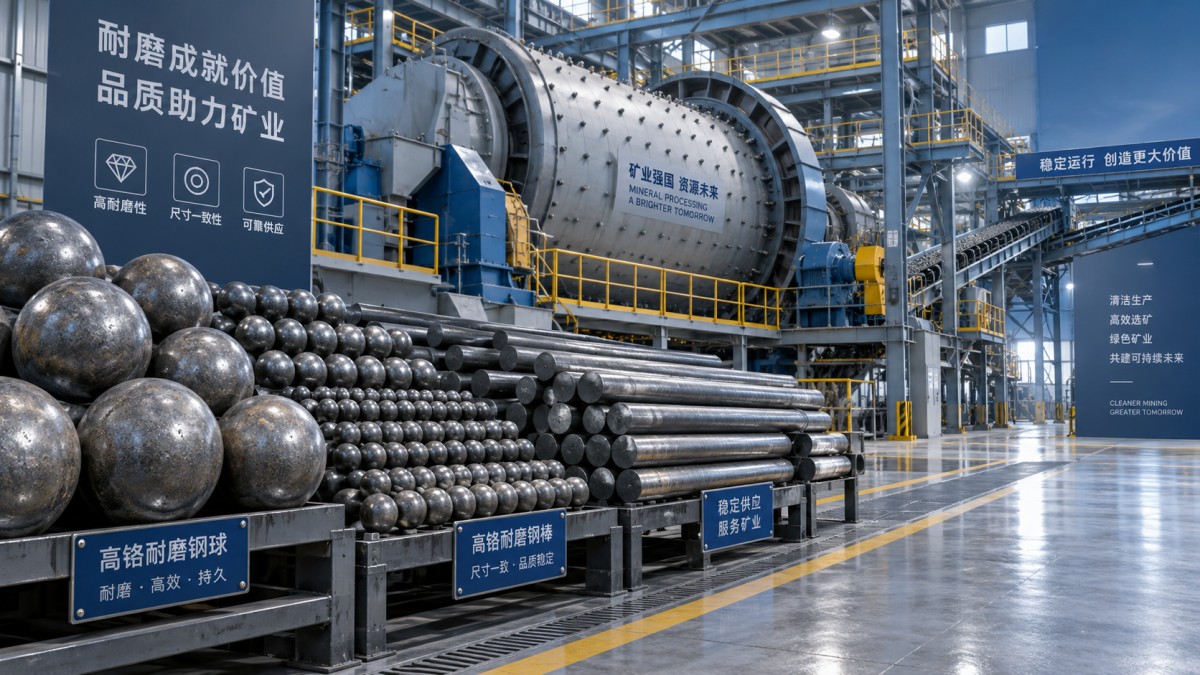
Dimensional tolerance deserves more attention than it usually receives in commercial comparisons. Ball size distribution affects charge motion and grinding behavior. If delivered media varies excessively from the stated diameter, the operating team may not get the intended balance of impact and attrition. This is particularly relevant where mills use planned top-up sizes rather than a broad, uncontrolled mix.
For example, products such as Casting balls may be supplied in diameters from 20 mm to 150 mm for mining, mineral extraction, cement, power generation, and other grinding applications. The relevant question is not simply whether that range is available. A buyer should confirm which sizes are suitable for the site’s mill type, ore characteristics, target particle size, and existing media charging practice.
Supply reliability is now a technical and commercial risk
The wear-resistant steel market remains exposed to fluctuations in raw-material availability, freight conditions, and regional manufacturing capacity. Mining sites cannot easily compensate for a missed grinding-media shipment. If stock reaches a critical level, the plant may be forced to use an unsuitable size mix, reduce throughput, or accept an emergency substitute without proper qualification.
That means supplier assessment in 2026 should include more than annual output claims. Buyers should ask where the steel is sourced, whether batch identification is maintained, how production scheduling is managed, and what logistics route is realistic for the destination. A supplier located near a major export port may have an advantage, but proximity alone does not guarantee dependable delivery. Packaging, shipment planning, documentation capability, and communication during delays all matter.
It is also sensible to distinguish between an emergency order and a planned supply program. The lowest spot price can look attractive, yet a planned arrangement with agreed specifications, inspection points, and replenishment timing may reduce operational uncertainty over a full year. This is one area where procurement savings and plant reliability can pull in opposite directions.
Technical documentation should answer operational questions
Certificates and test reports are useful only when they help the buyer judge suitability. A proper technical review should examine declared chemical composition, applicable diameter tolerances, surface hardness, impact toughness, and the manufacturer’s quality-control process. For some grinding ball specifications, stated surface hardness may exceed 60 HRC, while impact toughness may be specified at 12 J/cm² or above. Those figures need to be interpreted in the context of the product grade and operating duty rather than treated as universal proof of superiority.
Quality-system credentials can also be relevant. ISO 9001, ISO 14001, ISO 45001, or third-party inspection arrangements may indicate that a manufacturer has documented processes, but they do not replace incoming inspection or site trials. Buyers should request representative batch records where appropriate and clarify whether inspection is conducted on every lot, at what stage, and against which agreed acceptance criteria.
One common mistake is accepting a supplier’s “equivalent grade” description without checking the actual chemistry and heat-treatment approach. Labels such as B2, B3, B4, B6, 60Mn, 65Mn, 40Cr, or 42CrMo can be useful starting points, but naming conventions alone do not establish equivalent service performance across manufacturers. The production route and quality discipline behind the grade are part of the comparison.
A better way to evaluate a 2026 sourcing decision
Rather than awarding business entirely from a quotation sheet, mining buyers can build a short evaluation plan around the realities of the circuit. It should define the target application, expected ball sizes, baseline media consumption, sampling method, inspection points, and the duration needed to observe meaningful wear behavior. The exact method will vary by site, but the principle is simple: compare products under conditions close to normal operation.
- Confirm the mill type, ore conditions, feed characteristics, and target grind before selecting a material grade.
- Review hardness, toughness, diameter tolerance, chemistry, and traceability as a package rather than isolated claims.
- Check whether the supplier can support technical questions after shipment, not only during the tender stage.
- Assess logistics lead time and contingency arrangements for critical media sizes.
- Measure consumption and breakage patterns during a controlled site trial whenever practical.
The central 2026 buying decision is unlikely to be “which material is cheapest?” It is more likely to be “which supply option gives the plant the most predictable cost per tonne over the operating period?” That calculation includes purchase price, but it also includes mill stability, media life, energy behavior, inventory exposure, and the effort required to resolve problems when conditions change.
For mining organizations reviewing Wear Resistant Materials, the strongest suppliers will be those that can connect steelmaking and heat-treatment discipline with the realities of a grinding circuit. A technically sound product still needs to arrive in the right size, in the right condition, at the right time. That is the standard against which 2026 sourcing decisions should be tested.
Get real-time quotes
Interested? Leave your contact details.