
Why Forged Steel Grinding Balls Improve Reliability in High-Impact Milling
In a high-impact mill, grinding media does more than reduce ore size. It absorbs repeated impact, transfers energy to the feed, and helps maintain a stable grinding environment. When balls crack, chip heavily, or wear out of shape too quickly, the result is often lower throughput, unstable product size, higher media consumption, and avoidable mill stoppages.
Forged steel grinding balls improve reliability because their production route is designed to create a dense, continuous internal structure with a useful balance of surface hardness and core toughness. In practical terms, the ball is better able to survive repeated collisions with ore, liners, and other balls without failing prematurely. That benefit matters most in mills handling hard, coarse, abrasive, or variable feed.
Reliability is not just about a hard surface
Hardness is important because it slows abrasive wear. However, hardness alone does not make grinding media reliable. A very hard ball with insufficient toughness can become vulnerable to cracking under severe impact. Conversely, a tough ball that is too soft may flatten or wear away rapidly, reducing its grinding effectiveness.
Forging helps address this balance. During forging, the steel is worked under pressure, which refines its internal grain flow and reduces the risk of loose or discontinuous internal structure. Heat treatment then develops the desired hardness profile. A well-made forged ball should retain a hard, wear-resistant outer layer while keeping enough toughness inside to withstand impact loads.
This is why two balls with a similar stated hardness can perform differently in service. The more reliable option is not necessarily the one with the highest hardness reading; it is the one whose metallurgy, forging quality, and heat treatment fit the actual mill conditions.
What changes inside a high-impact mill
High-impact conditions occur when larger media, coarse feed, high mill speed, or hard ore produce frequent and energetic collisions. In these situations, media is exposed to several forces at once: direct impact, sliding abrasion, compression between particles, and corrosion when slurry chemistry is aggressive.
A forged ball is especially useful where impact failure is a concern. Its tougher core helps it resist catastrophic breakage, while its hardened surface helps preserve diameter for longer. Maintaining diameter matters because media size determines how efficiently the mill can break particles. If large balls disappear too quickly or become badly misshapen, the charge loses its intended impact capability.
For operators, the visible benefit is usually greater consistency. The mill is less likely to experience sudden changes caused by fractured media, excessive fines from broken balls, or an uncontrolled shift in ball-size distribution.
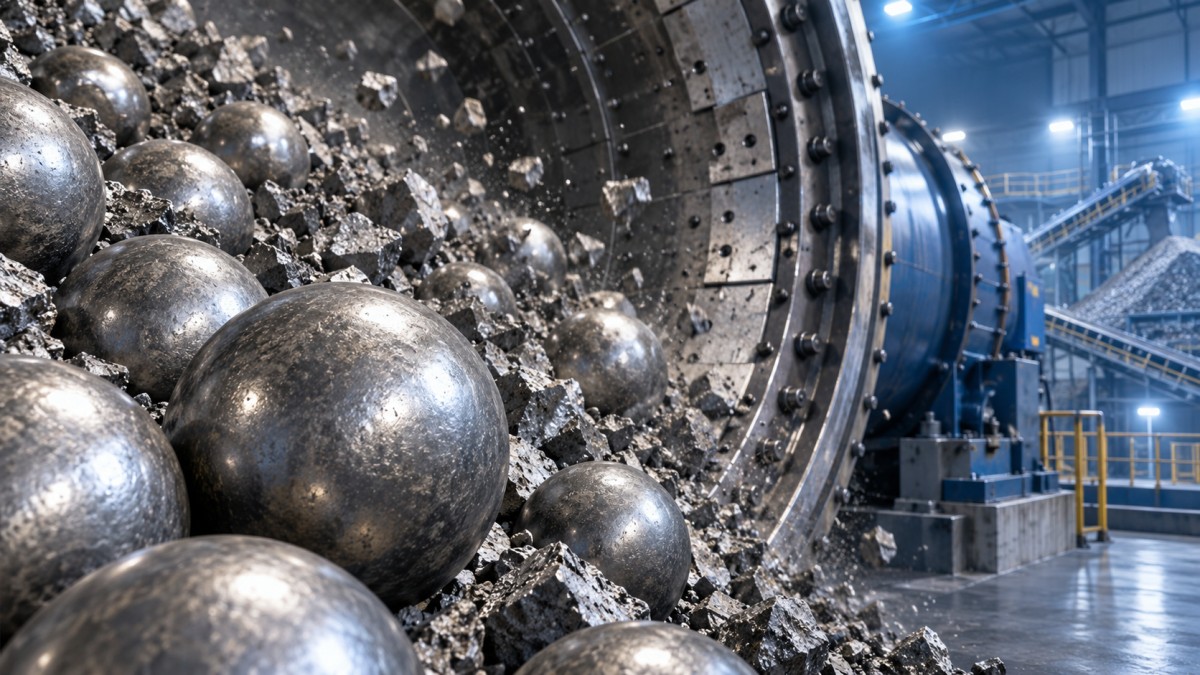
How forged balls support more stable mill operation
The reliability advantage comes from several connected effects rather than one isolated property.
- Lower risk of breakage: A sound forged structure is better suited to repeated impact than media with internal defects or inadequate toughness.
- More predictable wear: Gradual, relatively uniform wear makes it easier to manage media additions and maintain the intended charge.
- Better energy transfer: Balls that retain their roundness and useful size continue to deliver impact energy where it is needed.
- Less contamination from failed media: Broken fragments can disturb charge behavior, complicate inspection, and contribute to downstream handling issues.
- Fewer unplanned interventions: Reliable media does not eliminate maintenance needs, but it reduces one source of unexpected operating disturbance.
These benefits are most meaningful when the balls are matched to the mill. Installing premium forged media without correcting an unsuitable ball-size mix, liner condition, mill speed, or feed condition will not solve the underlying problem.
Choose for the mill duty, not the word “forged” alone
“Forged” describes an important manufacturing method, but it is not a complete selection specification. Operators should begin with the duty of the grinding stage: feed size, ore competency, target product size, mill type, mill diameter, slurry conditions, and the size distribution of the existing charge.
A common mistake is selecting media only by nominal diameter or price per tonne. A lower purchase price can be misleading if the balls break early, wear unevenly, or require more frequent additions. The relevant operating question is how the media behaves over its service life: wear rate, breakage tendency, size retention, and its effect on mill stability.
Ball size distribution deserves as much attention as material grade
Even a reliable ball can perform poorly if the charge is poorly balanced. Large balls deliver stronger impact and are useful for breaking coarser particles. Smaller balls provide more contact points and are generally more effective once particles have already been reduced. A mill charged with too many large balls may leave fine material under-ground; too many small balls may struggle to break coarse feed efficiently.
Media additions should therefore support the existing grinding strategy rather than simply replace lost tonnage with one diameter. Inspect the charge pattern during planned stops and compare it with feed changes, liner condition, and product-size trends. This provides more useful guidance than choosing a single “best” ball size.
There are also circuits where balls are not the preferred medium. Rod mills, for example, rely on line contact and are often selected where a different grinding action is needed. In mineral processing and other applications, operators evaluating rod-media duty can review options such as Grinding steel rod in diameters from 20 mm to 150 mm. The choice between balls and rods should follow the mill design and required product characteristics, not a general assumption that one medium is always superior.
Signs that media reliability needs attention
Some problems blamed on ore variability or mill settings may be related to grinding media. Repeatedly finding broken balls, unusually sharp fragments, excessive flattening, or wide differences in ball shape can indicate that the media is not suited to the impact environment. A sudden increase in top-up demand, unstable circulating load, or a change in product size can also justify checking the charge.
Inspection should look beyond obvious breakage. Compare wear across balls from the same batch, observe whether the surface wears smoothly or develops deep pitting, and note whether failures occur in one area of the mill or across the charge. Localized failures can point to operating or liner-related issues rather than a media problem alone.
What to confirm before changing grinding media
Before switching suppliers, grades, or diameters, record the conditions under which the current media is operating. Confirm the feed size range, ore hardness variation, mill speed, charge volume, liner condition, slurry density where relevant, and the actual distribution of balls remaining in the mill. Then identify the specific problem to solve: high wear, ball breakage, unstable throughput, poor size control, or excessive downtime.
Shandong Jinchi New Material Technology Co., Ltd. develops grinding media including steel balls, rods, and cylpebs for mining applications, alongside technical support. For a high-impact milling duty, the useful discussion is not simply whether forged media is available, but which material grade, diameter range, hardness level, and toughness balance suit the operating conditions.
Forged grinding media is most valuable when its toughness and wear resistance are matched to the impact environment. That match gives operators a more predictable charge, more stable grinding behavior, and a clearer basis for controlling media consumption over time.
Get real-time quotes
Interested? Leave your contact details.