
Building Grinding Media Solutions Around Ore Hardness, Mill Type, and Cost
Grinding media selection should begin with the breakage task inside the mill, not with a preferred ball grade or a purchase price. Ore hardness, feed size, mineral texture, mill geometry, operating speed, slurry conditions, and target product size all influence whether the media transfers energy efficiently or is consumed without producing the required grind.
A workable media program connects three questions: how much impact energy is needed to break the largest competent particles, how much surface contact is needed to finish the smaller fraction, and how quickly the media will wear under the actual ore and pulp chemistry. When those questions are separated, a lower-cost option can appear attractive while raising media consumption, reducing throughput, or producing an unstable grind.
Start with the ore's breakage behavior
Ore hardness is not a single value. Competency can vary between benches, lithologies, and mineral zones, while an ore body with a similar bulk hardness result may break very differently because of fracture patterns, grain boundaries, moisture, or abrasive gangue. A media choice based only on a laboratory hardness classification may therefore miss the load that the mill actually sees.
For coarse, competent feed, larger media retains enough mass to deliver the impact required for initial fracture. If the charge is dominated by small balls, the mill can circulate coarse particles for too long. This often appears as a throughput problem, yet the restriction may be insufficient impact energy rather than inadequate motor power.
At the other end of the circuit, excessively large media reduces the number of contact points available for fine grinding. The result can be a satisfactory coarse breakage rate but a broad product-size distribution, with fine particles remaining above the desired cut size. A mixed charge is often necessary because ore entering a secondary or regrind stage rarely consists of one uniform particle size.
Abrasiveness needs separate attention. Hard, angular silica-bearing material can remove media by abrasion even when impact breakage is moderate. Conversely, an ore with high impact demand may promote spalling or breakage if the media lacks adequate toughness. Wear observations should distinguish gradual diameter loss from cracking, shelling, and irregular fracture. These mechanisms point to different corrections; treating all consumption as ordinary wear can lead to the wrong material grade or heat-treatment requirement.
Match the media form to the mill and duty
Mill type determines how energy reaches the particles. In a rod mill, line contact and the movement of long rods suit relatively coarse feed and can limit excessive fines in certain applications. Rod length, straightness, and wear pattern matter because bent or tangled rods disrupt charge motion and reduce grinding consistency.
Ball mills use cascading and cataracting motion to combine impact and abrasion. Ball diameter selection should reflect the feed top size, mill diameter, rotational speed, charge volume, and required discharge size. A feed containing occasional oversize fragments may need a controlled portion of larger balls even when the nominal feed specification suggests a smaller top size. Ignoring the coarse tail in the feed distribution commonly causes intermittent overloads and fluctuating cyclone performance downstream.
Cylpebs offer a different surface-area-to-mass relationship and are often considered where fine grinding is the dominant duty. Their use should be evaluated against mill design and charge behavior rather than assumed to be a direct substitute for balls. A media shape that improves fine-particle contact may be less effective where substantial impact breakage remains necessary.
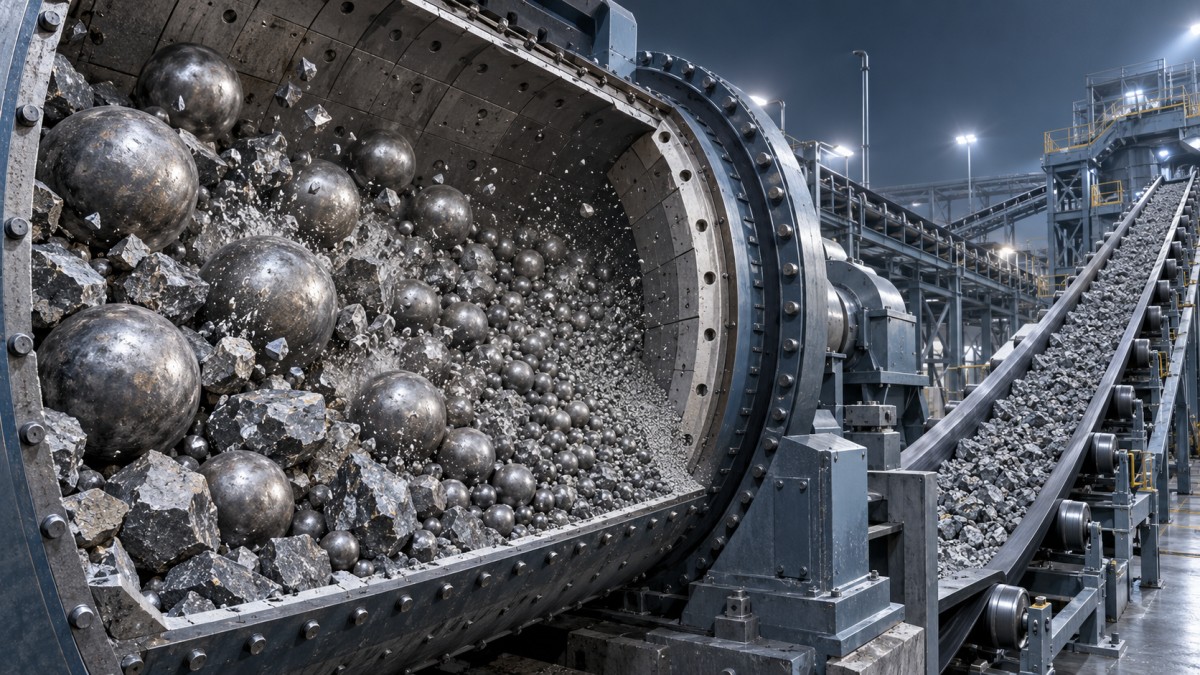
For ball-mill duties with a broad feed range, Hot-rolled steel balls are available across diameters from 20 mm to 150 mm. That range permits a charge design based on the actual breakage stages inside the mill instead of forcing one diameter to perform every task. The selected size range still needs to align with liner profile, lifter condition, and the operating speed that governs trajectory.
Hardness is useful only when read with toughness and wear profile
Surface hardness is a meaningful screening parameter, but it does not fully describe grinding-media performance. A hard surface can resist abrasion, while a weak internal structure can make larger balls vulnerable to impact damage. This distinction becomes more important as ball diameter rises because larger pieces experience higher collision forces. A specification should therefore consider hardness distribution, impact toughness, microstructure control, and the consistency of the heat-treatment process.
Diameter also changes how a hardness figure should be interpreted. A larger ball has a greater thermal mass during heat treatment, so a surface reading alone does not establish whether the required properties extend sufficiently below the surface. For demanding coarse-grinding duty, request evidence that production controls account for size-dependent hardening behavior rather than applying the same expectation to every diameter.
Chemistry supports those properties but should not be viewed as a standalone ranking system. Carbon, chromium, manganese, silicon, and alloy additions interact with rolling, quenching, and tempering. A chromium-containing grade may offer stronger wear resistance under one abrasive condition, while a different grade with better toughness may be more appropriate in a high-impact section of the circuit. The correct comparison is performance under the operating condition, not the nominal alloy label.
Build total cost around consumption and production stability
The relevant cost is not simply the delivered price per tonne of media. A complete comparison includes media consumption per tonne of ore, the effect on throughput, energy demand, liner wear, screen or cyclone loading, inventory requirements, and stoppages associated with charge management. A lower initial price loses its advantage when replacement frequency increases or inconsistent size distribution disrupts the grinding circuit.
Media wear also changes mill performance over time. As balls become smaller, total surface area increases, but impact capability falls. If additions are made without a planned size distribution, the charge can drift toward fine media and gradually lose its ability to break new coarse feed. Conversely, adding only large balls can displace the small media needed for finish grinding. The addition schedule should preserve the intended charge mix, not merely restore the total tonnage.
Use a controlled trial rather than a simple replacement
A useful trial begins by recording a stable baseline: ore blend, feed size distribution, throughput, mill power, circulating load where relevant, product size, media additions, and liner condition. The trial media should then be introduced in a defined size mix while other major operating changes are avoided. Changing media, feed blend, cyclone settings, and mill density at the same time makes the result difficult to interpret.
Sampling should extend beyond a single shift because ore variation and charge dynamics can conceal the effect of a media change. Inspect the retained media after enough residence time to identify whether it is wearing uniformly, flattening, cracking, or developing surface defects. Compare consumed media against tonnes processed and grind quality, while noting operational interruptions that may distort the figures.
Grinding Media Solutions become durable when the charge design is treated as a controlled operating variable. Ore behavior defines the breakage demand, mill type defines the energy environment, and total cost is determined by the interaction between wear rate and production response. A media program that is reviewed as feed conditions, liners, and throughput targets change is more reliable than a fixed grade-and-size purchase specification.
Get real-time quotes
Interested? Leave your contact details.