
Where Low Chrome Grinding Balls Deliver Value in Low-Impact Milling Operations
Low Chrome Grinding Balls can deliver dependable, cost-effective performance in low-impact milling operations where extreme abrasion resistance is not the primary requirement.
For technical evaluators, the key is balancing media hardness, wear rate, mill conditions, and total operating cost across the complete grinding circuit.
This article examines where low chrome media creates measurable value and how to assess its suitability for specific mineral processing applications.
Start with the Mill Duty, Not the Lowest Purchase Price
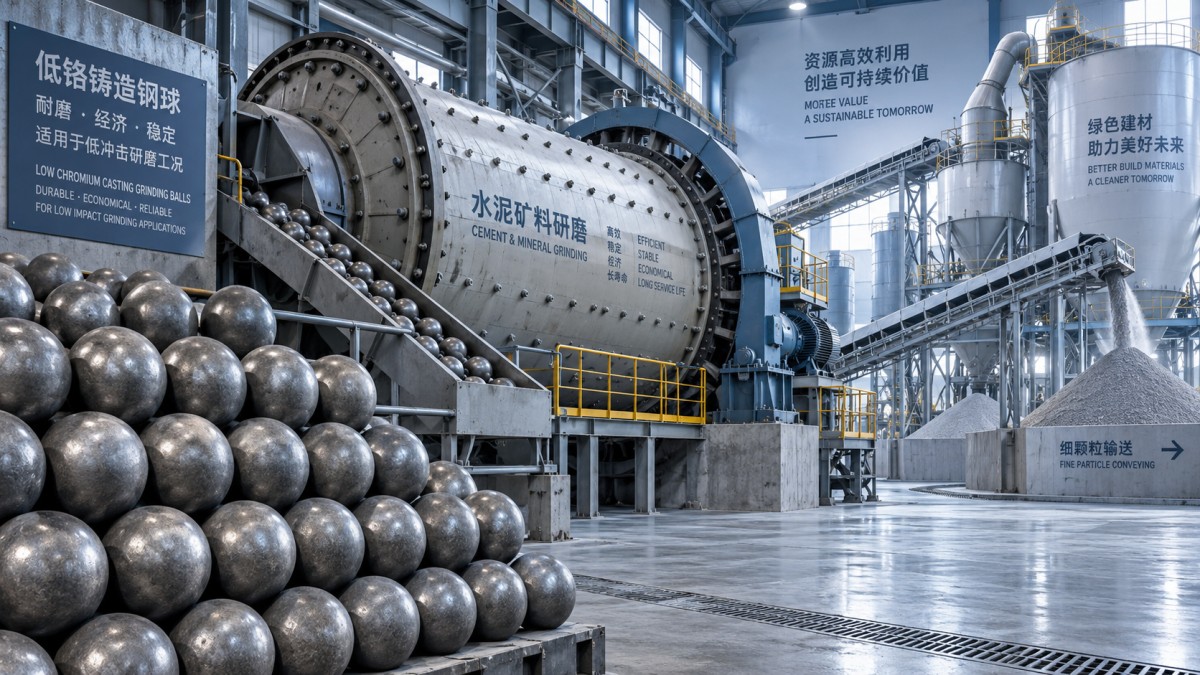
Low chrome grinding media is most valuable when a milling circuit has moderate impact energy, controlled feed size, and ore characteristics that do not demand premium alloy performance.
Technical evaluators should first classify the operation by mill type, ball diameter, feed particle size, pulp density, rotation speed, and expected throughput.
A media selection decision becomes unreliable when it is based only on unit price per tonne without measuring consumption, grinding efficiency, and downstream process stability.
In low-impact applications, higher-cost high chrome media may provide more wear resistance than the process can economically use, increasing media expenditure without proportional recovery benefits.
Low Chrome Grinding Balls can therefore be a rational selection when their lower initial cost offsets their expected wear rate under actual operating conditions.
Which Milling Operations Are Usually Suitable?
Suitable environments commonly include secondary grinding duties, cement raw material milling, coal grinding, selected chemical processing circuits, and relatively soft mineral ores.
These applications often generate enough abrasion to require reliable media, but not enough repeated impact to justify the highest alloy content available.
Ball mills operating with stable feed characteristics are particularly relevant because predictable conditions make media wear easier to estimate and control.
Coal grinding in power plants may benefit when contamination requirements, moisture conditions, and safety controls are addressed through a site-specific technical review.
Cement and building-material producers can also evaluate low chrome options where grinding targets are stable and the circuit does not experience severe oversized feed events.
For mineral extraction, ore hardness alone is not sufficient for selection; competency variation, silica content, slurry chemistry, and liner interaction also influence media behavior.
Understand the Tradeoff Between Wear Resistance and Cost
Low chrome media generally contains less chromium than high chrome alternatives, so it may wear faster in highly abrasive or corrosive milling environments.
That limitation does not automatically make it unsuitable. The relevant question is whether the additional wear is economically acceptable for each tonne of product processed.
Evaluators should compare media consumption in kilograms per tonne, not only nominal hardness values or supplier claims about service life.
A lower-cost ball can create value when its replacement frequency remains manageable and its size reduction performance supports required mill throughput and product fineness.
Conversely, low chrome media may be a poor fit when sharp feed particles, high-impact breakage, severe corrosion, or abrasive ores cause rapid diameter loss.
Premature breakage is especially important because fragmented media can disturb the charge profile, reduce grinding efficiency, and create avoidable sorting or discharge issues.
Evaluate Hardness, Toughness, and Diameter Retention Together
Media performance is not determined by hardness alone. A ball must retain useful diameter while resisting surface wear, deformation, cracking, and breakage throughout its working cycle.
Hardness supports abrasion resistance, while adequate toughness helps the media tolerate impact loading and avoid brittle failure during charging and milling.
Technical teams should request test data that identifies hardness distribution, chemical composition, microstructure controls, and dimensional consistency for the proposed media grade.
For casting balls, diameter selection should align with the mill duty rather than follow a standard purchasing specification used across unrelated circuits.
Smaller balls typically support fine grinding through greater surface area, whereas larger diameters provide more impact energy for coarser feed particles.
A supplier offering sizes from 20 mm to 150 mm can support charge optimization, but the selected size mix should be validated against operating data.
Use a Controlled Trial to Verify Total Cost
The most credible evaluation method is a controlled production trial comparing candidate media under equivalent ore, mill loading, operating hours, and maintenance conditions.
Before the trial, record baseline values for media addition rate, throughput, power draw, product size distribution, liner wear, and metallurgical recovery where applicable.
During the trial, maintain consistent sampling intervals and distinguish normal media consumption from losses caused by spills, abnormal shutdowns, or charging errors.
Measure the retained charge periodically to understand diameter reduction. A simple mass balance alone may hide whether balls are wearing uniformly or breaking prematurely.
The resulting comparison should calculate cost per tonne processed, including procurement price, freight, charging labor, inventory requirements, and effects on grinding performance.
A technically sound trial often reveals that the best option is neither the cheapest ball nor the most wear-resistant ball, but the most efficient overall choice.
Check Process Risks Before Broad Implementation
Low chrome grinding media should be reviewed carefully where iron contamination can affect concentrate quality, flotation response, pigment color, or chemical product specifications.
Corrosive slurry conditions also deserve attention. Acidic environments and dissolved oxygen can accelerate electrochemical wear beyond the expected mechanical abrasion rate.
Mill feed variability is another risk factor. A circuit handling occasional oversized material may need tougher media than its average ore profile suggests.
Technical evaluators should also assess compatibility with existing liners, lifters, separators, pumps, and classification equipment before changing the media specification.
Changes in ball density, size distribution, or wear profile can alter circulating load and classification efficiency, even when the media appears suitable in isolation.
What to Request from a Grinding Media Supplier
Supplier evaluation should cover product consistency, production controls, inspection records, traceability, packaging practices, delivery capability, and technical support during commissioning.
Ask for documented chemical ranges rather than a generic material name. Carbon, manganese, chromium, phosphorus, sulfur, and heat-treatment control can affect final performance.
For low chrome products, chromium content around 0.4 to 0.6 percent may be relevant, but composition must always be considered alongside manufacturing quality.
Shandong Jinchi New Material Technology provides grinding media for mining, cement, power generation, chemical engineering, machinery, and gold mining applications.
Its Casting balls range includes multiple material grades and diameters from 20 mm to 150 mm for application-specific selection.
ISO9001, ISO14001, ISO45001, and SGS-related quality documentation can assist procurement reviews, although site trials remain necessary for confirming actual mill performance.
Make the Selection Decision on Measured Value
Low Chrome Grinding Balls deliver the strongest value where mill impact is moderate, ore conditions are stable, and premium wear resistance does not improve operating economics.
They are not a universal replacement for high chrome media, particularly in aggressive abrasive, corrosive, or high-impact circuits with demanding reliability requirements.
For technical evaluators, the practical decision framework is straightforward: define the duty, verify material quality, run a controlled trial, and compare total cost per tonne.
When performance data confirms acceptable wear, stable particle-size control, and no harmful downstream effects, low chrome media becomes a defensible cost-management choice.