
Key Performance Factors to Compare Before Buying Industrial Casting Balls
Buying industrial casting balls is not a simple matter of comparing unit prices or selecting the highest advertised hardness. In a grinding circuit, media performance affects throughput, product size distribution, liner wear, media consumption, and the frequency of unplanned interventions. A lower-priced ball can become the more expensive option if it breaks prematurely, loses diameter too quickly, or delivers inconsistent grinding energy.
For procurement teams, the practical question is whether a particular ball will remain stable under the ore, mill type, feed size, and operating conditions of the site. The most useful comparison therefore starts with four linked factors: hardness profile, impact resistance, wear behavior, and dimensional consistency. Chemical composition and supplier process control support those outcomes, but should not replace performance-focused evaluation.
Compare hardness through the ball, not only at the surface
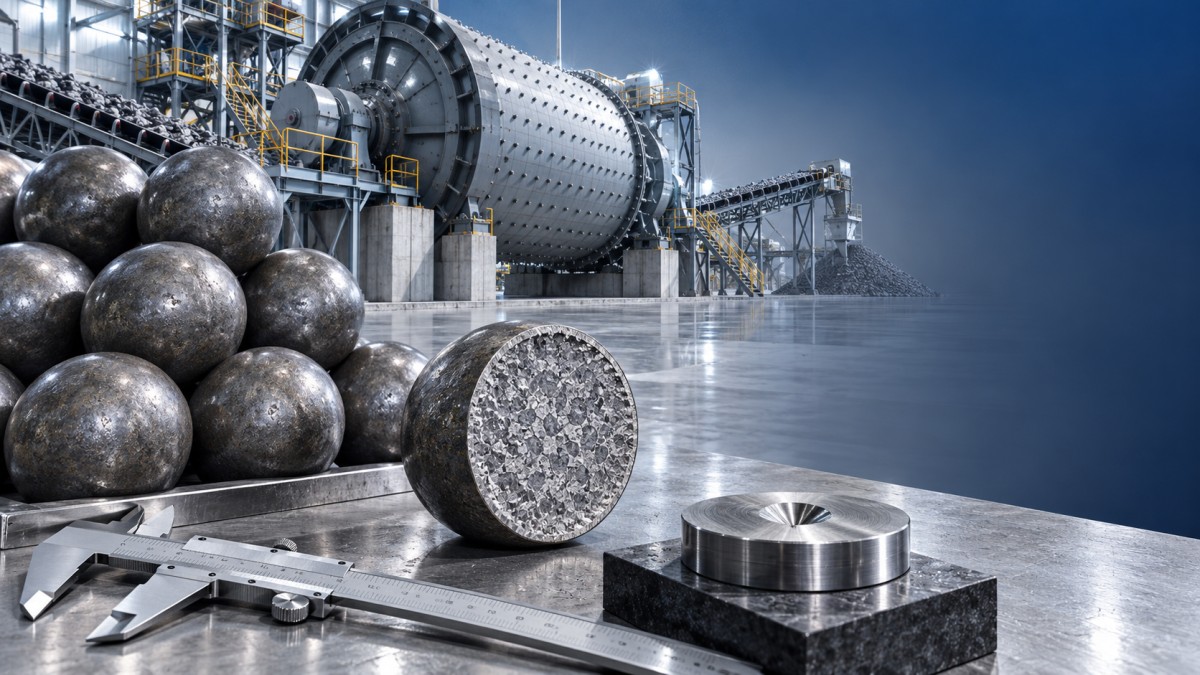
Surface hardness is an important screening point because it influences abrasion resistance. Yet a surface result alone does not show how the ball will behave after repeated impacts and gradual wear. Industrial casting balls may develop a hard outer layer while having a different internal structure. If the hardness drops too sharply beneath the surface, wear can accelerate after the outer layer is consumed.
Buyers should ask suppliers how hardness is checked: at the surface only, at several depths, or across a sectioned sample. The answer matters most in large-diameter media and in mills where balls remain in service long enough for subsurface properties to affect consumption.
A higher HRC value is not automatically preferable. Excessive hardness without sufficient toughness can raise the risk of chipping or breakage, especially in SAG mills, large ball mills, or circuits processing hard and coarse feed. The better specification is one that identifies an appropriate hardness range and confirms consistency by ball size, grade, and heat-treatment batch.
Impact resistance determines whether wear turns into failure
Abrasion slowly reduces a ball's diameter. Breakage changes the economics much faster. Broken balls can reduce effective grinding, complicate media charging, and create concerns for mill internals. This is why impact toughness should be reviewed alongside hardness rather than treated as a secondary laboratory number.
The severity of impact loading depends on the application. Fine grinding environments with relatively small media may place more emphasis on abrasive wear resistance. Coarse-feed milling, high mill speeds, large ball sizes, and variable ore hardness impose more demanding impact conditions. A specification suitable for a low-impact cement grinding application may not be suitable for a mining circuit with large feed particles and frequent high-energy collisions.
When comparing offers, procurement teams should request the test method and acceptance basis for impact properties, not just a broad statement such as “high impact resistance.” They should also clarify how the supplier controls defects associated with casting, including shrinkage cavities, inclusions, porosity, and cracking. These internal defects may not be visible during a routine visual inspection, but they can become fracture initiation points in service.
For applications where impact exposure is the dominant concern, buyers may also evaluate alternative media routes. For example, Forged steel balls can be considered where a combination of high surface hardness and specified impact toughness is needed. The decision should follow mill conditions and operating evidence rather than a blanket preference for cast or forged media.
Wear rate must be assessed in the context of grinding performance
Wear resistance is often discussed as kilograms of media consumed per tonne of ore processed, but this figure cannot be interpreted in isolation. Ore abrasiveness, slurry chemistry, feed size, target fineness, liner profile, mill filling, and ball size distribution all influence media consumption. Comparing two suppliers only by a generic wear claim can lead to a misleading decision.
A more useful procurement comparison asks three questions:
- How steadily does the ball retain its usable diameter during its service life?
- Does its shape remain sufficiently round to preserve grinding action and predictable classification?
- Does the media grade support the required throughput and product size at the selected charge mix?
Wear should also be separated from spalling. A ball that becomes smaller through uniform abrasion may remain functional through much of its expected life. A ball that sheds large fragments or develops cracks has a different failure pattern, even if its nominal hardness appears favorable. Purchase specifications should therefore define unacceptable breakage and spalling, not only target hardness.
A controlled site trial is often more informative than a catalogue comparison. To make a trial meaningful, keep the media size mix, feed conditions, mill operating settings, and sampling period as stable as practical. Measure consumption, inspect retained media, and record any effect on throughput or product size. A trial without clear baseline conditions may show normal process variation rather than a genuine difference between media grades.
Chemical composition is a control point, not a stand-alone buying decision
The composition of industrial casting balls influences hardenability, carbide formation, microstructure, toughness, and response to heat treatment. Carbon, chromium, manganese, silicon, phosphorus, and sulfur limits can all be relevant, but a chemical analysis certificate should be read as evidence of process control rather than proof of service performance.
Two balls with similar nominal chemistry can perform differently if melting practice, casting quality, cooling conditions, or heat treatment differ. Conversely, a ball with a more modest alloy design may be a better commercial fit when the circuit is not highly abrasive or impact-intensive.
Low phosphorus and sulfur limits are commonly included because these elements can adversely affect steel quality when poorly controlled. Buyers should request batch-level material traceability and make sure certificates correspond to the delivered lot, particularly when the purchase is substantial or the media will be used in a critical grinding stage.
Size accuracy affects the charge more than many buyers expect
Ball diameter is selected to match feed size and required breakage energy. Consistent dimensions help maintain the intended media distribution in the mill. Significant variation can alter the charge profile, reduce predictability of grinding behavior, and complicate replenishment planning.
This becomes more important when the order includes several sizes or when the operation uses a carefully managed top-up schedule. Ask for diameter tolerances by nominal size rather than accepting one general statement for the entire range. Large balls may require different allowable tolerances from small balls, and the specification should make that explicit.
Visual checks at receipt should cover diameter sampling, roundness, obvious surface cracks, and damaged packaging. These checks will not replace metallurgical inspection, but they can identify shipment-level issues before media enters the mill. The receiving process should also retain the lot number so that any later performance issue can be traced back to a specific production batch.
Evaluate the supplier's ability to support the operating decision
Media selection is rarely finished when the purchase order is issued. Ore characteristics may change, mill throughput may be adjusted, or a different size mix may be required. Suppliers that can explain their grade selection, provide batch documentation, and support a structured trial are easier to evaluate over the long term than suppliers whose comparison begins and ends with price.
Quality systems and third-party certifications can indicate that a manufacturer has formal controls, but they should not be treated as a substitute for product-specific evidence. Procurement should still review inspection records, traceability practices, manufacturing consistency, delivery capability, and the supplier's response process for non-conforming material.
The most defensible buying decision is usually a total-cost comparison: delivered price, expected wear consumption, breakage risk, operational impact, and the cost of managing inconsistency. Industrial casting balls are consumables, but their influence reaches far beyond the invoice line. A clear technical specification, a controlled trial where conditions justify one, and batch-level verification provide a stronger basis for purchase than headline hardness or the lowest quoted price alone.
Get real-time quotes
Interested? Leave your contact details.