
Choosing Grinding Rods to Prevent Tangling and Breakage in Rod Mills
Rod tangling and rod breakage are rarely solved by simply ordering a “harder” grade of grinding rods. In a rod mill, the charge must remain sufficiently straight, uniform, and mobile to tumble in a controlled pattern. When rods bend, develop hooks, wear unevenly, or fracture into short pieces, the charge can knot together. The result is reduced grinding efficiency, unstable power draw, poor product-size control, and more frequent mill stoppages for inspection or recharging.
The most reliable selection decision starts with the mill’s operating conditions rather than a nominal material grade. Rod diameter, length tolerance, straightness, heat-treatment consistency, hardness profile, and fracture resistance must work together. A rod that performs well in one mill can create serious operating problems in another if the mill diameter, feed size, pulp density, or operating speed differs.
Tangling is usually a charge-management problem before it becomes a material problem
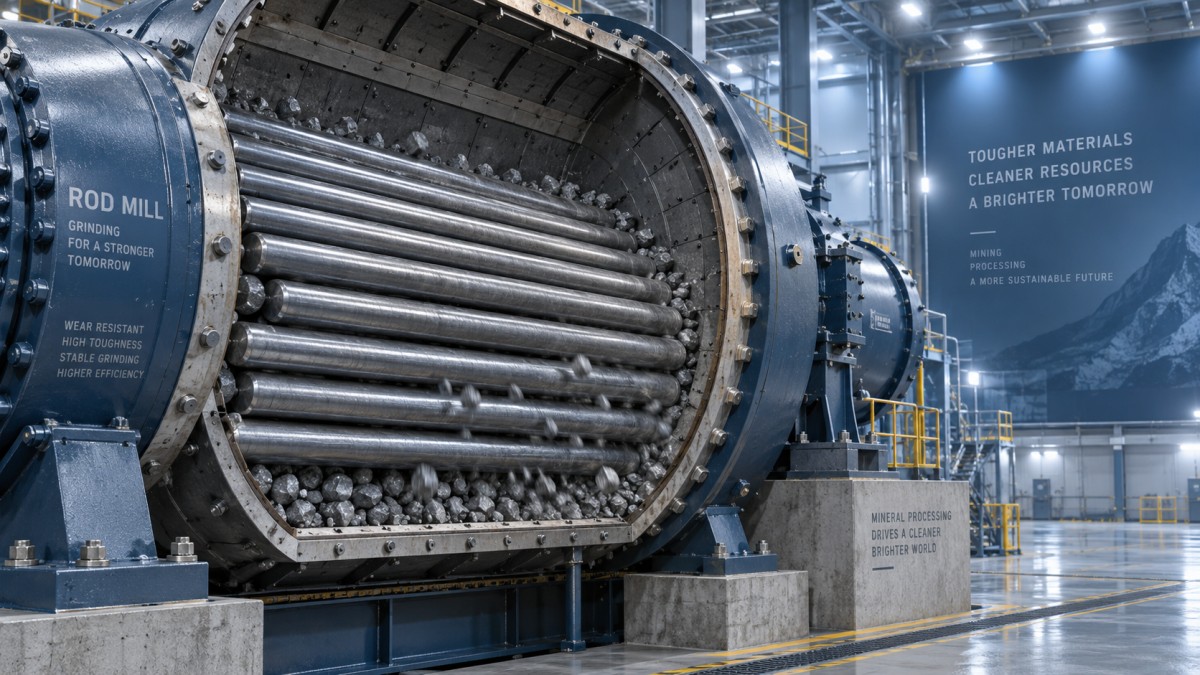
Rod mills operate differently from ball mills. Their grinding action depends on long rods lying substantially parallel to the mill axis. As the mill rotates, the charge cascades and produces line contact with the feed. This action is effective for producing controlled coarse-to-medium grinding products, but it also makes the mill sensitive to rod geometry.
Tangling occurs when the parallel arrangement is disrupted. Bent rods, unevenly worn rods, rods with excessive length variation, and a high proportion of broken pieces all interfere with normal charge movement. Once short sections accumulate, they can wedge between longer rods and create local entanglement. Operators may see fluctuating motor load, reduced throughput, abnormal noise, or a mill that appears to be grinding inefficiently despite an adequate media charge.
Material quality matters, but it should not be isolated from operating practice. Even well-manufactured Grinding Rods can tangle if the mill is overfilled, if the feed contains unexpectedly large competent particles, or if the charge contains too many worn-down or broken remnants. A proper investigation should therefore distinguish between a rod defect and a mill-condition issue.
Length and straightness deserve the same attention as chemistry
For rod mill service, length is not merely a purchasing specification. Rods should be selected to suit the effective grinding length of the mill, with an allowance appropriate to the mill’s liner arrangement and charging practice. Rods that are too long can bind at the ends, while rods that are too short may lose their ability to align with the main charge. Mixing rods from different length lots without control can accelerate charge disorder.
Straightness is equally critical. A small permanent bend can become more significant after repeated impact and abrasion in service. Rods with inconsistent residual stress or inadequate heat-treatment control are more likely to distort as they wear. The effect is cumulative: one bent rod can obstruct movement, while several bent rods can initiate a tangled mass that is difficult to correct without stopping the mill.
Before accepting a delivery, maintenance teams should verify more than nominal diameter and length. Practical incoming checks include:
- visual inspection for bends, surface seams, laps, deep scale pits, and end defects;
- random straightness checks on a flat support or suitable inspection fixture;
- verification that actual length variation remains within the agreed purchase tolerance;
- confirmation that rods are clearly traceable to a production batch and heat-treatment lot;
- review of mill-specific diameter and length requirements before mixed stock is charged.
Surface discontinuities deserve attention because they can become crack initiation sites under cyclic loading. A rod may look acceptable at delivery yet fail prematurely if a seam, transverse mark, or decarburized surface zone was not controlled during manufacture.
Choose toughness for impact resistance, not hardness alone
A frequent mistake is specifying the highest possible hardness in pursuit of lower wear. Wear resistance is important, but rod mills impose repeated bending and impact stresses that differ from the mainly compressive environment experienced by spherical media. If the rod is excessively hard and lacks adequate core toughness, it may resist abrasion initially but become vulnerable to brittle fracture.
The desired property balance depends on ore characteristics, feed size, mill diameter, rotational speed, and slurry conditions. Coarse, hard, or competent feed can create high-impact loading, placing greater emphasis on fracture resistance. Abrasive feed with relatively moderate impact may justify stronger focus on wear life, provided the selected rod still retains sufficient toughness.
Instead of accepting a single surface-hardness figure as proof of suitability, request evidence of the full manufacturing control system: steel chemistry, rolling quality, heat-treatment method, hardness uniformity, and mechanical-property verification where specified. The useful question is not “How hard is the rod?” but “Will its hardness and microstructure remain sufficiently uniform from surface to core and from one production lot to the next?”
In rod milling, inconsistent rods can be more damaging than moderately lower-rated but uniform rods. A mixed charge containing products with significantly different wear rates or fracture behavior loses its orderly geometry earlier. Stable performance is generally more valuable than an isolated peak specification that cannot be maintained across deliveries.
Diameter selection affects both grinding and breakage risk
Diameter determines the mass of each rod, contact pressure, charge voidage, and resistance to bending. A larger diameter rod has greater stiffness and can better tolerate severe impact, but it also changes the grinding environment and may reduce the number of contact points within the charge. A smaller diameter can increase surface area and may suit finer feed conditions, yet it is more susceptible to bending and rapid consumption when impact loading is high.
The original mill design and operating history should be the starting point. If the mill has run stably on a defined diameter range, a change in rod size should be treated as an operating modification, not a routine substitution. Diameter changes may require reassessment of feed preparation, charge mass, makeup practice, classification performance, and mill power behavior.
Mixing too broad a diameter range can also create uneven wear patterns. Some variation is part of normal operation, particularly as rods wear down, but introducing widely different diameters at charging can reduce orderly packing. The risk rises when new rods are added without removing a significant quantity of undersized remnants.
Breakage patterns reveal what should be corrected
The location and appearance of a fracture can help identify whether replacement material alone is likely to solve the problem. Clean, relatively flat fracture surfaces may indicate brittle failure or a material discontinuity. A fracture preceded by obvious bending may point to overload, excessive feed size, poor charge management, or inadequate rod stiffness for the service condition. Repeated breaks near rod ends can suggest handling damage, end-quality issues, or localized impact conditions inside the mill.
Broken pieces should not be treated as ordinary scrap without examination. Record the rod diameter, approximate remaining length, operating hours if available, charging batch, break location, and visible surface condition. Photographs and retained samples allow meaningful discussion with the supplier and prevent recurring failures from being dismissed as random events.
It is also important to separate normal wear from abnormal loss. A rod that wears gradually and retains a straight form until replacement is generally behaving as intended. A rod that develops bends, hooks, severe diameter steps, or early fractures is creating a charge-control risk even if its average wear rate appears acceptable.
Mill conditions can defeat an otherwise suitable rod
When tangling is recurrent, inspect the operating environment before changing material grade. Check liner condition, lifter profile, mill speed, feed-size distribution, pulp density, and charge volume. Worn liners can alter charge trajectory. A feed surge containing oversize particles can impose impact loads beyond normal design conditions. Excessively low slurry density may increase metal-to-metal impact, while unsuitable charge volume can reduce the controlled cascading action required for effective rod milling.
Charging practice is another common source of instability. Adding a large quantity of new rods into a charge already containing many short, bent, or broken pieces can worsen tangling rather than restore performance. Planned removal of abnormal remnants, followed by controlled addition of rods with consistent diameter and length, is more likely to re-establish a stable charge.
Media intended for ball mills should not be assumed to be interchangeable with rods. For example, Casting balls are designed for different grinding-media duties and contact conditions. Their availability in mining and other comminution applications does not make them a remedy for rod charge entanglement; the mill’s grinding mechanism must determine the media form.
Specify what must be controlled, then monitor what happens in service
A purchase specification for rod-mill media should clearly define diameter, length, straightness tolerance, steel grade or approved chemistry range, heat-treatment expectations, surface quality, identification requirements, and acceptance procedures. If the operation has experienced breakage, the specification should also state the need for batch traceability and a process for reviewing abnormal failures.
After installation, track practical indicators rather than relying only on tonnes consumed: frequency of rod-mill inspections, quantity of broken pieces removed, tendency toward tangling, mill power stability, product-size consistency, and makeup intervals. These observations connect media selection to actual mill behavior.
The best grinding rod is therefore not simply the one with the longest claimed life. It is the rod that preserves a straight, mobile, and predictable charge under the mill’s real operating conditions. When geometry, toughness, wear behavior, and charging discipline are aligned, tangling and premature breakage become manageable maintenance issues rather than recurring causes of unplanned downtime.
Get real-time quotes
Interested? Leave your contact details.