
How Round Grinding Steel Rod Quality Influences Rod Mill Product Size
How Round Grinding Steel Rod Quality Influences Rod Mill Product Size
Rod mill performance starts with the quality of every round grinding steel rod. In a rod mill, the media does more than reduce ore size: its movement creates a preferential grinding action that is often selected when a controlled, relatively narrow product-size distribution is required. When rod quality varies, that grinding environment changes inside the shell. The result may be more oversize material, unstable circulating load, excessive fines, higher media consumption, or a product that shifts from one operating period to the next.
For mill operators, this relationship matters because product size is rarely controlled by feed rate and water addition alone. Feed mineralogy, mill speed, pulp density, and classification all matter, but the rods determine how energy is transferred to the particles. A rod that remains straight, wears evenly, and resists breakage maintains the intended media charge. A rod that bends, fractures, or develops irregular wear can disrupt it quickly.
Why rod condition changes the grinding mechanism
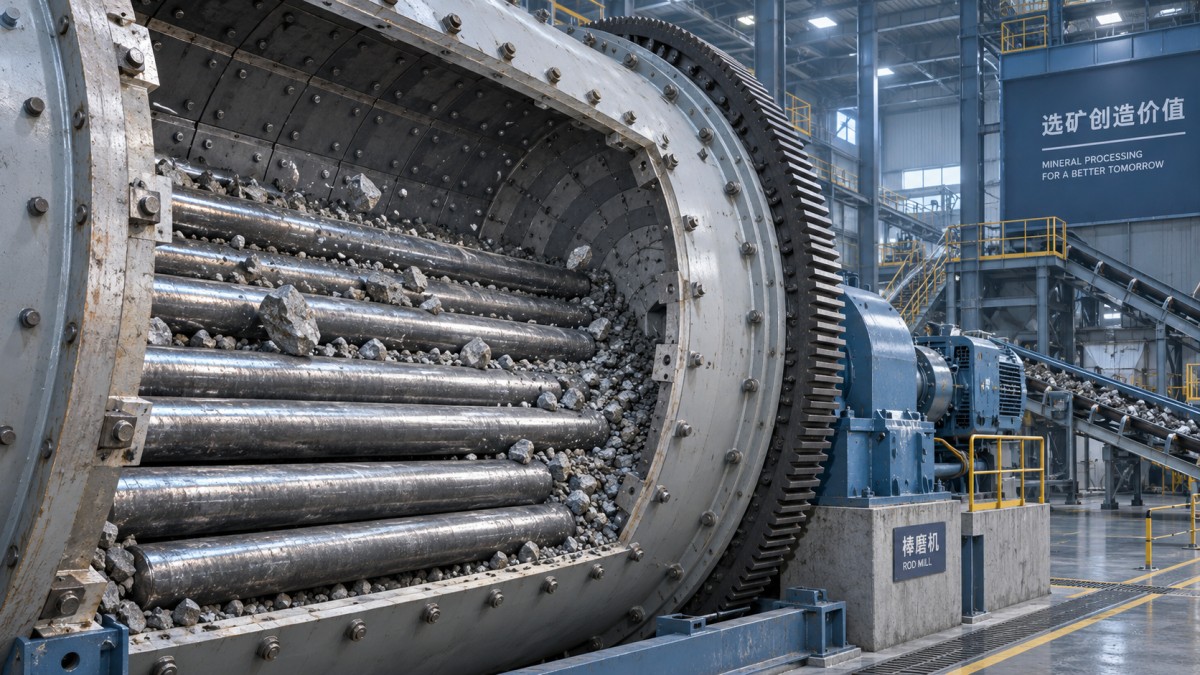
Unlike a ball charge, rods operate as an interconnected mass. Their line contact and cascading motion help grind coarse particles while limiting some of the random point-impact behavior associated with balls. This is one reason rod mills are used ahead of downstream grinding or concentration stages in mineral extraction, including certain gold mining circuits. The mechanism depends on rods rolling and settling in a reasonably orderly manner.
Straightness is therefore not a cosmetic requirement. Bent rods can cross and tangle, sometimes called rod entanglement. Once this happens, the charge no longer moves uniformly. Localized impacts increase, slurry flow can become less predictable, and coarse particles may escape the expected grinding path. Operators may see a wider size distribution even though the mill motor load appears normal. Replacing only the visibly damaged rods may help, but the root cause can be a mismatch between rod metallurgy, heat treatment, diameter selection, and mill duty.
Rod breakage creates a related problem. Short pieces behave differently from full-length rods and can concentrate in parts of the charge. They may produce more fines than intended while reducing the effective coarse-grinding action needed for the largest feed particles. In a circuit with a tight downstream screen or hydrocyclone target, that change can become visible as rising oversize or an unstable classifier feed.
Hardness must be consistent, not simply high
A common purchasing mistake is to treat the highest surface hardness as the universal answer. Hardness supports wear resistance, but product-size control depends on the balance between hardness and impact toughness. A very hard rod with insufficient toughness may be more vulnerable to cracking under repeated impacts, especially with competent ore, coarse feed, or frequent operating disturbances. Conversely, a rod that is too soft can wear down rapidly, reducing its diameter and altering the grinding charge before the mill schedule anticipates it.
Consistency along the rod and from heat to heat is just as important. If rods in the same charge have widely different hardness or microstructural response, their wear rates diverge. Larger rods remain active while undersized rods lose their ability to break the coarsest particles. The nominal charge may still look adequate by weight, yet its size profile no longer matches the feed. That is when operators may compensate by increasing throughput restraint or adding media more frequently, neither of which necessarily addresses the underlying issue.
For this reason, material choice should follow the ore and operating regime rather than a generic grade preference. B2, B3, 65Mn, 60Mn, C1090, 40Cr, and 42CrMo are among the steel options used for grinding media, but their suitability depends on the required balance of hardness, toughness, wear behavior, and manufacturing control. Test records should be read alongside the mill’s actual breakage history, feed size, and target grind.
Diameter accuracy and wear profile affect the final size curve
Rod diameter is a working parameter, not merely a catalogue dimension. Larger diameters generally bring more force to coarse-particle breakage; smaller diameters provide more contact opportunities and can support finer grinding. A mixed charge is normally managed to preserve the intended balance. If incoming diameter varies beyond the agreed tolerance, the effective charge distribution changes from the day of loading.
This is particularly important when the circuit has a narrow product specification. A charge containing too many undersized rods may generate extra fines without adequately reducing the top size. Too many large rods can leave the product coarser than target and increase the burden on downstream equipment. Diameter tolerances should therefore be stated on the purchase specification for each rod size, rather than accepted as a general statement. Available tolerances may differ by diameter and manufacturing route; they need to be confirmed against the mill design and operating objective.
The same principle applies to wear shape. Even, gradual wear is preferable because it allows predictable media addition and helps the charge retain its grinding character. Deep surface defects, localized soft zones, or irregular end damage can accelerate uneven loss. Operators should not rely only on total rod consumption in tonnes. Measuring discarded rod lengths, checking residual diameters, and recording the share of bent or broken pieces gives a more useful view of how the charge is affecting product size.
What to inspect before rods enter the mill
A practical incoming inspection does not need to become a laboratory project, but it should cover the factors most likely to disturb operation. Confirm the steel grade and heat-treatment records required by the purchase order, then take representative checks of diameter, length, straightness, surface condition, and hardness. Visual inspection is useful for identifying obvious bends, laps, cracks, heavy decarburization signs, or damaged ends. Where breakage risk is a concern, impact-toughness requirements and testing methods should be agreed before supply.
It is also worth separating transport damage from manufacturing defects. Poor packing, repeated handling, and unsupported long rods can introduce bends before charging. A sound quality program includes traceability through production and delivery, but site storage practices still matter. Keep rod bundles supported, avoid dropping them from height, and prevent long periods of exposure to conditions that promote heavy corrosion.
Shandong Jinchi New Material Technology Co., Ltd. develops and manufactures grinding media, including rods, balls, and cylpebs, while providing mining-industry technical support. Its rod range covers diameters from 20 mm to 150 mm and multiple material options. For an operator, the useful starting point is not the widest available range but matching the selected diameter, hardness level, tolerance, and toughness requirement to the established mill charge plan. Details for a Grinding steel rod can be reviewed in that context rather than as a stand-alone material selection.
Use product-size trends to diagnose media problems
When product size begins to drift, rod quality should be investigated alongside process variables. Start with the time sequence. Did the shift begin after a new media delivery, a change in make-up size, or a period of abnormal feed hardness? Compare screen or particle-size results with media consumption, mill sound, power draw, and observations made during planned inspections. No single signal proves that rods are responsible, but several changes appearing together can point to a charge problem.
- More oversize with normal feed conditions may indicate inadequate effective rod diameter, bent rods, or charge tangling.
- A sudden increase in fines can accompany excessive short pieces or irregular breakage within the charge.
- Rising media addition without a clear ore change often justifies checking hardness consistency and wear profile.
- Repeated broken rods require review of toughness, surface quality, loading practice, and mill operating conditions together.
The most reliable approach is to define acceptance criteria before delivery and then connect those criteria to routine mill observations. Specify what must be measured, how samples are taken, which tolerances are acceptable, and what documentation is required. Quality systems such as ISO 9001 can support process control, while ISO 14001, ISO 45001, and SGS-related documentation may be relevant to supplier qualification where required; they do not replace verification of the physical properties that govern grinding performance.
A well-chosen round grinding steel rod helps keep the rod charge stable, which makes product size easier to control. Before changing mill speed, water, or feed rate to correct a sizing problem, inspect the media condition and compare it with the original charge design. In many cases, that is where a controllable source of variation first becomes visible.
Get real-time quotes
Interested? Leave your contact details.