
news
Forged Steel Ball Hardness
Forged Steel Ball Hardness: What Mining Operations Should Really Evaluate
Forged Steel Ball Hardness is a critical factor in grinding efficiency, wear resistance, and operating cost control across mining and mineral processing applications. High-quality forged grinding balls must deliver a balanced combination of surface hardness, core toughness, and impact resistance to perform reliably in demanding mills. Shandong Jinchi New Material Technology Co., Ltd. develops and supplies advanced grinding media and technical support to help mining operations improve milling performance, extend service life, and achieve more consistent results.
For mill operators, however, hardness is rarely a simple pass-or-fail number. A ball with a high surface HRC value can still be a poor choice if its hardness drops too quickly below the surface, if its core cannot tolerate repeated impact, or if its chemistry and heat treatment do not suit the ore, mill design, and operating conditions. The practical question is not “Which ball is the hardest?” but “Which hardness profile will remain stable while delivering the required grinding action?”
This distinction matters because grinding media is consumed continuously. Small differences in breakage rate, diameter retention, or wear pattern can affect charge behavior, product size distribution, liner wear, and the frequency of media addition. In abrasive copper, gold, iron ore, and polymetallic circuits, media selection should therefore be treated as part of process control rather than as a routine purchasing item.
Hardness Is a Profile, Not Just a Surface Reading
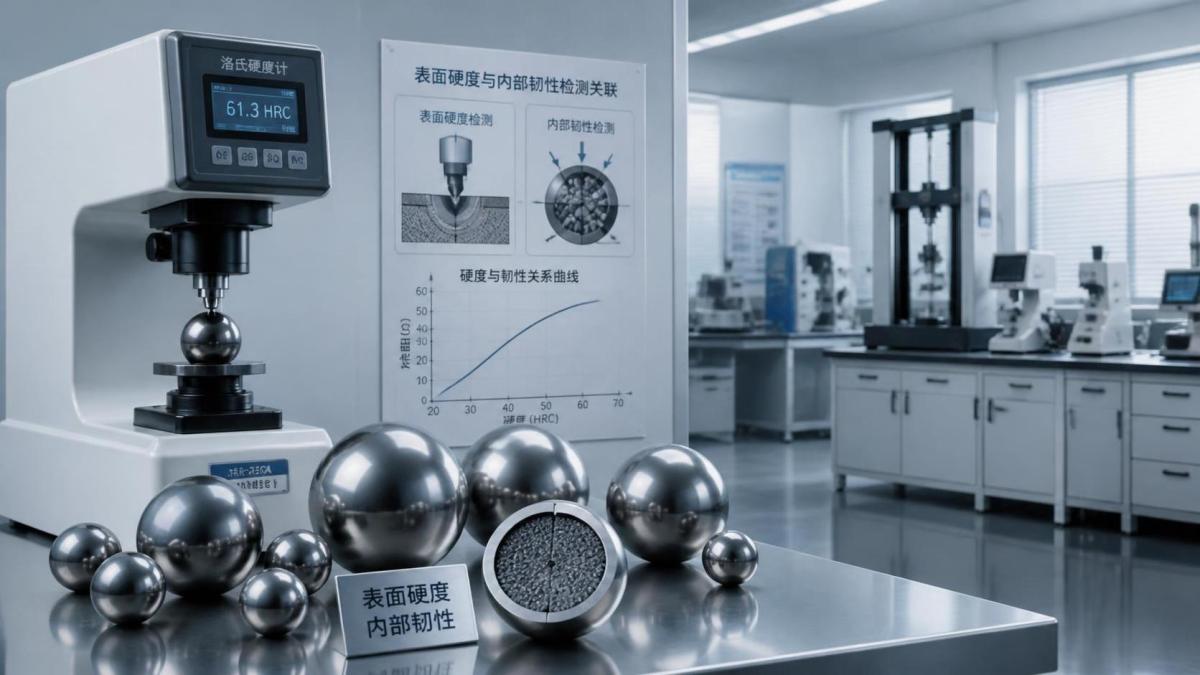
Hardness is commonly expressed in HRC for forged steel balls, but the surface measurement alone tells only part of the story. Surface hardness is relevant because it resists abrasive wear from ore particles, slurry, and liner contact. Yet grinding balls are also subjected to repeated impacts from cascading charge motion and direct ball-to-ball collisions. A very hard outer layer supported by an insufficiently tough core may be vulnerable to cracking, spalling, or catastrophic fracture.
A sound evaluation looks at three connected properties:
- Surface hardness: the first defense against abrasive loss and rapid diameter reduction.
- Through-hardness or hardness gradient: the degree to which useful hardness is maintained from the surface toward the center.
- Impact toughness: the material’s ability to absorb repeated energy without brittle failure.
The required balance changes with the application. A large-diameter ball in a primary or semi-autogenous grinding environment may face high-impact conditions and needs dependable internal toughness. Smaller media in a fine-grinding stage may place greater emphasis on wear resistance and maintaining an effective size distribution. Ore competency, feed size, mill speed, volumetric filling, slurry density, and liner configuration all change the loading environment.
That is why identical nominal hardness claims should not automatically be considered equivalent. Two products may show similar readings at the surface while performing differently because of steel cleanliness, alloy design, forging reduction, quenching practice, tempering control, or variation in the cooling path through the ball section.
Why Forging and Heat Treatment Affect Mill Performance
Forging does more than shape the ball. Done properly, it helps refine the internal structure of the steel and reduces the risk associated with defects that can become crack initiation points under impact. The subsequent heat treatment determines whether the material achieves a usable combination of hardness and toughness. The process must be controlled with the actual ball diameter in mind: a heat-treatment cycle suitable for a smaller ball will not necessarily create the same core condition in a much larger one.
The usual trade-off is straightforward, although its execution is not. Increasing hardness can improve resistance to abrasive wear, but excessive hardness or an unsuitable microstructure can reduce tolerance to shock loading. Tempering is therefore not a secondary step. It is part of the engineering balance that prevents a high-hardness ball from becoming unnecessarily brittle.
Raw-material consistency also deserves attention. Steel chemistry influences hardenability, toughness, and the response to quenching and tempering. Grades such as B2, B3, 65Mn, 60Mn, C1090, 40Cr, and 42CrMo are not interchangeable labels. Their suitability depends on the intended size, operating environment, and performance target. A supplier should be able to discuss why a particular material route is proposed rather than simply offering the highest advertised HRC value.
The Risks of Choosing by Hardness Alone
The most common purchasing error is to compare grinding balls solely by unit price and surface hardness. That approach can overlook the losses created by premature breakage, irregular wear, excessive fines in the mill charge, or frequent additions needed to restore the intended ball-size mix. A lower-cost ball that loses diameter rapidly may not maintain the impact energy needed for coarse breakage. Conversely, a ball designed for high abrasion may not be the right option where impact dominates.
Several warning signs merit investigation before a full-scale order:
- A hardness value is provided without identifying the test method, sampling location, or acceptable variation.
- The supplier cannot explain how hardness is controlled across different diameters.
- Breakage performance is discussed only in general terms, with no attention to impact toughness or defect control.
- Ball dimensions and tolerances are treated as unimportant, even though charge behavior depends on size consistency.
- A proposed grade is selected without asking about ore abrasiveness, mill type, feed size, or operating history.
These are not reasons to reject a product automatically. They are reasons to ask better technical questions. Grinding-media performance is application-specific, and a responsible comparison should include delivered quality, inspection records, physical integrity, and observed wear behavior in the relevant circuit.
Reading the Numbers in a Useful Way
For buyers reviewing forged ball specifications, three numerical areas are particularly useful: diameter range, hardness requirement, and impact toughness requirement. Diameter determines the energy available for particle breakage and influences the media charge distribution. Hardness provides an indication of wear resistance, while impact toughness helps indicate resistance to cracking under repeated loading.
Specifications from Shandong Jinchi cover grinding media in multiple material options and sizes, with diameter ranges extending from 20 mm to 150 mm. Depending on grade and application requirements, stated surface hardness levels may be above 55 HRC, 58 HRC, or 60 HRC, while impact toughness requirements can also be specified. Those figures should be interpreted alongside the selected material and ball size rather than lifted out as universal performance rankings.
Ball Size, Media Mix, and the Changing Role of Hardness
A mill does not work with one ball in isolation. It works with a dynamic mix of sizes that changes as media wears. Larger balls provide greater impact energy and are generally needed where feed particles are coarser or ore is more competent. Smaller balls create more contact points and can be more effective for fine grinding once particles are already reduced. If balls wear unevenly or fracture, the charge may drift away from the intended distribution.
This is where forged steel ball hardness becomes a process issue. Consistent wear allows the media mix to evolve in a more predictable manner. Inconsistent wear can produce an excess of undersized media, alter grinding kinetics, and complicate replenishment planning. The best approach is to define the required ball sizes together with expected feed characteristics, target grind, mill type, and the established charging strategy.
The same principle applies when rod mills are part of the circuit. Rod media must retain straightness and resist breakage while providing the line-contact grinding action associated with rod milling. Operations using both balls and rods should avoid treating them as unrelated consumables; the upstream rod-mill product can materially affect the duty imposed on downstream ball milling. For applications requiring rod media in grades such as B2, B3, 65Mn, 60Mn, or C1090, the available Grinding steel rod range covers diameters from 20 mm to 150 mm and is relevant to mineral extraction, gold operations, cement processing, coal grinding, and related industrial duties.
How to Build a More Reliable Qualification Process
A practical qualification process begins with operational information, not a generic request for “high-chrome” or “high-hardness” media. Share the mill type, nominal diameter, feed size, ore characteristics where known, current media grade, consumption history, and the problem being addressed. Is the priority abrasive wear, unexpected breakage, poor grinding efficiency, or an unstable size distribution? Each problem points toward a different technical discussion.
Before comparing trial results, agree on how performance will be observed. Media consumption per tonne of ore processed is often useful, but it should be viewed with operating context. Changes in ore hardness, throughput, grind target, mill speed, liner condition, or water addition can distort a simple comparison. Inspection of worn balls, retained size distribution, evidence of spalling, and breakage observations can reveal more than a single consumption figure.
Documentation matters as well. Buyers with defined quality, environmental, and occupational safety requirements may need to verify the supplier’s management systems and test capability. Shandong Jinchi states certification to ISO9001, ISO14001, and ISO45001 management systems and reports SGS testing. For a project with formal documentation requirements, the relevant certificates, test reports, acceptance criteria, and scope should be confirmed directly for the specific order.
A Better Definition of Value in Grinding Media
The value of a forged steel ball is not captured by hardness alone, nor by price per tonne alone. It lies in whether the ball maintains enough wear resistance to preserve size, enough toughness to survive impact, and enough production consistency to support stable mill operation. That balance depends on metallurgy, forging, heat treatment, dimensional control, and—just as importantly—the fit between the media and the duty.
Shandong Jinchi New Material Technology Co., Ltd. combines grinding-media manufacturing with technical support for mining applications, covering forged balls, rods, cylpebs, and related grinding solutions. When evaluating a supply option, it is sensible to request a discussion that starts with the circuit conditions and required performance criteria. Confirm the proposed steel grade, hardness target, toughness expectation, ball-size range, inspection basis, packaging, delivery needs, and any project-specific documentation before treating a nominal HRC number as the final decision.
Get real-time quotes
Interested? Leave your contact details.