
news
Forged Steel Ball Materials
Material choice sets the limit on forged ball performance
In a grinding circuit, a forged steel ball is expected to do two jobs at once: transfer impact energy to break ore and resist gradual loss of mass during repeated contact with ore, slurry, liners, and other balls. Material selection determines how well those jobs can coexist. A ball that is very hard but lacks toughness may chip, spall, or break. A ball with good toughness but insufficient hardenability may wear too quickly, especially as diameter increases.
For mining operators, the useful question is rarely, “Which forged steel ball material is best?” The better question is: which material and heat-treatment combination can hold an acceptable wear rate without creating premature breakage risk in this specific mill, ore type, and ball-size range? The answer changes with grinding stage, mill speed, feed size, slurry conditions, and the abrasiveness and impact characteristics of the ore.
Material names such as B2, B3, B4, B6, 40Cr, 42CrMo, 65Mn, and 60Mn can be helpful starting points, but they are not complete performance specifications. Their practical value depends on verified chemistry, billet cleanliness, forging quality, ball diameter, quenching method, and the resulting hardness profile from surface to core.
Why chemistry alone does not predict service life
Forged steel balls are commonly made from medium- or high-carbon alloy steels. Carbon is central to achievable hardness after heat treatment. In broad terms, increasing carbon makes it possible to form a harder martensitic structure, which can improve abrasive wear resistance. It also narrows the margin for error: excessive hardness, poor temperature control, or inadequate tempering can leave the ball more vulnerable to cracking or spalling under impact.
Chromium is often used to improve hardenability and wear resistance. This matters particularly for larger balls, where a hard surface alone is not enough. If the core remains comparatively soft, the surface can deform or crack as the ball repeatedly takes high-impact loads. Materials with chromium additions are therefore often considered where larger diameters, coarse feed, or high-impact milling conditions require a more consistent through-section structure.
Manganese contributes to hardenability and strength, while silicon can support strength and deoxidation behavior. Molybdenum, found in alloy grades such as 42CrMo, can improve hardenability and tempering resistance. These additions should not be read as an automatic ranking of materials. A more heavily alloyed grade may offer a wider heat-treatment window, but its value must be measured against actual operating conditions and the cost of media consumption, not against a material label alone.
Phosphorus and sulfur deserve attention even though they are not selling points. Controlled low levels help reduce concerns associated with embrittlement and inclusions. In a grinding ball, non-metallic inclusions, segregation, decarburization, or internal defects can become initiation points for cracks. A chemical certificate is useful, but it should be matched with process controls and finished-ball inspection rather than treated as final proof of suitability.
Hardness is necessary, but a hardness number is not enough
Buyers often start with surface hardness because it is simple to specify and compare. It is a meaningful indicator, especially where abrasive wear dominates. Yet surface hardness alone does not reveal whether the ball has a sound microstructure, sufficient core hardness, or enough impact toughness for the mill environment.
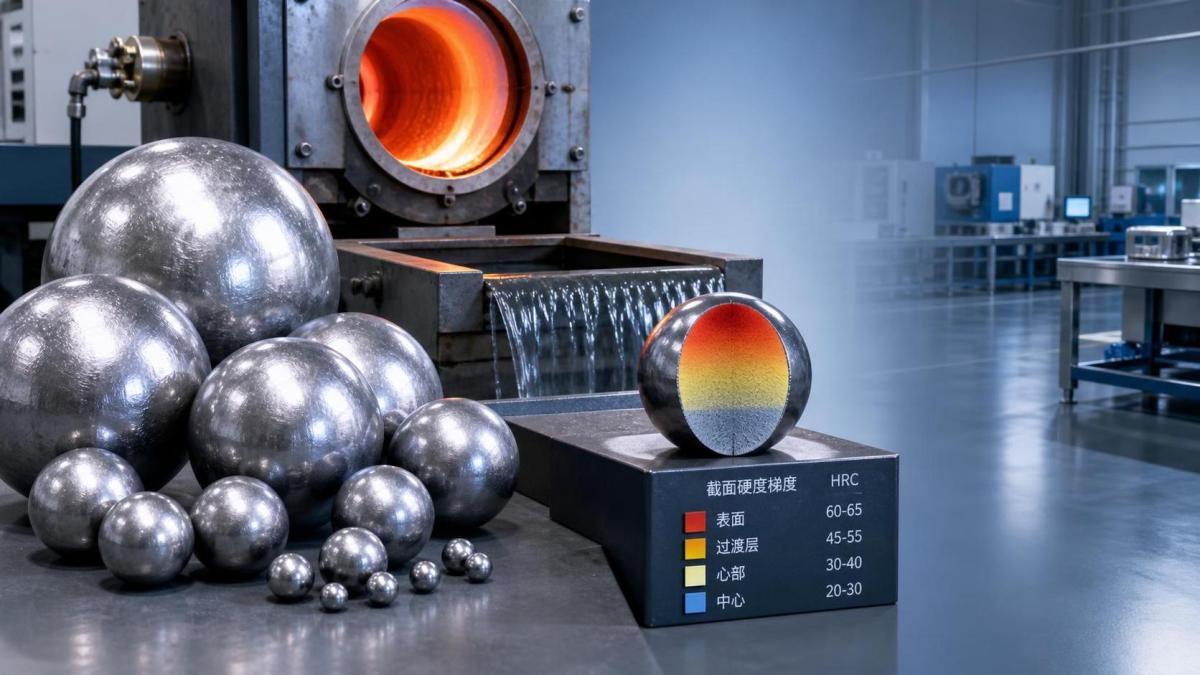
A smaller forged ball can be quenched more uniformly than a large one. As diameter rises, cooling rates at the center fall. The material must therefore have enough hardenability, and the heat-treatment process must be designed for the diameter range. A specification showing high surface hardness for a 20 mm ball does not establish the same result for a 100 mm or 150 mm ball.
For a hot-rolled range covering approximately 20 mm to 150 mm, it is reasonable to expect target hardness to vary by size. Higher values are more attainable in smaller diameters, while larger balls may use a lower surface-hardness threshold to preserve toughness and avoid an overly brittle structure. The correct question for a supplier is not simply “What is the HRC?” It is “What hardness range and hardness depth are achieved for this ball diameter and grade, and how is that result controlled?”
- Ask for surface hardness requirements by diameter, not one value applied to every ball size.
- Request the intended core-hardness or hardness-gradient standard for larger balls.
- Confirm the impact-toughness requirement and test method where the mill has high impact loading.
- Clarify whether tests are conducted by production lot and whether traceability reaches the raw-material heat and heat-treatment batch.
A ball can satisfy a surface hardness requirement and still underperform if its core structure is weak or inconsistent. Conversely, selecting the maximum possible hardness can be counterproductive in a primary grinding stage where impact damage is more costly than moderate wear.
Match the material to the grinding duty
The first distinction is between impact-dominant and abrasion-dominant service. Primary mills processing coarse ore generally subject larger balls to more severe impact. Here, a material must retain enough toughness to resist fracture and spalling. High carbon alone is not a complete answer; alloy design and a controlled quench-and-temper route are usually more important than chasing the highest surface hardness.
In secondary grinding, where particle size is smaller and abrasion becomes more prominent, higher hardness can carry more weight in material selection. This does not remove the need for toughness. Mills can still generate ball-to-ball impacts, and ore hardness is rarely uniform. It does, however, change the balance: a more wear-resistant grade may offer better media retention if it remains structurally sound through its service cycle.
Ore mineralogy is equally important. Hard, abrasive ores can accelerate mass loss even in a well-treated alloy ball. Corrosive slurry environments add another variable because electrochemical wear may interact with mechanical wear. A material selected only from nominal ore hardness may miss this interaction. Operators should review ball consumption alongside slurry chemistry, pH control, water quality, and the presence of corrosive minerals before assigning the problem entirely to the ball grade.
Ball diameter must be included in the selection discussion. Large balls are chosen for impact energy and coarse-particle breakage; their material needs adequate hardenability and internal integrity. Smaller balls have greater total surface area per tonne and are often used where finer grinding requires more contact points. Their selection should consider wear rate, size distribution, and whether the balls retain useful geometry long enough to support the desired grinding action.
Grades in the B2/B3 family, chromium-bearing alloy steels, manganese steels such as 65Mn or 60Mn, and engineering grades such as 40Cr or 42CrMo may all be considered in forged grinding media depending on the duty. The grade designation is only the first filter. Two balls carrying the same nominal designation can perform differently when their chemistry ranges, rolling or forging conditions, quenching practice, and tempering controls differ.
What to examine beyond the grade name
The ball-making route has a direct effect on whether the selected material delivers its theoretical properties. During hot rolling or forging, deformation should compact the steel structure and form the ball without folds, excessive decarburization, or surface defects. Heat treatment then determines whether the ball develops the intended balance of hardness and toughness. Both stages must be controlled as one system.
For procurement, this changes the evaluation from “Which alloy is used?” to “Can the manufacturer repeatedly convert that alloy into a stable grinding ball?” A credible review looks at the production process, inspection plan, and lot consistency alongside the stated chemical composition.
- Raw-material control: Verify that billets are sourced to defined chemical requirements and linked to heat certificates. Small deviations in carbon, chromium, or manganese can alter heat-treatment response.
- Size-specific heat treatment: Confirm that 25 mm, 60 mm, and 125 mm balls are not assumed to follow one identical quench practice. Larger sections require their own process validation.
- Surface condition: Look for cracking, laps, seams, abnormal pits, or signs of severe decarburization. Surface discontinuities can grow under cyclic mill loading.
- Breakage monitoring: Define what counts as unacceptable breakage, including complete fracture, spalling, and severe cracking. A low wear rate is not a success if broken media disrupts operation.
- Dimensional consistency: Diameter tolerance affects charge behavior and can influence the stability of a designed ball-size distribution, particularly when media is replenished regularly.
Documented management-system certifications can indicate that a supplier has established quality, environmental, or occupational safety controls, but they should not replace product-level verification. The relevant evidence remains the ball’s chemistry, hardness distribution, impact performance, visual condition, and traceability for the delivered lot.
A practical way to compare forged steel ball materials
Comparing offers by price per tonne is common, but it can obscure the operational difference between materials. The material with the lower purchase price can become more expensive when it wears faster, breaks more often, or requires a higher make-up rate. On the other hand, a higher alloy content is not automatically economical if the mill duty does not use its additional performance margin.
A useful comparison begins with a defined operating baseline. Record the mill type, nominal and actual ball size, ore description, feed size, mill throughput, operating hours, charge level, and historical media consumption. Then compare candidate materials under the same replenishment practice. The aim is to observe consumption and failure behavior in the actual circuit, rather than infer performance from a single laboratory number.
When a controlled trial is possible, avoid changing multiple variables at the same time. Altering ball grade, ball size mix, mill speed, water addition, and feed blend together makes the result difficult to interpret. A trial should also run long enough to account for the existing charge, since new media initially operates alongside balls with different wear histories.
The relevant outcome is usually cost per tonne of ore processed or cost per unit of useful grinding work, considered together with operational stability. Mass loss, broken-ball count, mill discharge behavior, and any effect on downstream classification or recovery should be reviewed as part of the same decision. An alloy selection that reduces ball consumption but creates undesirable fragmentation may not improve total circuit performance.
Common assumptions that cause poor selections
One persistent assumption is that higher carbon always means longer life. Higher carbon can support higher hardness, but it can also increase brittleness if heat treatment is poorly matched to the grade and diameter. The better choice is the material-process combination that delivers stable wear and acceptable impact resistance in the intended mill.
Another is that a named grade guarantees a standard level of quality. Grade names describe a chemistry family or nominal composition range; they do not certify the cleanliness of the steel, the uniformity of the ball, or the discipline of the thermal cycle. Procurement specifications should define the measurable requirements that matter to the application.
A third mistake is evaluating a ball at delivery only. Incoming checks are important, especially for diameter, surface quality, hardness, documentation, and sampling. Yet the material decision should remain connected to in-mill results. A supplier can provide a technically compliant ball that is still poorly matched to a particular ore body or grinding stage.
How to frame a purchase specification
A concise but technically useful specification should identify the intended application, diameter range, candidate material family, surface-hardness target by size, impact-toughness requirement where applicable, permitted chemical range, diameter tolerance, and inspection documents required with delivery. It should also establish the sampling basis and the response expected if abnormal breakage or inconsistent hardness is found.
For buyers seeking a defined hot-rolled option across multiple sizes and material families, Hot-rolled steel balls can be assessed against those same criteria: material grade, diameter-specific hardness, toughness, dimensional tolerance, and production-lot traceability. This keeps the discussion focused on mill duty rather than on catalog terminology.
The most durable purchasing decision is rarely a universal material choice. It is a documented match between ore conditions, mill mechanics, ball diameter, metallurgy, and quality control. Once those factors are specified together, forged steel ball materials become easier to compare on their real contribution to grinding performance and operating cost.
Get real-time quotes
Interested? Leave your contact details.