
news
Forged Steel Balls for Mining
A mine considering forged steel balls is usually trying to answer a practical question: will a particular ball improve mill performance enough to justify its delivered cost? The answer depends less on the word “forged” alone than on the relationship between ore characteristics, mill conditions, ball size distribution, and the consistency of the media itself.
Forged grinding balls can be a strong choice for primary and secondary milling where impact loading is high and media breakage would disrupt the circuit. They are often selected because controlled deformation and heat treatment can produce a dense structure, good impact resistance, and a hard working surface. Those advantages matter only when the balls retain their shape, wear at a predictable rate, and match the grinding duty. A high nominal hardness is not enough if the media cracks, spalls, or creates an unsuitable size distribution before its useful grinding work is complete.
Start with the mill duty, not the ball catalogue
Grinding media selection should begin with the job inside the mill. A ball that performs well in a large SAG or ball mill processing competent ore may be a poor economic choice in a smaller regrind circuit, where abrasion and surface chemistry can matter more than repeated high-energy impacts.
For mining operations, four operating conditions shape the decision most directly:
- Ore competence and feed size: Coarse, hard feed places greater impact demand on larger media. The balls need sufficient toughness to resist breakage while transferring energy to the ore.
- Mill type and diameter: Larger mills generally generate higher impact forces. Media selected for a smaller ball mill should not automatically be carried over to a high-impact SAG or large-diameter grinding application.
- Target grind size: Coarse grinding, conventional ball milling, and fine regrinding require different media size strategies. Using oversized balls for fine work can waste energy and reduce the number of grinding contacts available.
- Slurry and mineral environment: Pulp density, water chemistry, corrosive conditions, and mineral composition can change wear behavior substantially. Abrasion, impact, corrosion, and spalling should be assessed as separate loss mechanisms.
This is why a purchase specification limited to “60 HRC forged ball” is incomplete. Surface hardness is relevant, but it does not define core hardness, impact toughness, microstructure, dimensional tolerance, or the rate at which a ball loses mass in a particular circuit. A supplier may meet the stated hardness while the mill still experiences excessive breakage or unstable consumption.
Hardness and toughness must work together
The basic trade-off in forged steel balls is familiar: harder media generally resists abrasive wear better, while tougher media is more able to survive impact. In practice, mines need both properties, with the balance determined by operating duty.
A ball with an overly hard but brittle structure can fracture under repeated impacts. Breakage produces several problems at once: it changes the intended charge composition, can increase the amount of undersized media in the mill, complicates liner and discharge protection, and raises consumption even when the remaining fragments continue to provide some grinding action. Conversely, media designed primarily for toughness may survive well but wear too quickly in abrasive ore, increasing tonnage consumption and requiring more frequent additions.
Material chemistry and heat-treatment control determine whether this balance is repeatable. Carbon, manganese, chromium, and other alloying elements influence hardenability and wear resistance, but chemical composition should be interpreted together with the manufacturing route. A chemical analysis cannot by itself demonstrate that the ball has been heated, formed, quenched, and tempered consistently through its full cross-section.
For a high-impact mining application, ask for evidence that addresses both wear and breakage risk. This normally includes surface and core hardness data, impact toughness information where applicable, dimensional checks, and visual inspection criteria for cracking, laps, decarburization, or severe surface defects. The requested acceptance criteria should reflect the specific ball diameter. Larger balls are exposed to different internal cooling conditions than small balls, so assuming identical through-hardness performance across a wide diameter range can be risky.
Ball size is a process decision, not a procurement convenience
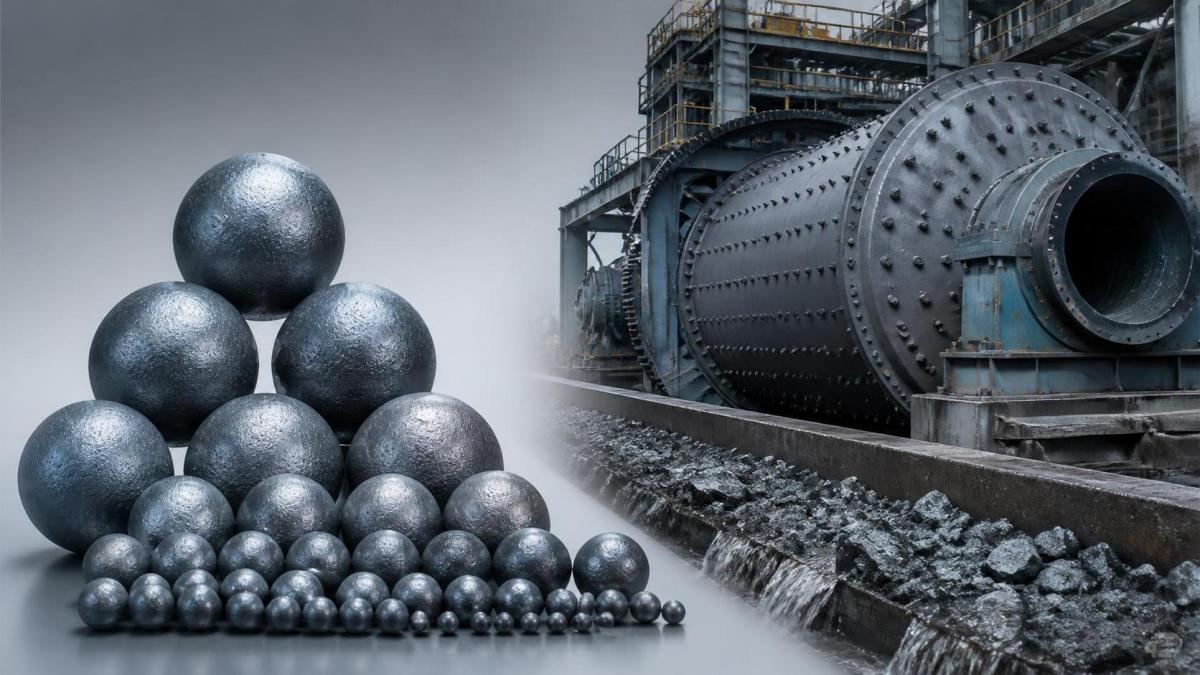
Media size is often one of the most consequential variables in grinding efficiency. Larger balls supply greater impact energy and are useful when the mill receives coarse or competent feed. Smaller balls provide more contact points per tonne of media and are generally more effective once particles are already sufficiently small. The correct charge is therefore usually a distribution, not a single diameter selected because it is readily available.
In many circuits, a change in ore hardness, feed top size, liner profile, mill speed, or classification efficiency should trigger a review of the makeup-ball strategy. Continuing to add the historical ball size after a material or operating change can gradually move the charge away from what the mill now needs.
A sensible review asks a few direct questions:
- Has the feed become coarser or more competent than the basis used for the present makeup size?
- Is the mill failing to break coarse particles, or is it generating too much coarse material because the media charge has become undersized?
- Is fine grinding being limited by insufficient media contacts, suggesting that the charge contains too much large media?
- Are worn balls being removed or retained in a way that changes the charge distribution over time?
- Does the stated nominal diameter match the actual delivered size range and sphericity needed for the mill?
Diameter availability also matters operationally. A producer capable of supplying a broad range, such as 20 mm to 150 mm, gives the operation more flexibility to align replenishment with the grinding plan. That flexibility is useful only if the supplier can maintain consistent properties at each size and keep different size grades properly segregated during production, packing, and delivery.
Why total media cost is more useful than purchase price
The lowest price per tonne can become the highest-cost choice when media consumption rises, mill throughput falls, or unplanned cleaning and sorting work increases. Grinding balls should be compared through their effect on total grinding cost, not as an isolated consumable.
A practical comparison should include delivered media price, average consumption per tonne of ore processed, breakage or rejection rate, effect on milling energy, and any production impact associated with charge stability. Mines do not always need a complex trial program to begin this assessment, but they do need a baseline. Without a reliable record of ball additions, ore tonnes, feed characteristics, product size, and operating conditions, a lower wear rate cannot be separated from unrelated process changes.
Short-term observations can also mislead. A fresh media charge may temporarily change mill behavior because the ball-size distribution has shifted, regardless of the steel grade. A meaningful comparison needs enough operating time for normal wear patterns to emerge, while keeping feed conditions and mill operating settings as comparable as possible.
For this reason, buyers should be cautious about simple claims that one forged ball “lasts twice as long” or offers a universal consumption reduction. Wear performance is application-specific. The useful supplier discussion is one that defines the ore, mill, target size, media diameter, and evaluation method before making a performance claim.
What to examine before approving a supplier
Supplier qualification for forged steel balls should focus on process control and traceability as much as quoted chemistry. Grinding media is consumed continuously, so variability between batches can create a recurring process problem that may not be visible in a single delivery inspection.
First, establish the raw material standard and the permitted chemistry range for the proposed grade. Steel supplied from controlled sources helps reduce variation at the start of production, but incoming material verification remains important. Phosphorus and sulfur limits, for example, can be relevant to cleanliness and toughness, particularly when the intended duty is impact-intensive.
Second, review how the supplier controls forming and heat treatment. Automated rolling or forging lines can support repeatability, but automation alone does not guarantee quality. The important questions concern temperature control, quench conditions, tempering practice, lot identification, and the inspection frequency used to verify output. A consistent production process should be able to connect a delivered batch with its material heat, manufacturing lot, and test records.
Third, define the inspection package before the order is placed. Depending on the application and purchase volume, it may include:
- chemical composition certificates for the steel grade;
- surface and, where required, core hardness measurements;
- diameter, roundness, and weight tolerance records;
- visual inspection standards for cracks, folds, surface defects, and abnormal oxidation;
- batch identification and traceability documents;
- independent inspection arrangements where the contract requires them.
Management-system certifications such as ISO 9001 can indicate that a supplier has documented quality processes, while environmental and occupational health and safety systems may matter for vendor qualification. They should not replace product-specific inspection. The ball delivered to the mine must still meet the technical acceptance requirements written into the purchase order.
Hot-rolled media and the limits of broad product claims
Hot-rolled grinding balls are widely used where a production route can provide efficient volume output with controlled properties. For mineral extraction, gold milling, cement grinding, power-plant coal applications, and related industrial duties, the relevant question remains the same: does the grade and diameter suit the specific milling environment?
For example, Hot-rolled steel balls are available across diameters from 20 mm to 150 mm and can be specified in grades such as B2, B3, 65Mn, 60Mn, C1090, and chromium-containing alternatives. That range can support different grinding stages, but grade names should not be treated as interchangeable performance labels. Two products described by the same grade family can still differ through raw material control, rolling quality, heat treatment, and inspection discipline.
Claims such as surface hardness above 60 HRC or stated impact toughness values are useful starting points for technical discussion. They become meaningful purchasing criteria only after the mine confirms the measurement method, sampling location, acceptable variation, and suitability for the intended ball diameter. This prevents a specification from relying on a single attractive figure while overlooking the properties that govern service behavior.
Common mistakes that increase media risk
One frequent mistake is treating all wear as an alloy problem. If balls wear faster than expected, the root cause may be grade selection, but it may also be excessive mill speed, poor classification, an unsuitable charge level, a change in ore abrasiveness, or an incorrect makeup size. Replacing the media without reviewing those conditions can leave the underlying issue untouched.
Another is judging a shipment only by appearance. A clean, round surface is desirable, but it does not reveal internal structure or confirm consistent hardness. Conversely, surface discoloration from handling or storage should be distinguished from material defects that affect performance. Inspection standards need to define what is cosmetic and what is rejectable.
Buyers also sometimes specify a broad diameter range without identifying the intended mix. This can invite substitutions that are technically within the order but operationally unhelpful. The purchase order should state the required sizes, quantity by size, permitted tolerance, packing method, lot marking, and the documentation needed at dispatch.
Delivery reliability is part of the grinding-media decision as well. A mine cannot easily compensate for a delayed ball shipment if its inventory falls below the level required to maintain the planned charge. Lead time, port access, shipment lot size, packaging strength, and the supplier’s ability to schedule repeat deliveries should be reviewed alongside mechanical properties.
Build the specification around measurable mill outcomes
A strong forged steel ball specification connects product requirements with process needs. It defines the operating duty, ball-size mix, grade or approved alternatives, mechanical and dimensional acceptance criteria, traceability requirements, and the method used to assess ongoing consumption. It also leaves room to adjust the media program when ore or circuit conditions change.
That approach produces a more useful decision than choosing the hardest ball or the cheapest tonne. For mining operations, the preferred grinding media is the one that maintains a stable charge, survives the relevant impact environment, wears predictably, and supports the target grind at an acceptable total cost.
Get real-time quotes
Interested? Leave your contact details.