
news
Forged Steel Ball Sizes
How Forged Steel Ball Size Affects Grinding Results
Forged steel ball size is not a catalog detail. It determines how much impact energy reaches the ore, how frequently particles are contacted, how the mill charge behaves, and how quickly grinding media is consumed. A larger ball can break a coarse, competent feed that smaller balls repeatedly fail to fracture. The same large ball can also leave too little contact area for efficient fine grinding. There is no universally “best” diameter; the practical choice is the size mix that matches the feed, mill, circuit target, and ore behavior.
For most milling operations, the right starting question is not “Which forged steel ball size is the hardest?” It is: “What size of particles must this mill break, and what product size must it consistently deliver?” That distinction avoids a common purchasing mistake: choosing a single large diameter for durability while sacrificing throughput or final grind control.
Ball Diameter Must Match the Largest Particles Entering the Mill
Impact breakage depends heavily on ball mass. As diameter increases, the mass of each ball rises rapidly, allowing it to deliver higher impact energy when it falls or cascades through the charge. This is why larger forged balls are commonly used where the feed contains coarse fragments, hard mineralized material, or a broad particle-size distribution.
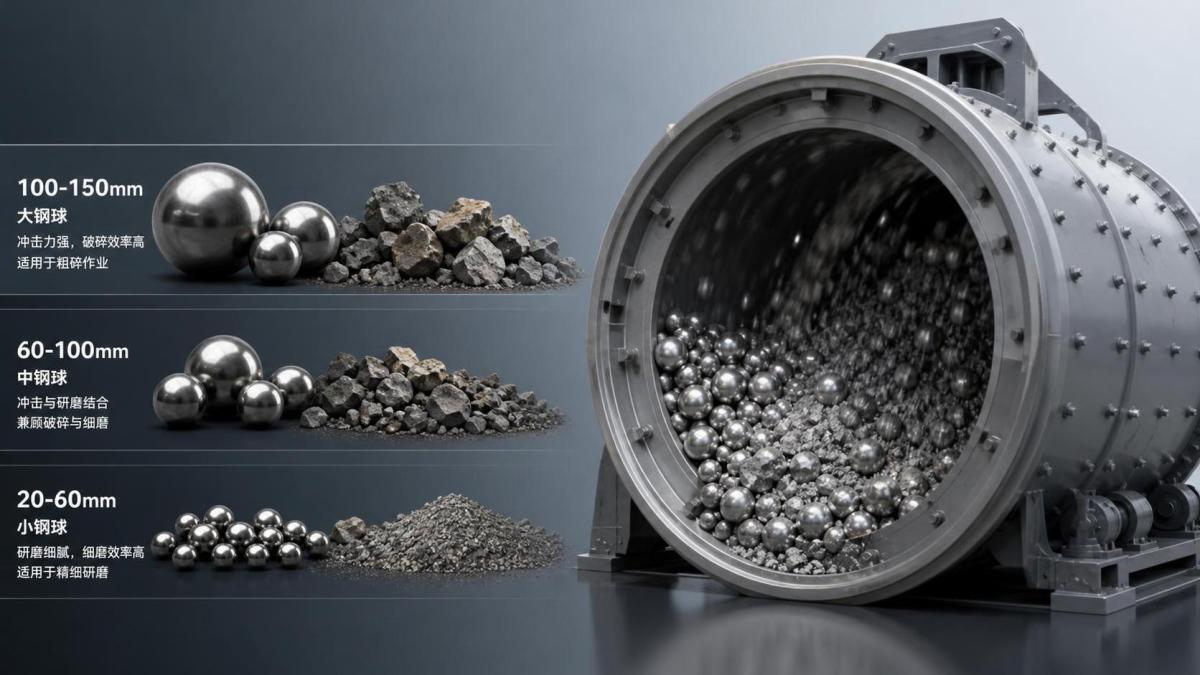
In rough terms, sizes in the 100 mm to 150 mm range are associated with duties that require stronger breakage force. They are often considered when a primary ball mill receives a relatively coarse feed or when the ore has high hardness and resists fracture. Balls from 60 mm to 100 mm often serve mixed or intermediate grinding duties. Smaller diameters, such as 20 mm to 60 mm, provide a denser population of grinding points and are generally more useful as the circuit approaches a finer product requirement.
These ranges should be treated as operating logic, not as a sizing rule that replaces mill data. Two plants handling ore with the same nominal top size may need different media because mineral texture, competency, feed moisture, mill speed, lifter condition, and slurry density can all change the breakage environment.
A ball that is too small for the feed may circulate in the mill with limited breakage effect. The mill can appear fully charged while coarse particles remain in the discharge or build up in the circulating load. A ball that is too large can create the opposite problem: adequate coarse-particle impact but inefficient treatment of fines, with excess media mass consuming energy that does not translate into useful size reduction.
Why a Mixed Ball Charge Usually Performs Better Than One Size
Grinding is not a single event. Material enters the mill at one size distribution and leaves at another, so the media charge must perform different tasks at the same time. Larger balls are responsible for opening coarse particles and creating new fracture surfaces. Medium balls continue the reduction process. Smaller balls create more contact points for fine-particle grinding.
A uniform charge may be justified for a narrow and stable feed, but it is often a poor long-term strategy for variable ore. A mill running only large forged steel balls may retain coarse-breakage capacity but lose fine-grinding efficiency. A charge made primarily of small balls may produce a fine fraction effectively but struggle when coarser feed enters the circuit.
For this reason, operators should assess the makeup schedule as well as the initial charge. The ball size distribution changes continuously as media wears. If replenishment consists of one diameter only, the working charge may gradually shift away from the distribution required by the circuit. A practical media program considers:
- the top size and size distribution of fresh feed;
- the target product size and classification cut point;
- the mill’s effective volume, power draw, speed, and liner profile;
- the proportion of coarse, intermediate, and fine material already circulating;
- the wear rate of each media size during operation; and
- whether ore characteristics are stable or change between mining zones.
The goal is not to maintain a visually even load. It is to maintain enough impact energy for the coarse fraction while preserving sufficient media surface area and contact frequency for the finer fraction.
Hardness Matters, but So Does Hardness Through the Ball
When comparing forged steel ball sizes, buyers often focus first on surface hardness. It is an important indicator, particularly in abrasive ore, but it does not describe the whole performance picture. A large-diameter ball must retain a suitable hardness profile below the surface while also resisting breakage under repeated impact. If the outer layer is hard but the internal structure lacks adequate strength or toughness, the ball may crack, spall, or fail prematurely.
This balance becomes more demanding as diameter increases. Heat treatment must be controlled so that larger balls do not develop an excessive hardness gradient from the surface to the core. Small balls are easier to heat and cool more uniformly. Large balls require a process capable of producing consistent metallurgical properties through a much greater section thickness.
For example, a supplier specification may list surface hardness above 60 HRC for forged ball sizes from 70 mm to 90 mm, above 58 HRC for 100 mm to 120 mm, and above 55 HRC for 130 mm to 150 mm. That pattern should not automatically be read as declining quality at larger diameters. It reflects the practical need to balance wear resistance with impact toughness as ball cross-section increases. A stated impact toughness requirement of at least 12 J/cm2 is also relevant because brittle media can create operational problems even when its initial hardness is high.
Hardness figures should therefore be reviewed alongside the test location, the ball diameter, and the supplier’s heat-treatment consistency. A single surface test result does not establish whether a batch will behave reliably in a high-impact mill.
Size Selection Cannot Be Separated from Steel Chemistry
The same diameter can perform differently depending on its alloy design and heat treatment. Carbon, manganese, chromium, silicon, and other controlled elements influence hardenability, wear resistance, and toughness. In practice, the question is not whether one grade name is always better than another. The relevant question is whether the chemistry and process are suitable for the operating duty and ball diameter.
Higher-carbon or chromium-bearing grinding media can support high hardness and abrasion resistance, but a grinding circuit with severe impact also needs sufficient toughness. For a large forged ball used against coarse, hard ore, a composition selected only for surface wear may increase the risk of cracking if the heat-treatment route does not maintain an appropriate internal structure. Conversely, a very tough but comparatively soft ball may survive impact yet wear too quickly, increasing consumption and changing the charge distribution faster than expected.
Grade labels such as B2, B3, B4, B6, 65Mn, 60Mn, 40Cr, and 42CrMo are useful starting points for discussion, but they are not a complete purchasing specification. Chemical ranges can overlap, and processing quality can materially affect the final result. Batch traceability, raw-material control, forging quality, heat-treatment records, and representative mechanical testing are more informative than a grade name alone.
What to Check Before Ordering a Larger or Smaller Ball
A change in forged steel ball size should be treated as an operating adjustment, not merely a procurement substitution. Before moving to larger media, confirm whether the circuit actually has a coarse-breakage problem. Signs may include persistent coarse material in the mill discharge, a rising circulating load, reduced throughput at a stable feed rate, or a product size that becomes coarser despite otherwise normal operation. Those symptoms can also result from worn liners, changed feed competency, classification issues, or unsuitable slurry conditions, so ball size should not be blamed in isolation.
Before moving to smaller media, check whether the mill is already producing enough impact for the largest feed particles. Finer media can improve the treatment of intermediate and fine fractions, but it cannot compensate for insufficient breakage force at the coarse end of the feed.
For a trial or new supply contract, purchasers should request a size-specific technical package rather than a generic media brochure. It should identify the nominal diameter and tolerance, weight range, hardness requirement, toughness requirement where applicable, chemical composition range, and the method used to verify the batch. Inspection should also include a visual review for cracks, seams, excessive decarburization, irregular shape, and abnormal surface defects.
Do Not Compare Cost Only by Price Per Tonne
Large forged steel balls typically carry a higher unit mass and may have a higher purchase price per piece, while smaller balls increase the number of pieces needed to build a charge. Neither comparison tells the full cost story. The meaningful measurement is the cost of media per tonne of ore processed or per tonne of qualified product, considered together with energy use, throughput, product size, and unplanned mill interruptions.
A lower-priced ball can be expensive if it wears rapidly, breaks, or forces frequent changes to the media charge. A premium ball can also fail to justify its cost if its hardness and size exceed what the ore and mill actually require. The most useful commercial comparison is based on a documented trial period with defined operating conditions, not on one delivery batch or a short observation window.
Where rod milling is used ahead of or alongside ball milling, the interaction between media types also deserves attention. Rod mills generate a different grinding action and are often selected for particular feed characteristics and product requirements. Specifications for Grinding steel rod should therefore be considered separately from forged ball specifications, even when both are supplied to the same concentrator. Rod diameter, straightness, wear pattern, and tangling behavior create a different set of operating concerns.
A Practical Way to Make the Decision
Start with the existing circuit data: feed top size, feed size distribution, target grind, throughput, power draw, current media consumption, and the size distribution of balls removed from the mill. Then compare that information with the condition of the liners and classification equipment. If those elements are stable, a controlled adjustment to the makeup size distribution can reveal whether the media is limiting performance.
For new installations or major ore changes, it is sensible to begin with a reasoned mixed charge rather than commit immediately to one diameter. Track product size, throughput, power, and media wear under consistent conditions. The purpose is to identify a repeatable operating range, not to prove that the largest or hardest forged steel ball is superior.
The size that works best is the one that supplies enough impact to break the coarsest material without carrying unnecessary mass through the fine-grinding portion of the duty. Once that balance is established, chemistry, heat treatment, quality control, and replenishment discipline determine whether the selected size continues to deliver value over the life of the mill charge.
Get real-time quotes
Interested? Leave your contact details.