
news
Forged Steel Balls for Ball Mills
Forged Steel Balls for Ball Mills: What Determines Real Grinding Performance
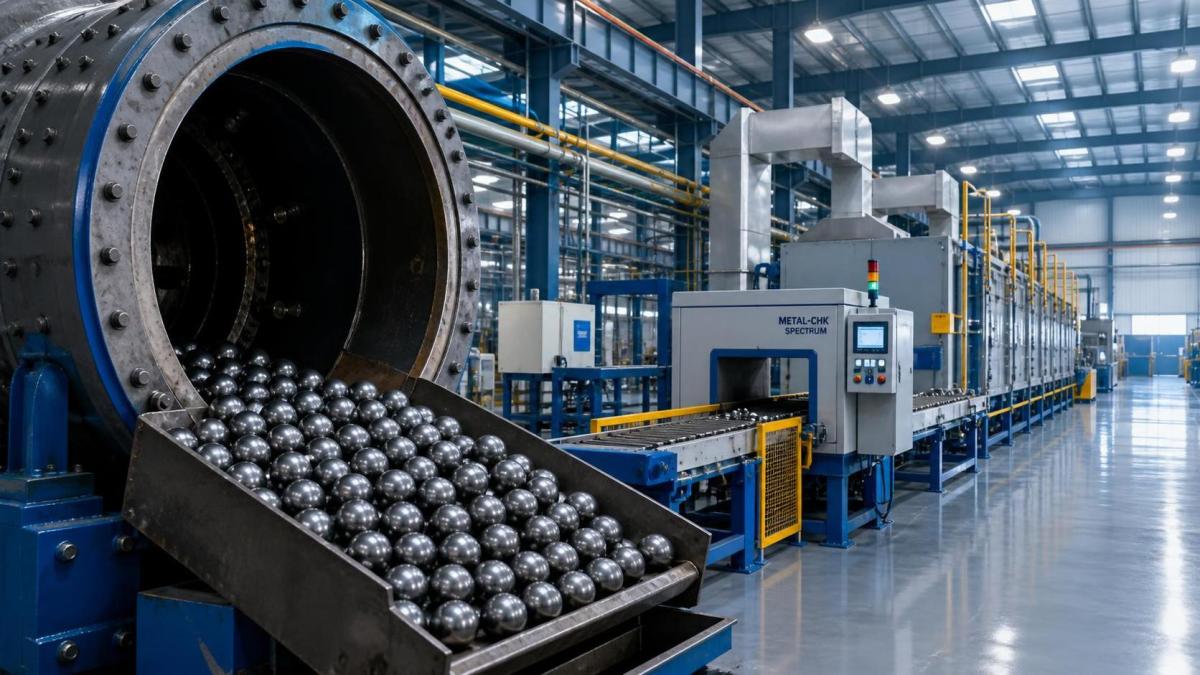
Forged steel balls for ball mills are not simply consumables purchased by diameter and tonnage. In a mineral processing circuit, they influence breakage efficiency, mill throughput, particle-size distribution, media consumption, liner wear, and the stability of downstream separation. A ball that appears economical on a delivered-price basis can become expensive when it breaks prematurely, loses its shape too quickly, or creates an unsuitable media charge inside the mill.
This is why experienced mill operators look beyond a nominal hardness value. The useful question is not “Which ball is hardest?” but “Which grinding media matches this ore, mill condition, target grind, and operating strategy?” The answer often depends on the interaction between steel chemistry, forging quality, heat treatment, ball size distribution, slurry conditions, and the impact environment inside the mill.
For operations processing hard rock, gold ore, base-metal ore, or other abrasive feed, forged grinding balls remain a widely used option because they can combine high impact resistance with controlled wear. Their value is especially clear where large-diameter media repeatedly strikes coarse feed, where breakage of individual balls would disrupt the charge, or where a predictable wear profile is needed for media addition planning.
Why the Ball Mill Charge Cannot Be Treated as a Commodity
A ball mill reduces particles through impact, abrasion, and attrition. Larger balls carry more impact energy and are generally used to break coarser feed. Smaller balls provide more contact points and can be more effective as the feed becomes finer. Yet size alone does not determine performance. If the ball surface becomes excessively smooth, if balls deform irregularly, or if the charge contains too many undersized remnants, the mill may lose the grinding action intended by the original design.
The media charge is also dynamic. Every operating hour changes the distribution of ball sizes. For that reason, a mill should be assessed as a system rather than through one isolated specification. Ore competency, feed size, mill speed, volumetric filling, liner profile, pulp density, cyclone operation, and target product size all affect which forged steel ball grade and diameter range are appropriate.
A common purchasing error is to select the highest advertised surface hardness without asking what happens beneath the surface. A ball with a very hard exterior but insufficient core toughness may be vulnerable in high-impact duty. Conversely, a very tough ball with inadequate wear resistance may last structurally but be consumed too quickly. Good grinding media design aims for a controlled relationship between surface hardness, through-hardening depth, impact strength, and microstructural consistency.
What Forging Adds to Grinding Media Quality
Forging forms steel under pressure rather than relying on a casting solidification process. When raw material quality, heating, deformation, and heat treatment are properly controlled, forged balls can achieve a dense internal structure suited to demanding milling conditions. This does not mean every forged ball will automatically outperform every alternative. It means the production route can provide a strong foundation for impact-sensitive applications, provided the material grade and thermal process match the duty.
Steel selection matters at the beginning of this chain. Carbon, manganese, chromium, silicon, boron, phosphorus, and sulfur levels influence hardenability, wear behavior, and toughness. For example, a B2-type alloy may use a carbon range of 0.70–0.85%, manganese of 0.70–1.00%, chromium of 0.4–0.6%, silicon of 0.17–0.37%, and controlled phosphorus and sulfur levels of no more than 0.035%. Such figures are useful as material references, but they should not replace a discussion of the required hardness profile and the mill’s actual operating conditions.
The heat-treatment stage is where many differences become visible in service. Quenching and tempering must be controlled to avoid an overly brittle structure, insufficient hardening, or large hardness variation between batches. A supplier should be able to explain how raw material is identified, how process parameters are monitored, and how finished balls are inspected. The practical benefit is consistency: operators need media additions to behave predictably over repeated deliveries, not merely perform well in a sample test.
Choosing Diameter and Grade for the Grinding Duty
Ball diameter selection begins with the feed and the mill’s role in the circuit. A primary ball mill handling coarse ore normally requires a meaningful proportion of larger balls to generate impact energy. A secondary grinding stage may favor a different make-up pattern, while regrind duties often require a finer and more closely controlled charge. Simply replacing a mixed charge with one diameter because it is easier to order can reduce grinding efficiency.
Commercial forged media can be supplied across a broad range, such as Φ20 mm through Φ150 mm. Within that span, selection should be based on mill diameter, feed F80, ore hardness, desired product size, and the existing media charge. Larger sizes are not automatically better for high-tonnage mills; they may increase impact while reducing the number of grinding contacts. Smaller sizes are not inherently more efficient either, particularly when they lack sufficient energy to break the coarsest particles entering the mill.
The alloy grade should be considered alongside size. B2, B2-1, High Carbon B2, B3, B4, B6, B6-1, 40Cr, 42CrMo, 45#, 50MN, 60MN, and 65MN are names often encountered in grinding-media discussions, but no grade is universally correct. A high-impact coarse grinding environment may demand different toughness characteristics from a lower-impact, highly abrasive application. The responsible approach is to review the ore type, mill stage, size of balls currently used, consumption pattern, and any history of breakage or abnormal wear before finalizing a grade.
Wear Rate Is Only One Part of the Cost Equation
Media consumption is often measured in kilograms per tonne of ore, but this figure should be interpreted carefully. A lower consumption rate is desirable only when grinding performance remains on target. If balls wear slowly but no longer maintain the size distribution needed for breakage, the operation may face coarser product, recirculating load changes, or reduced recovery conditions downstream. The goal is not merely to minimize steel loss; it is to obtain the required grind at a sensible total operating cost.
A useful evaluation includes delivered media cost, consumption rate, unplanned ball breakage, effect on mill availability, and the labor involved in managing additions. It should also consider whether the media generates fragments that complicate screening, pumping, or separation. When a supplier proposes a different steel grade, a controlled trial with documented operating conditions is usually more informative than a claim based solely on laboratory hardness.
There is also a distinction between forged and cast grinding media that should not be blurred. Cast products can be appropriate for certain applications, particularly where abrasion resistance is the primary requirement and operating conditions support their use. Their metallurgy and production route differ from forged steel balls, so they should be compared according to the duty rather than treated as interchangeable. For operations considering alternative media types, Casting balls provide a relevant reference point for examining available grades, sizes, and application contexts.
Questions That Reveal a More Reliable Supplier
Grinding media procurement becomes less risky when the discussion moves from broad claims to traceable controls. Buyers should ask where the steel is sourced, whether heat numbers can be tracked, how chemical composition is verified, and what inspections occur before shipment. A supplier that can only provide a general hardness statement leaves important questions unanswered: Is the hardness consistent from surface to core? What is the tolerance for ball diameter and ovality? How are cracking and surface defects screened? What information accompanies each batch?
Production capacity also deserves context. A large annual capacity may support supply continuity, but it is not by itself proof of product suitability. It becomes meaningful when combined with automated process control, laboratory testing, batch traceability, and a practical ability to make the requested diameter and grade consistently. Logistics matter as well. Grinding media is heavy, and delays in replenishment can affect a mill’s make-up plan. Port access, packaging discipline, shipment documentation, and realistic lead-time communication should be reviewed before a long-term supply arrangement is made.
Shandong Jinchi New Material Technology Co., Ltd. operates as a high-tech enterprise focused on the research, development, production, and sales of grinding media, including grinding steel balls, rods, and cylpebs, while providing technical support for mining applications. Its stated production capability reaches up to 150,000 tonnes annually, with annual output exceeding 100,000 tonnes. The company’s approach includes raw-material selection from major domestic steel mills, automated production control, laboratory inspection from incoming material through finished goods, and traceability across the process.
For buyers with formal supplier-qualification requirements, management-system and inspection documentation should be checked against the project’s own requirements. ISO9001, ISO14001, ISO45001, and SGS-related documentation may be relevant where specified, but the purchaser should confirm the current scope, validity, test method, and acceptance criteria rather than relying on a certificate name alone.
How to Run a Meaningful Media Trial
A media trial is most useful when it avoids changing several variables at once. Record the ball size distribution added, tonnes processed, feed characteristics where available, mill operating conditions, product size, and media consumption. If the circuit changes ore source, liner configuration, cyclone settings, or throughput during the trial, note those changes. Without that context, comparing one month of consumption against another can lead to the wrong conclusion.
Physical inspection is equally important. Recovering representative worn balls can reveal whether the media is wearing uniformly, spalling, cracking, flattening, or retaining an unexpected shape. The objective is not to demand zero wear—wear is inherent to grinding—but to understand whether the observed condition matches the intended behavior of the media and the milling duty.
Before specifying forged steel balls for ball mills, prepare a concise technical brief: mill type and dimensions, grinding stage, feed size, target product size, ore characteristics, current ball sizes and grade, estimated consumption, and any problems with the existing charge. This information gives a media manufacturer a real basis for recommending material, diameter mix, quality-control documents, and delivery arrangements. It is a more dependable starting point than selecting a ball solely because its price per tonne appears attractive.
Get real-time quotes
Interested? Leave your contact details.