
news
Forged Steel Balls vs Cast Steel Balls
Forged Steel Balls vs Cast Steel Balls: Choosing Grinding Media for Real Milling Conditions
Choosing between forged steel balls and cast steel balls is not a minor purchasing detail. In a grinding circuit, the media influences breakage rates, power draw, media consumption, mill availability, and the consistency of downstream separation. A ball that appears economical on a quotation can become expensive if it fractures early, wears irregularly, or changes the mill charge behavior.
The forged steel balls vs cast steel balls decision is therefore best treated as an operating question rather than a simple product comparison. Ore competency, feed size, mill type, slurry chemistry, ball diameter, liner condition, and target grind all matter. Neither option is automatically superior in every mine, cement plant, or power-generation application. The useful question is: which grinding medium delivers the lowest total cost per tonne under this specific duty?
The Difference Begins with How the Ball Is Made
Forged grinding balls are typically made by heating steel bar stock and forming it through rolling, hammering, or forging processes, followed by controlled heat treatment. The deformation created during forging can refine and align the internal grain structure. When chemistry, forging temperature, quenching, and tempering are properly controlled, the result is generally a dense ball with high toughness and good resistance to repeated impact.
Cast steel balls are produced by pouring molten steel or alloyed steel into molds. Their performance depends heavily on melt chemistry, mold quality, solidification control, and subsequent heat treatment. Casting makes it practical to manufacture a wide range of diameters and compositions, but it also requires disciplined process control to minimize internal shrinkage, porosity, segregation, and surface defects. A cast ball should never be judged solely by its appearance or nominal hardness.
This manufacturing distinction explains the usual performance pattern: forged balls are often favored where high impact is constant, while cast balls can be a sensible choice where abrasion resistance, size availability, and cost balance suit the grinding environment. These are tendencies, not guarantees. Steel grade and heat treatment can alter the outcome significantly.
Hardness Is Necessary, but It Is Not the Whole Story
Procurement discussions often start with HRC values. Surface hardness is important because it affects abrasive wear, particularly with hard and angular ores. Yet a hardness figure alone says little about the ball’s core properties, microstructure, or resistance to cracking. A very hard surface on a ball with insufficient toughness may chip, spall, or break under severe impact. Conversely, a very tough ball with inadequate hardness may wear too quickly and lose its effective grinding size before it has delivered enough useful work.
The better evaluation combines surface hardness, hardness distribution from surface to core, impact toughness, chemical composition, and visual or dimensional inspection. For cast products, the integrity of the casting deserves special attention. For forged products, buyers should ask how raw material quality, deformation, and heat treatment are controlled across each production batch.
A practical warning: “high chromium,” “high carbon,” or “high hardness” are not complete specifications. They describe only one part of the material decision. Carbon, silicon, manganese, chromium, boron, phosphorus, sulfur, and other elements need to be considered in relation to the intended heat-treatment route and actual mill duty. The same nominal steel grade can perform differently when process control differs.
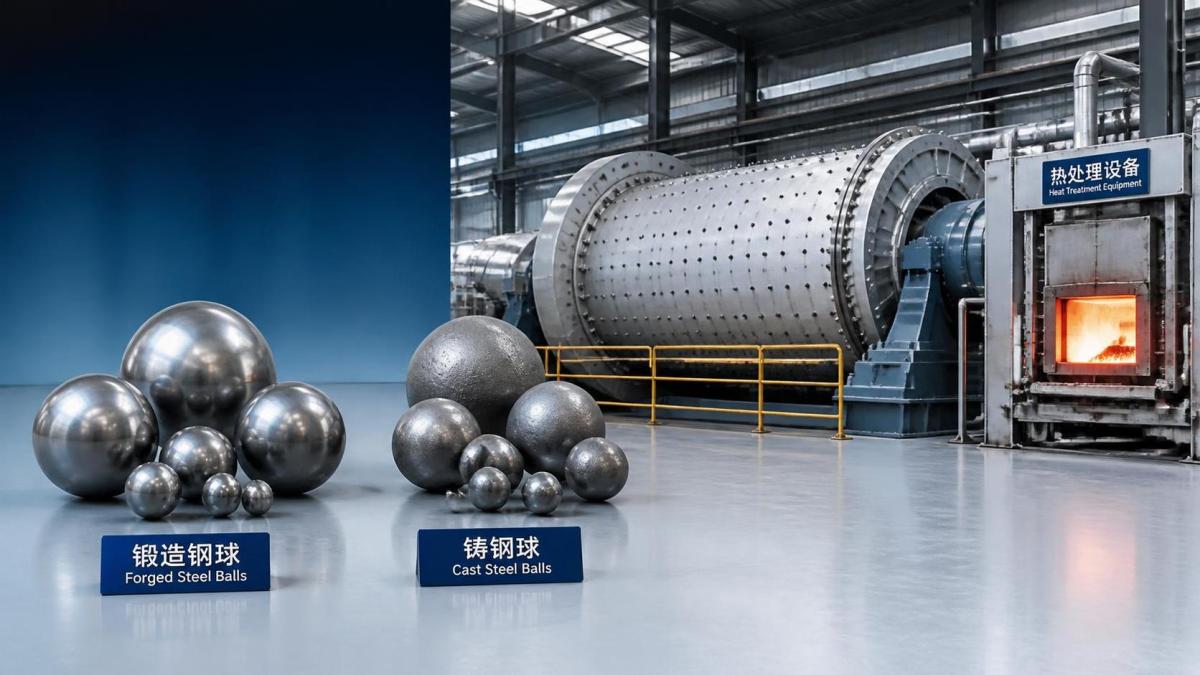
Where Forged Balls Usually Make Sense
Forged media is commonly selected for aggressive grinding conditions: coarse feed, large mill diameters, high lift, high ball-drop energy, and ores that impose repeated impact loading. In these circumstances, resistance to breakage is often more valuable than chasing the highest possible initial hardness. Large balls are especially exposed to impact because their mass and falling distance increase collision energy inside the mill.
For primary grinding or circuits handling competent ore, a forged ball may provide more stable service if it maintains its shape and avoids catastrophic fracture. A broken ball does more than increase media consumption. It can disturb charge dynamics, create an irregular size distribution, complicate screening, and occasionally contribute to operational interruptions. The actual impact risk depends on mill speed, liner profile, ball size, feed characteristics, and operating practice, so it should be assessed from site conditions rather than assumptions.
That said, forged does not automatically mean the right answer for every ball mill. If the circuit is dominated by abrasive wear rather than impact, the comparative benefit may be smaller. The operating objective matters: maximizing resistance to breakage, lowering wear loss, stabilizing grind size, or balancing all three.
When Cast Steel Balls Deserve Serious Consideration
Cast steel balls are widely used in mining, mineral extraction, cement and building-material grinding, coal grinding in power plants, chemical engineering, and machinery applications. They can be produced across a broad size range and with multiple alloy options, allowing suppliers to match the medium more closely to wear-focused duties. Their value is often clearest when the ball is properly engineered for the ore and mill rather than selected as a generic low-cost alternative.
For example, a cast product may be appropriate when the mill requires a defined diameter range, the grinding environment is relatively stable, and abrasive wear is the dominant mechanism. It can also be considered for gold-mining operations, but gold ore is not a single operating category. Hardness, abrasiveness, sulfur content, slurry conditions, feed variability, and circuit configuration can differ greatly between sites. A trial or controlled comparison is more meaningful than a broad claim about suitability.
For buyers reviewing Casting balls, useful specification points include diameter tolerance, hardness target, impact-toughness requirement, steel chemistry, heat-treatment documentation, and the inspection method used before shipment. Product ranges from 20 mm to 150 mm can support many milling duties, but selecting a diameter should follow the mill’s feed size and required breakage mechanism, not simply what is readily available.
The Most Common Comparison Mistakes
The first mistake is comparing only price per tonne. Media consumption is measured in the circuit, not on the supplier’s invoice. A lower purchase price may be offset by faster wear, breakage, reduced milling efficiency, or more frequent replenishment. The more relevant indicator is usually total grinding-media cost against processed tonnage, while also watching product size distribution and mill performance.
Another mistake is comparing two products with different ball diameters or different operating periods. A fair trial needs comparable mill conditions: similar feed, ore blend, throughput, mill speed, water addition, charge level, and liner condition. If several variables change at once, the result may reflect the circuit change rather than the media itself.
There is also a tendency to treat a laboratory hardness value as a complete quality certificate. It is not. Buyers should define acceptable sampling procedures and confirm whether testing is performed on the surface, at a specified depth, or across a section. If breakage has been a historical issue, asking about impact testing and internal-defect control is reasonable. If excessive wear is the concern, monitor diameter loss and retained ball shape over the operating period.
Build the Selection Around the Circuit, Not the Catalog
A productive supplier discussion starts with operating information. Mill type and dimensions, nominal ball size, target particle size, ore hardness, feed top size, daily throughput, slurry density, existing media consumption, and recurring failure modes are all relevant. Even incomplete information is useful if it identifies the main uncertainty: unexpected breakage, high wear rate, inconsistent grind, or unreliable supply.
Shandong Jinchi New Material Technology Co., Ltd. works in the research, production, and supply of grinding steel balls, rods, cylpebs, and related technical support for mining applications. For a media producer, the important capability is not merely offering different steel grades. It is being able to connect raw-material selection, automated production, heat treatment, inspection, and technical feedback to the operating problem at the mine or plant.
For cast products, available material options can include grades such as B2, B3, 65Mn, 60Mn, C1090, 40Cr, 42CrMo, B4, and B6-series steels. These names should be treated as a starting point for engineering review, not as interchangeable performance labels. The final selection should account for chemistry limits, specified hardness, required toughness, diameter tolerance, and the application’s impact-to-abrasion balance.
A Better Way to Validate the Decision
When the cost of a wrong choice is meaningful, a controlled industrial trial is often more useful than prolonged debate. Establish the baseline before introducing new media: current consumption, ball additions, throughput, grind size, power conditions, and any observed breakage. Then run the comparison long enough to cover normal ore variation. Short tests may be distorted by the existing charge or a temporary change in feed.
The trial should also include physical inspection. Look for cracking, flattening, spalling, unusual diameter loss, and broken fragments. Record the actual ball-size mix removed from the mill if possible. This shows whether the product is wearing down predictably or disappearing through failure. It also gives metallurgical and maintenance teams a common basis for discussion.
In the forged steel balls vs cast steel balls debate, the right answer is rarely a slogan. Forged balls often justify their position where impact is severe and structural toughness is critical. Cast steel balls can be highly effective where their metallurgy, dimensional range, and wear characteristics align with the circuit. Specify the duty, verify the properties that matter, and judge the result by mill performance and media consumption over time—not by the label on the delivery note.
Get real-time quotes
Interested? Leave your contact details.