
How to Evaluate a Custom Casting Balls Supplier for Mine-Specific Requirements
How to Evaluate a Custom Casting Balls Supplier for Mine-Specific Requirements
Selecting a custom casting balls supplier is a critical procurement decision for mining operations facing unique ore hardness, mill conditions, and wear requirements.
The right partner can reduce grinding costs, improve throughput, and maintain stable media performance across changing ore bodies and demanding operating conditions.
For procurement teams, the lowest quoted price rarely represents the lowest total grinding cost. Wear life, breakage, delivery reliability, and technical response matter.
A capable supplier should translate mine data into a documented media recommendation, then prove its value through controlled trials and consistent batch quality.
Start With Mine Data, Not a Standard Product Catalog
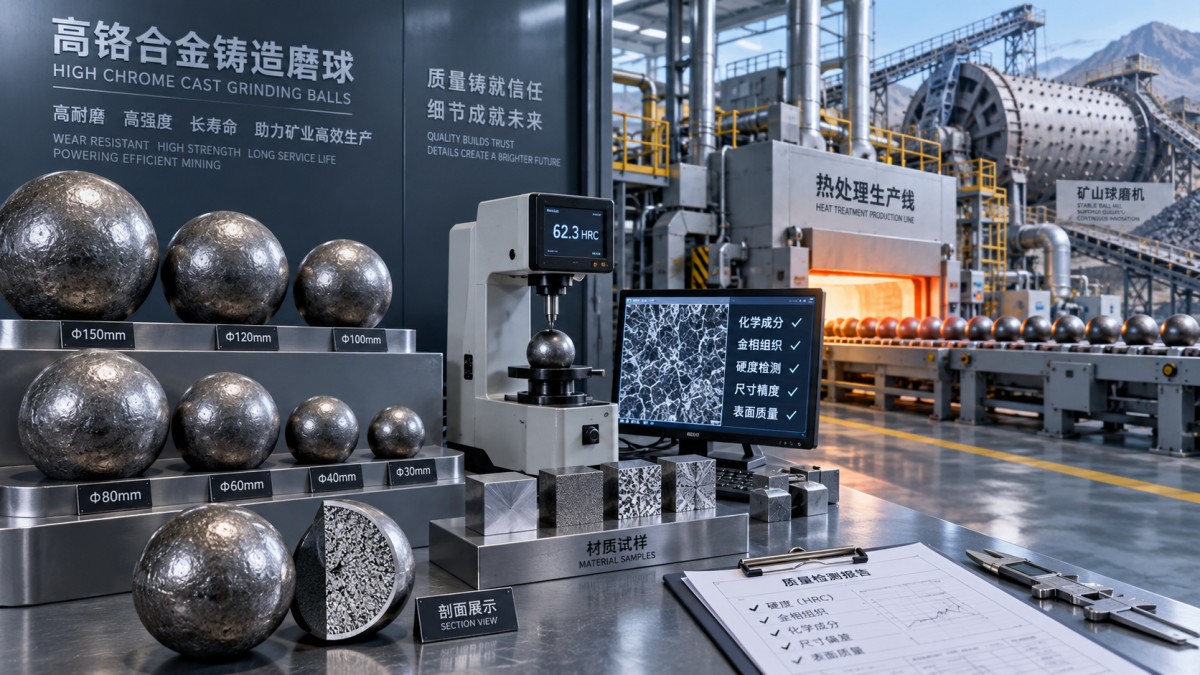
Before comparing suppliers, buyers should define the operating variables that determine grinding media performance within their specific milling circuit and ore characteristics.
Relevant data includes ore hardness, abrasiveness, feed size, mill type, mill diameter, rotation speed, slurry density, target grind size, and existing ball consumption.
A supplier that requests this information early is generally better positioned to recommend suitable chemistry, hardness distribution, diameter mix, and heat-treatment parameters.
Ask whether the supplier can distinguish between impact-dominated and abrasion-dominated wear. This distinction directly affects the preferred balance between hardness and toughness.
For example, highly abrasive ore may require stronger surface hardness, while coarse grinding circuits often need greater impact resistance to reduce cracking and spalling.
Mine-specific evaluation should also consider downstream consequences. Media that wears predictably can stabilize classification, reduce contamination concerns, and support more consistent metallurgical performance.
Assess Material Design and Metallurgical Capability
A custom casting balls supplier should explain why a proposed material grade fits the application instead of simply offering the same alloy to every customer.
Buyers should request chemical composition ranges for carbon, silicon, manganese, phosphorus, sulfur, chromium, boron, and other relevant alloying elements.
Composition control is important because small variations can change hardenability, microstructure, impact toughness, and resistance to abrasive or corrosive grinding environments.
Evaluate whether raw materials come from traceable, reputable steel sources. Consistent inputs reduce the risk of variable hardness and premature failures between production batches.
Material options may include B2, B3, B4, B6, 65Mn, 60Mn, 42CrMo, 40Cr, C1090, and related high-carbon steel grades.
The important question is not which grade sounds strongest. It is whether the supplier can justify the selected grade using your mill conditions and historical wear results.
Ask for metallographic inspection records where appropriate. Grain structure, carbide distribution, decarburization, and heat-treatment results can reveal risks invisible in surface inspections.
Verify Size Control, Hardness, and Mechanical Properties
Grinding media dimensions affect charge behavior, impact energy, breakage efficiency, and wear rate. Diameter consistency therefore has operating value beyond simple visual conformity.
Confirm that the supplier can produce the required range, such as 20mm to 150mm, while maintaining documented tolerances for each selected diameter.
For larger balls, dimensional variation can influence mill charge balance and make consumption data difficult to interpret during commercial performance comparisons.
Hardness should be evaluated at the surface and, when relevant, through the cross-section. Surface-only results can hide inadequate hardening depth.
A supplier may offer surface hardness targets above 55HRC, 58HRC, or 60HRC, but the appropriate target depends on the mine’s impact and abrasion profile.
Impact toughness is equally important in many mining applications. For demanding conditions, buyers should request test evidence rather than relying on broad product claims.
Review sampling rules carefully. Test certificates should identify batch numbers, sample quantities, inspection methods, acceptance criteria, and the actions taken when results fall outside specifications.
Examine Casting Process and Heat Treatment Controls
Reliable casting quality depends on more than furnace capacity. Mold design, pouring temperature, cooling control, cleaning, and inspection discipline all influence final ball performance.
Ask suppliers how they prevent shrinkage cavities, gas porosity, cracks, inclusions, and uneven microstructures. These defects can trigger early breakage under mill impact.
Automated production lines can improve repeatability, but buyers should confirm that automation is supported by process records and experienced metallurgical supervision.
Heat treatment deserves detailed attention because it establishes the relationship between hardness, wear resistance, and toughness throughout the finished grinding ball.
Request information on quenching media, tempering stages, temperature control, holding time, and monitoring procedures. The supplier should explain how these settings are validated.
Manufacturers offering Casting balls for mining should be able to connect their heat-treatment approach to expected service conditions and failure prevention.
During qualification, ask to inspect production records from recent comparable orders. A strong process is demonstrated by repeatable evidence, not only technical descriptions.
Compare Quality Systems and Traceability Practices
Procurement risk increases when suppliers cannot link finished products to material certificates, production lots, inspection records, and shipment documentation.
A practical traceability system allows the mine to investigate unusual breakage, hardness variation, or consumption changes without relying on assumptions or incomplete records.
ISO9001 certification provides useful baseline evidence of quality management, while ISO14001 and ISO45001 can support broader supplier risk assessments and compliance requirements.
Independent verification, including SGS testing when needed, can provide additional confidence for new suppliers or high-value trial orders with strict technical specifications.
Ask how nonconforming products are identified, isolated, investigated, and replaced. The response should include a clear corrective-action process and defined communication responsibilities.
Also review final inspection coverage. Critical checks may include diameter, weight, surface condition, hardness, chemistry, impact performance, and packaging integrity before dispatch.
Require Technical Support Before and After Delivery
Grinding media should be purchased as part of a performance solution, not as a disconnected commodity. Technical support can materially affect trial quality and operating outcomes.
Assess whether the supplier can assist with ball-size selection, initial charge design, make-up schedules, wear monitoring, and interpretation of consumption data.
A qualified supplier should establish trial objectives before shipment. These may include reduced kilograms per tonne, lower breakage, improved throughput, or stable product fineness.
Define a baseline using comparable operating periods. Ore variability, liner condition, mill loading, and process changes must be considered before claiming savings.
Post-delivery support matters when results differ from expectations. Buyers need timely investigation, data review, and corrective recommendations rather than generic assurances.
For gold mining operations, technical collaboration can be particularly valuable because media selection may influence grinding efficiency, operational continuity, and overall processing economics.
Evaluate Commercial Reliability and Delivered Cost
Unit price should be compared with total delivered cost, including freight, lead time, packaging, customs exposure, inventory requirements, expected wear rate, and replacement risk.
Suppliers located near major ports may offer logistical advantages for export mining projects. Confirm shipping schedules, container loading practices, and document preparation capabilities.
Buyers should ask about minimum order quantities, production lead times, emergency supply options, payment terms, and capacity reserved for repeat customers during peak demand.
Review references from mines with similar ore types and mill configurations. Relevant operating history is more useful than a long customer list without technical context.
Commercial agreements should define specifications, acceptance criteria, warranty handling, reporting frequency, claim procedures, and responsibilities for independent testing when disputes arise.
The best custom casting balls supplier is not necessarily the largest producer. It is the supplier that combines stable quality, responsive engineering, and dependable fulfillment.
Use a Structured Supplier Qualification Process
A structured evaluation prevents decisions based on price, samples, or sales presentations alone. Create a weighted scorecard aligned with the mine’s operational priorities.
Give substantial weight to metallurgical suitability, batch consistency, technical service, traceability, delivery performance, and proven results in comparable grinding applications.
Begin with document review, followed by technical meetings, sample testing, factory audits when practical, and a controlled industrial trial under agreed operating conditions.
Trial orders should be large enough to generate meaningful consumption data. Very small quantities can be distorted by mixed media, ore changes, or normal process variability.
Set review intervals and decision thresholds before the trial begins. This makes supplier comparison more objective and helps internal stakeholders align on purchasing decisions.
Conclusion: Choose Evidence Over General Claims
Evaluating a custom casting balls supplier requires more than checking available sizes, alloy names, and quoted prices. Mine-specific performance should guide the decision.
Procurement teams should prioritize suppliers that understand operating data, control metallurgy, document quality, support trials, and remain accountable after the shipment arrives.
When these factors are assessed systematically, grinding media purchasing becomes a measurable operating-cost decision rather than a recurring source of avoidable uncertainty.
Get real-time quotes
Interested? Leave your contact details.