
news
What Are Forged Steel Balls?
What Are Forged Steel Balls?
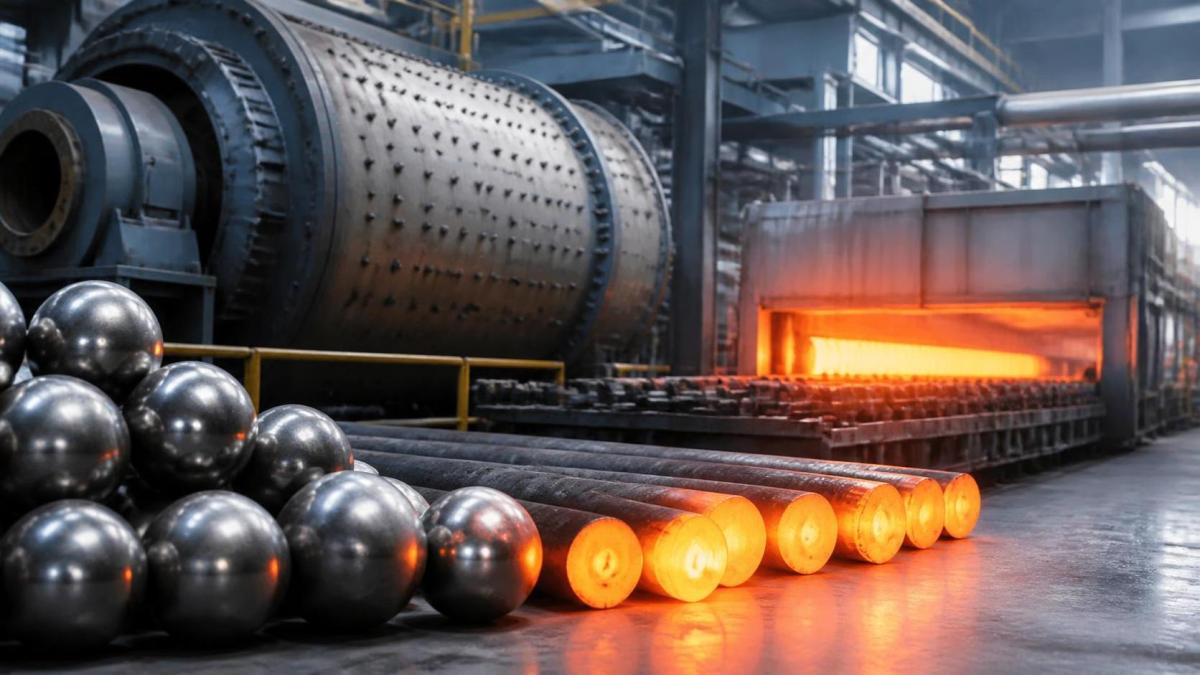
Forged steel balls are essential grinding media used to reduce ore and mineral particles in ball mills across mining and processing operations.
They are manufactured through high-temperature forging and controlled heat treatment, giving them strong impact resistance, high hardness, and reliable wear performance.
For mine operators, the practical question is not simply what these balls are, but whether they can improve throughput, reduce media consumption, and stabilize milling results.
In demanding grinding circuits, the right media selection affects energy use, maintenance intervals, product size distribution, and the total cost of mineral processing.
How Forged Grinding Balls Work in a Ball Mill
A ball mill reduces material size by rotating a cylindrical shell filled with grinding media and slurry or dry feed.
As the mill rotates, the media is lifted and then falls or cascades onto ore particles, generating impact, abrasion, and compression forces.
Larger balls generally provide stronger impact energy for coarse feed, while smaller diameters create more contact points for fine grinding.
The grinding process is continuous, so media quality must remain stable despite repeated collisions with ore, mill liners, and other balls.
Forged media is commonly selected where impact loads are high, especially during primary grinding stages and in mills processing hard, abrasive ore.
Its role is to transfer mechanical energy efficiently while resisting breakage, excessive deformation, and rapid diameter loss during service.
When media wears unevenly or breaks prematurely, mill performance may become less predictable and operators may need to adjust loading more frequently.
How Are They Manufactured?
Production begins with carefully selected steel bar stock, because chemical composition directly influences final hardness, toughness, and heat-treatment response.
The steel is heated to a controlled forging temperature, then formed into spherical shapes using rolling, hammering, or automated forging equipment.
During forging, the internal grain structure becomes denser and more refined than in many cast production methods.
This improved structure helps the finished ball withstand repeated impact without developing serious internal defects or early cracking.
After shaping, the balls undergo heat treatment, typically involving quenching and tempering under closely controlled time and temperature conditions.
Quenching increases surface hardness, while tempering restores an appropriate level of toughness and reduces the risk of brittle fracture.
Reliable suppliers inspect ball diameter, hardness distribution, impact resistance, metallographic structure, and surface quality before shipment.
Traceability from incoming steel through final inspection is especially valuable for mining buyers managing long-term consumption and performance comparisons.
Why Forging Matters for Mining Performance
The main advantage of forging is not merely a smooth round shape; it is the combination of structural density, hardness, and impact toughness.
Grinding media must survive thousands of impacts every operating hour, often while processing highly abrasive ores containing quartz, sulfides, or hard rock.
A ball with adequate hardness resists abrasive wear, helping it retain useful mass and diameter for longer inside the mill.
However, hardness alone is not enough, because excessively brittle media can crack or spall under high-impact operating conditions.
Impact toughness helps the ball absorb shock without fragmenting, which supports safer mill operation and a more consistent media charge.
For this reason, buyers should evaluate hardness and toughness together instead of making procurement decisions based on a single value.
Well-balanced properties can reduce the frequency of top-up additions and help maintain a stable grinding environment over extended campaigns.
Forged Media Compared With Cast Grinding Balls
Forged and cast balls can both be used in mineral processing, but their manufacturing routes create different performance characteristics.
Cast balls are produced by pouring molten metal into molds, while forged balls are shaped from heated steel bars under mechanical force.
Forged products often provide stronger impact resistance because the forging process refines grain flow and reduces the likelihood of major internal shrinkage defects.
Cast media can be suitable for selected applications, particularly when operating conditions are relatively stable and impact loads are lower.
In contrast, forged options are frequently preferred for large mills, coarse grinding, hard ore, and environments where breakage poses a material cost risk.
The correct choice depends on feed size, ore abrasiveness, mill speed, pulp chemistry, liner design, and the required final particle size.
Rather than treating forged media as universally superior, operations should compare actual wear rates, breakage records, and production outcomes for their circuit.
Which Steel Grades Are Commonly Used?
Forged grinding media can be made from several carbon steel and alloy steel grades, selected according to ore hardness and mill operating conditions.
Common material options include B2, B3, B4, B6, B6-1, 45#, 40Cr, 42CrMo, 60Mn, 65Mn, and C1090.
High-carbon grades can provide strong hardness and wear resistance, while manganese and chromium additions can improve hardenability and mechanical performance.
For example, typical chemical specifications may include carbon content of 0.70 to 0.85 percent and manganese content of 0.70 to 1.00 percent.
Silicon may range from 0.17 to 0.37 percent, while phosphorus and sulfur are generally controlled at no more than 0.035 percent.
Some grinding media formulations also include chromium at approximately 0.4 to 0.6 percent to support wear resistance and heat-treatment performance.
The best grade is determined by operational evidence, not material names alone, because steel chemistry must match the supplier’s forging and heat-treatment capability.
What Specifications Should Buyers Check?
Diameter is one of the first specifications to review because media size determines impact force, contact area, and movement inside the mill.
Common diameters range from 20 mm to 150 mm, including Phi20, Phi25, Phi30, Phi40, Phi50, and larger sizes.
Medium and large balls such as Phi80, Phi100, Phi120, Phi130, Phi140, and Phi150 are often used for coarse or primary grinding duties.
Smaller media may be more appropriate when finer particle reduction is needed, provided the mill has sufficient energy for effective cascading motion.
Diameter tolerance matters because substantial variation can affect charge distribution, material flow, and the predictability of grinding behavior.
A tolerance of plus 2 mm and minus 1 mm is one example of a dimensional control target for industrial grinding balls.
Surface hardness above 60 HRC is commonly specified for demanding wear conditions, but buyers should also request hardness consistency across the ball section.
Impact toughness of at least 12 joules can be another useful indicator, especially where large balls experience severe drop impact inside SAG and ball mills.
How to Select the Right Ball Size and Grade
Selection should begin with the ore, not the catalog, because mineral hardness, feed size, and abrasiveness determine the stresses placed on grinding media.
Coarse feed usually requires larger diameter balls to generate sufficient impact energy and break large particles efficiently during early grinding stages.
Fine grinding often benefits from smaller media because it provides more grinding contacts and can improve particle-size reduction efficiency.
Mill diameter, rotation speed, ball filling rate, slurry density, and liner profile also influence the most effective media size distribution.
Many operations use a mixed charge rather than one diameter, allowing large balls to break coarse material while smaller balls assist downstream grinding.
Steel grade should be selected according to the balance between abrasive wear and impact loading within the particular circuit.
For hard, abrasive ores, high wear resistance is essential, while high-impact applications also require dependable toughness to minimize breakage.
A supplier with technical support can help evaluate mill data and recommend trial conditions instead of relying on generalized assumptions.
Where Are Forged Grinding Balls Used?
Mining is the primary application, including copper, gold, iron ore, lead-zinc, molybdenum, and other mineral extraction operations.
Gold mining operations frequently require consistent grinding performance because downstream recovery can be affected by particle liberation and flotation or leaching conditions.
These balls are also used in cement and building-material production, where clinker and other hard feed materials require controlled size reduction.
Coal grinding in power plants is another application, particularly where mills must deliver stable pulverized fuel quality for efficient combustion.
Chemical engineering processes can use grinding media for mineral powders, pigments, raw materials, and other industrial materials requiring mechanical milling.
Machinery and material-processing businesses may also use forged balls where dependable wear performance is important in heavy-duty grinding equipment.
How to Evaluate Supplier Quality and Total Cost
The purchase price per tonne is important, but it should not be the only measure used when comparing grinding media suppliers.
A lower-priced ball may create higher operating costs if it wears too quickly, breaks under impact, or requires frequent replenishment during production.
Useful performance indicators include media consumption per tonne of ore, breakage percentage, mill throughput, power draw, and final product size distribution.
Buyers should ask for material certificates, heat-treatment records, hardness testing procedures, and inspection reports for each production batch.
Quality systems such as ISO9001, ISO14001, ISO45001, and independent SGS testing can provide additional confidence in manufacturing and verification practices.
Factory capability also matters because automated production lines can improve consistency across large orders and reduce variation between production batches.
For international buyers, shipping reliability, packaging quality, port access, and technical communication can materially affect procurement continuity.
Shandong Jinchi New Material Technology Co., Ltd. combines grinding-media production with mining technical services, supporting product selection, customized manufacturing, and after-sales evaluation.
Its Forged steel balls are available in multiple grades and diameters for mining, cement, power, chemical, and machinery applications.
What Questions Should Be Asked Before a Trial Order?
A practical trial order should define the ore type, mill model, operating conditions, current media consumption, and the performance objective before delivery begins.
Ask whether the supplier can recommend a size mix based on feed size, target grind, mill volume, and existing liner configuration.
Request a clear description of the proposed steel grade, chemical composition range, surface hardness, impact-toughness target, and diameter tolerance.
It is also important to confirm how ball breakage, spalling, wear loss, and retained diameter will be measured during the evaluation period.
Trials should run long enough to generate meaningful data, since short observations may be distorted by inventory changes or temporary ore variations.
Comparing consumption against tonnes processed provides a more useful basis than comparing delivered tonnage or nominal unit price alone.
The final decision should consider both production benefits and supply reliability, especially for mines operating continuously with limited tolerance for inventory interruptions.
Conclusion
Forged steel grinding media is a high-performance option for mills that require strong impact resistance, stable hardness, and dependable wear life.
Its value comes from the forged structure and controlled heat treatment, which help balance abrasion resistance with toughness under demanding operating conditions.
For mining companies, the best selection starts with ore characteristics and mill conditions, then uses trial data to verify consumption and grinding performance.
By evaluating grade, diameter, hardness, toughness, quality controls, and supplier support together, buyers can make a more informed and economically sound media decision.
Get real-time quotes
Interested? Leave your contact details.